Advanced Prompt Techniques: Negative Prompts, Prompt Chaining, Prompt Engineering Patterns
Learn how negative prompts, prompt chaining, and simple prompt engineering patterns can help you get clearer, more accurate, and more reliable AI results, even if you're just starting out.

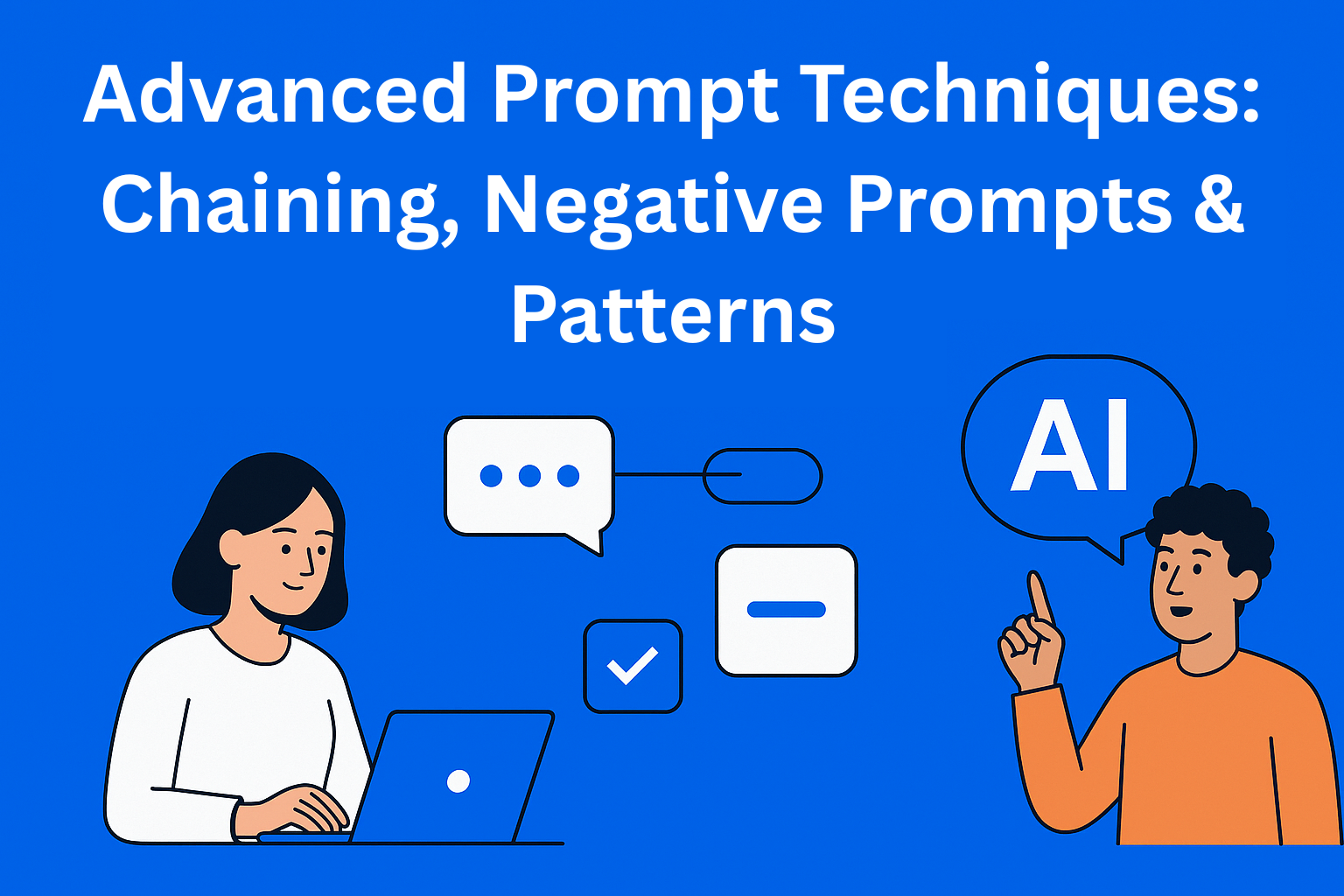
In the world of artificial intelligence, everything can seem very complicated at first, but it really isn’t. People often think they need a lot of technical knowledge to work with AI models, but most of the process simply comes down to writing good prompts. As AI has advanced, some simple techniques have appeared that help us get clearer, more accurate, and more useful results. In this text, we explain three such techniques, negative prompts, prompt chaining, and prompt engineering patterns, in a simple and easy-to-understand way, so anyone can follow along.
Key Takeaways
- Negative prompts increase control by telling the AI what to avoid - they prevent unwanted details, reduce errors, and keep outputs clean and focused.
- Prompt chaining improves quality by breaking big tasks into smaller steps - helping the AI understand context better and produce clearer, more logical results.
- Prompt engineering patterns provide reliable structures - including role prompting, few-shot prompting, chain-of-thought, ReAct, self-consistency, and refinement loops.
- Combining techniques leads to the strongest outputs - mixing patterns, chaining, and negative prompts creates clarity, accuracy, and predictable performance.
- Clear rules and small adjustments dramatically improve results - being specific, adding constraints, working step-by-step, and iterating makes advanced prompting easy even for beginners.
What Are Negative Prompts?
Negative prompts are a way to tell the AI what we don’t want to appear in the answer. Imagine that you want a picture of a dog with no background, or you want a text that is not emotional. Instead of only saying what you do want, you can clearly add what should not appear. This is very helpful when you want to avoid mistakes, unwanted details, or exaggeration.
For example, when generating an image, you can say: “Create a portrait of a dog, no blurry details, no extra limbs, no shadows.” If you’re generating text, you can say: “Write a travel article, without complicated words and without too many technical terms.” This approach gives you more control and makes results more predictable. It is also useful when you need clear structure or when doing something like prompt engineering, where accuracy matters.
Negative prompts also help reduce the chance that the AI will "make up" something that isn’t true. When used properly, they can significantly improve results in both text and image generation.
How and When Are Negative Prompts Used?
The most important rule is: use them when you want to remove something you don’t like. If you know what you don’t want, it becomes easier to guide the AI toward the right kind of answer. This is especially useful in writing blogs, scripts, advertisements, or even learning if you want simpler explanations. For example, in complex topics, people often use the keyword prompt engineering to tell the AI to focus on clear and structured answers.
However, it’s important not to overdo it. If you give too many negative instructions, the model can become confused. The best approach is to mix simple positive instructions with a few clear negative ones. For example: “Explain the topic clearly and simply, without technical terms.” This keeps everything balanced.
What Is Prompt Chaining?
Prompt chaining means completing a task in several small steps instead of one big step. Instead of asking for a long text all at once, you divide the process into phases. This helps AI models produce more accurate and logical results.
A simple example of a chain:
- “Extract the main ideas from the text.”
- “Create a short structure based on those ideas.”
- “Write the final text based on the structure.”
This approach makes things easier and reduces the chance of errors. It is used for longer texts, courses, analyses, and any situation where there is a lot of information. In the AI community, prompt chaining is often mentioned as part of advanced prompt techniques because it helps even complex tasks become much easier.
Why Is Prompt Chaining So Useful?
When we ask everything at once, the model tries to guess what we want, and sometimes it misses the point or loses the flow. But when we work in phases, the model first understands what is important, then organizes it, and finally creates the result. This leads to better logic, accuracy, and clarity.
This approach is especially helpful when writing long blogs, scripts, marketing text, or educational content. For example, if you’re writing an article about topics like negative prompts or “creative writing techniques,” chaining helps ensure that each part is processed clearly and thoroughly. It also allows for easy adjustments, you can correct things step by step instead of repairing a huge block of text.
What Are Prompt Engineering Patterns?
Prompt engineering patterns are simple templates that help you write better prompts. These are proven ways of structuring a question that often lead to better and more stable results. When you use them, AI becomes less random and more accurate.
Some of the best-known patterns include:
- Role Prompting - This means giving the AI a role. Instead of just asking a question, you tell it who it should act as. For example: “You are a marketing expert.” When AI takes on a role, it responds more confidently, clearly, and professionally, like giving an actor a script.
- Few-Shot Prompting - Here you show the AI a few examples of what you want the answer to look like. If you give 2-3 short examples, the AI will follow that style. It’s like showing someone: “Here’s how it should look.”
- Chain-of-Thought - This means asking the AI to explain its thinking step by step. Instead of a quick, short answer, you ask: “Explain it slowly, in order, step by step.” This produces clearer, more logical explanations.
- ReAct Pattern - This combines reasoning and action. The AI first thinks, then makes a decision, then performs an action. This is useful when solving problems or doing analyses where the AI needs to both explain and perform steps.
- Self-Consistency - Instead of one answer, you ask the AI to generate several answers and then choose the best one. This improves accuracy and quality.
- Refinement Loop - This is simply “polishing.” You ask the AI for an answer, then tell it what to fix, then fix again, and so on until the result is perfect. Like polishing a text over several rounds.
These methods are very popular because they offer a clear plan for getting the most out of AI.
When Should You Use Which Pattern?
Here are simple examples:
- If you need a more professional tone → use Role Prompting.
- If you want the AI to follow a specific style → use Few-Shot Prompting.
- If you want a clear, logical explanation → use Chain-of-Thought.
- If the task is complex → combine several patterns.
This is especially useful when doing things like writing, learning, analysis, or content creation. These patterns help AI give stable and predictable answers, which is important when using advanced prompt techniques.
Combining Techniques: Negative Prompts + Chaining + Patterns
These three techniques work best when used together. For example, when creating a complex blog:
- Role Prompting: “You are an AI communication expert.”
- Prompt Chaining: First create the outline, then sections, then the final text.
- Negative Prompts: “Write clearly and simply, without technical expressions or complicated words.”
This creates a perfect balance. The model knows who it is, what to do, and what to avoid. This approach is now standard when using advanced techniques like prompt engineering patterns and when the result needs to be clear, high-quality, and beginner-friendly.
Best Practices for Working With Advanced Prompts
To make working with AI as simple and effective as possible, it helps to follow a few basic rules. They aren’t complicated, but they make a big difference:
- Be clear and specific. The simpler you explain what you want, the better the AI will respond.
- Combine positive and negative instructions. Say what you want, but also what you don’t want appearing in the response.
- Work in steps. If the task is large or complex, break it into smaller parts (prompt chaining), this produces much better results.
- Use patterns. When you follow proven structures, the AI gives more stable and predictable answers.
- Edit and adjust. If something doesn’t sound right, tell the AI what to change. Small corrections lead to excellent results.
These practices help you achieve high-quality responses without stress or confusion, even when using advanced techniques like negative prompts, chaining, and patterns.
Conclusion
Creating webinar titles and landing pages doesn’t have to be complicated. With AI, you can quickly generate clear, engaging ideas that match the tone and goal of your webinar. The best part is that every prompt in this guide is easy to use and gives you instant results.
Whether you’re preparing your very first webinar or refining one that already exists, AI can help you shape stronger messaging, create more effective copy, and streamline the entire process. With a bit of testing and fine‑tuning, you can build landing pages and titles that attract the right audience and increase webinar sign‑ups.
Use these AI prompts to craft focused webinar titles and a landing page that clearly communicates value and motivates people to join.