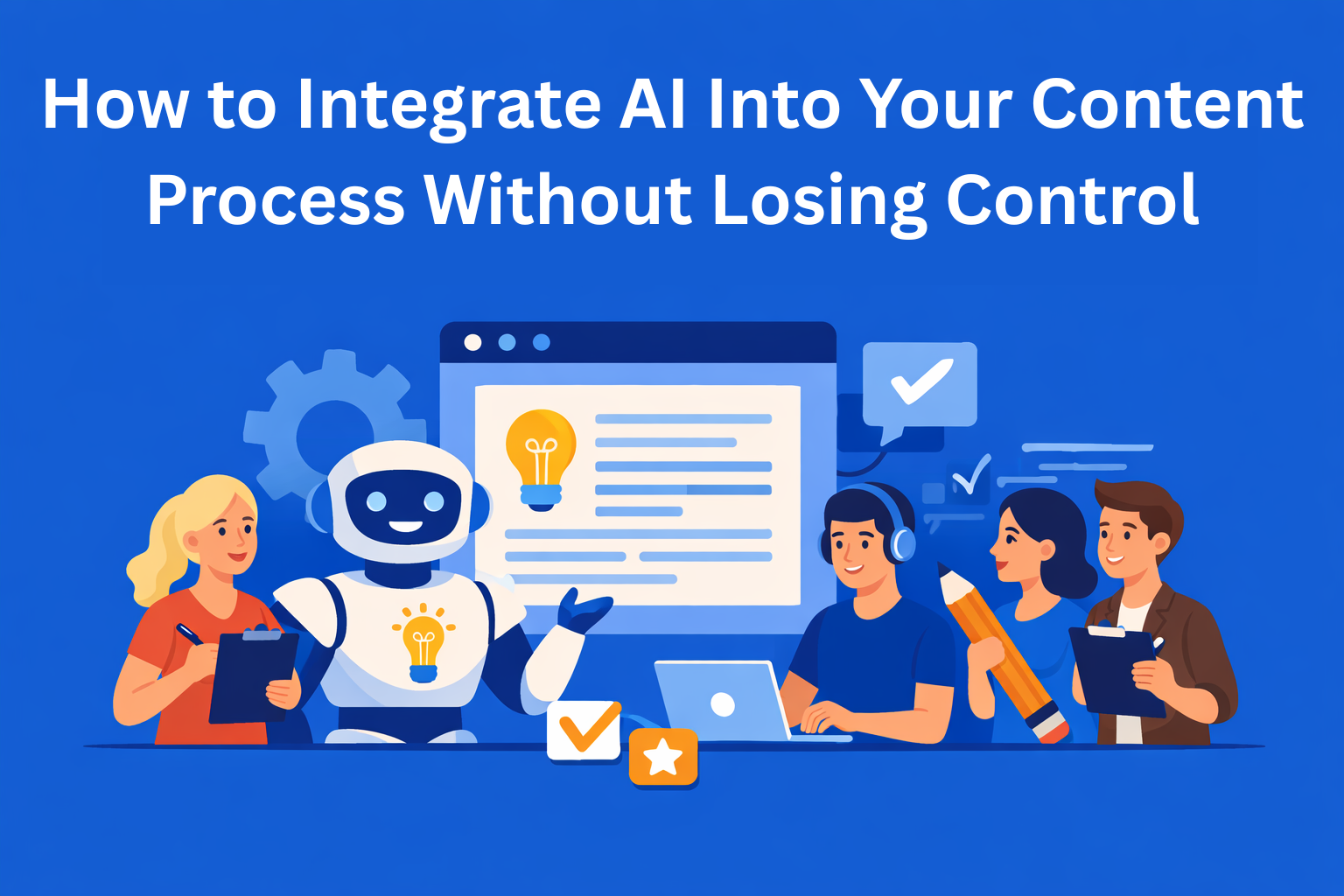
How to Integrate AI Into Your Content Process Without Losing Control
Learn how to integrate AI into your content process without losing control. This blog shows how content teams can use AI to speed up writing and organization while keeping humans in charge of strategy, quality, and brand voice.

Over the past few years, AI in content marketing has become a topic everyone is talking about. Some see it as a solution that speeds up work, while others see it as a threat that could harm content quality and authenticity. The truth, as usual, is somewhere in between. AI itself is neither good nor bad - how we use it makes the difference.
In this blog, we will talk about how to integrate AI into your content process without losing control over decisions, quality, and brand voice.
Key Takeaways
- AI is a support tool, not a decision-maker - it should assist with drafts and ideas, while humans stay in control of strategy and quality.
- Use AI where work is repetitive - first drafts, summaries, rephrasing, and research organization are ideal use cases.
- Set clear boundaries and roles early - AI gives suggestions, people make final decisions and approvals.
- Quality and brand voice need human control - guidelines, templates, and reviews prevent generic or inconsistent content.
- Integrate AI into an existing system - tools like EasyContent work best when AI fits into workflows, not outside them.
Why AI in the content process creates fear
When artificial intelligence is mentioned, many content teams immediately think it will take over the entire job. People are afraid that AI will write instead of them, make decisions for them, and that all content will start to look the same. This fear is understandable, especially when AI writing tools are used without clear rules and control.
The problem is not the technology, but the expectations. Tools like EasyContent are a good example of how AI can be used within a clear system, where processes, roles, and approvals already exist, so AI cannot take over control. If we see AI as a replacement for people, we can easily lose control. But if we use it as support, things become easier. AI in the content workflow should help the team work faster and more smoothly, not take over important decisions.
Where AI actually makes sense in the content process
Every content process has several steps. Some parts require thinking and important decisions, while others are repetitive and take a lot of time. It is exactly in these simpler tasks that AI in a content team can help the most.
For example, AI can help with:
- writing first drafts
- generating topic ideas
- organizing notes and research
- summarizing long documents
- rephrasing existing content
In these steps, AI as writing support helps the team save time. For example, on platforms like EasyContent, AI is used inside existing templates and workflows, so content already has a clear structure from the start. AI does not decide instead of people - it only helps create a first version that the team later improves.
What AI should never do instead of people
One of the most important things is knowing the boundaries in advance. There are parts of the content process where AI should never have the final say.
These include:
- deciding what to write and why
- choosing messages that go to the audience
- protecting brand tone and voice
- the final check to see if the content is truly good
AI does not think like a human. It does not always know how people will understand a message or how they will react to it. That is why it is important that humans stay in control of content, especially when final decisions are made.
Setting clear boundaries: who does what
One of the most common reasons for failure is that teams do not define roles. If everyone uses AI in their own way, without agreement, confusion quickly follows. That is why it is important to clearly define how AI is integrated into the content process. In tools like EasyContent, these boundaries are already built into the system through roles, permissions, and approval workflows, which makes it easier for teams to stay in control.
A simple rule that is easy to remember is:
- AI gives suggestions
- humans make decisions
In other words, AI can help with text, ideas, or structure, but the final word always belongs to people. This way, the team keeps control over AI-generated content while still benefiting from AI’s speed.
How to use AI as support, not a replacement
When used the right way, AI in the content workflow is like an assistant on the team. It does not do the work instead of people - it helps them do their part faster and more easily.
For example, a writer can use AI for a first draft and then adjust it to match the brand’s tone. An editor can use AI to check clarity, but not to make the final quality decision. In this way, AI as a tool for content teams speeds up work without lowering standards.
How to protect content quality and consistency
One of the biggest risks of using AI for writing content is losing consistency. Without clear guidelines, AI can produce content that feels generic or does not match the brand.
That is why it is important to have clear foundations that AI follows. In practice, platforms like EasyContent help here by allowing teams to define templates, guidelines, and structure before AI is even used. After that, teams can use the AI Writer and AI Editor inside the platform to speed up the process.
That is why it is important to have clear content guidelines, a defined brand voice, examples of good content, and a review process.
AI can follow the rules it is given, but it cannot create those rules on its own. That is why human quality control remains essential in every content process.
Risks of poor AI implementation
When AI is introduced without a plan, the result is often the opposite of what was expected. Instead of saving time, teams face unclear ownership and lower quality.
Common problems include:
- too much average content - AI can produce a lot of text quickly, but without clear rules that content is often shallow, generic, and not very useful for readers
- lack of clear ownership - it is unclear who is responsible for the final version, so mistakes, weak messages, or inconsistencies easily slip through
- loss of brand identity - content starts to sound like everyone else’s, without a clear tone, style, or personality that makes the brand recognizable
This happens when AI in content marketing is used without clear structure and control. More content does not automatically mean better results.
How to build a sustainable AI-supported content process
The best way to introduce AI into your work is gradually. Content platforms like EasyContent are designed for exactly this approach, where AI works inside an existing system instead of outside it. Instead of changing the entire process at once, it is smarter to test AI tools for content on smaller tasks.
Start with one small part of the process and see how it works in practice. Track what works well and what does not, and adjust your approach if needed. Over time, AI becomes a natural part of the team’s work, while the process stays controlled and easy to manage.
Conclusion
In the end, it is important to remember that AI is not a strategist, editor, or content owner. It is a tool that can help a content team work faster and more efficiently. Integrating AI into the content process only makes sense if people remain the ones who make decisions.
When clear boundaries are set, responsibilities are defined, and a healthy process is built, AI can increase efficiency without creating risk. The real value is not in full automation, but in the balance between technology and human control.