AI Prompts for Marketing: How to Write Better Prompts (+ Examples and Frameworks)
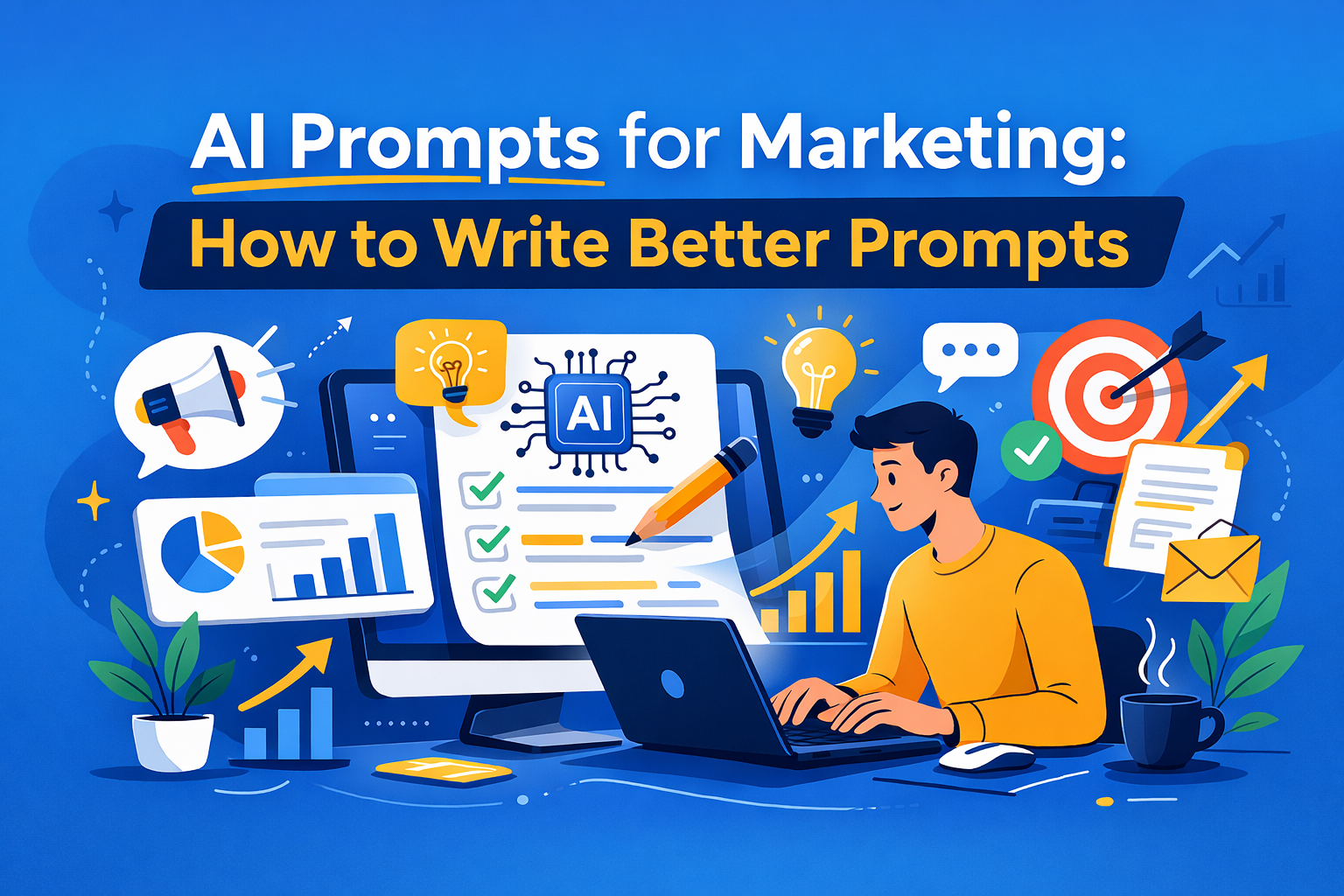
AI prompts for marketing are the key to getting better results from tools like ChatGPT. In this guide, you will learn why most prompts fail, how to structure them properly, and how to write clear, simple instructions that lead to stronger content and better marketing results.

AI is used today in almost every part of marketing.
But many people forget that AI delivers good results only if you give it clear and precise instructions.
That is why AI prompts for marketing are important.
If you have ever used ChatGPT or another AI tool and received a generic result, then the problem was most likely not in the tool. The problem was in how you wrote the prompt.
In this blog, we will talk about what AI prompts for marketing really are, why most of them do not produce good results, and how to write better prompts.
Key Takeaways
- AI output depends on prompt quality - generic instructions produce generic marketing content, while clear and structured prompts lead to stronger results.
- Strong prompts include five key layers - context, audience, goal, constraints, and format give AI the clarity it needs to generate useful content.
- Specificity improves performance across formats - blog posts, emails, social media, and landing pages each require defined tone, length, and structure.
- Prompt chains and systems outperform single prompts - breaking tasks into steps and creating reusable templates increases consistency and content quality.
- Treat prompts as strategic assets - build a prompt library, refine what works, align with brand tone, and continuously improve for better marketing results.
What Are AI Prompts for Marketing?
When we say AI prompts for marketing, we mean simple instructions that tell AI to create marketing content, such as:
- Blog posts
- Email campaigns
- Social media posts
- Landing pages
- Ads
Think of a prompt as a brief you give to a copywriter. The clearer and more detailed the brief is, the better the result will be.
Many people think everything depends on the AI tool. But in reality, everything depends on how you write the AI prompt. The tool only does what you tell it to do. It does not know what you meant unless you clearly write it.
Why Most AI Prompts for Marketing Do Not Produce Good Results
Most people write prompts like this:
“Write a professional LinkedIn post about AI.”
That is too vague.
When you write a weak AI prompt for marketing, you usually get text that sounds the same as everyone else’s, has no clear idea, has no personality, and does not lead toward a specific goal.
Some of the most common mistakes are:
1. The Prompt Is Too Unclear
If you do not explain the situation and background, AI will write something too general. And that kind of text easily gets lost among other content.
2. There Is No Clearly Defined Audience
Who is the content for?
- Beginners?
- Directors?
- Startup founders?
If you do not define the audience in your AI prompts, the content will feel empty.
3. There Is No Clear Goal
- Is the goal to drive traffic?
- Generate leads?
- Sell a product?
Without a goal, AI simply writes text. It does not think about results.
4. There Are No Constraints
Do you want 800 words or 2,000? A friendly tone or a serious one? Bullet points or long paragraphs?
AI needs structure.
If you solve these four problems, your AI prompts for marketing will immediately improve.
5 Layers of a Quality Marketing Prompt
Do not write random instructions. It is better to think step by step.
Good AI prompts for marketing have five simple parts.
1. Context Layer
Here you explain what your platform does and what problem it solves.
Example:
“We are a content management platform that helps marketing teams plan, create, approve, and publish content in one place.”
Now AI understands the bigger picture and the environment where the content will be used.
2. Audience Layer
Who are you addressing?
Example:
“Our audience includes content teams in B2B companies, marketing managers, and SEO specialists who work with multiple authors and campaigns at the same time.”
When you define the audience, AI can adjust the tone, examples, and level of detail.
3. Goal Layer
What is the goal of the content?
Example:
“The goal of this blog post is to show how marketing teams can simplify their workflow, reduce communication chaos, and speed up the process from idea to publication.”
Strong AI prompts for marketing always have a clear business goal.
4. Constraint Layer
Here you define clear rules.
Example:
“Make the article around 1,500 words. Use simple language. Focus on specific problems such as delayed approvals, content version control, and unclear communication within the team.”
Constraints help keep the text focused and practical.
5. Format Layer
Tell AI how you want the content to be structured.
Example:
“Use clear H2 and H3 headings. Include lists with specific steps. Add a short section with practical tips at the end.”
When you combine all five parts, your AI prompts become clearer and much more useful in practice.
AI Prompts for Blog Writing
Let’s look at simple examples.
Example: SEO Blog Prompt
“Write a 1,800-word SEO blog post about how marketing teams can organize AI prompts and improve their content workflow. The audience includes marketing managers and content teams in B2B companies. Use simple and clear language. Include real team examples and practical advice. The goal is to show how better organization leads to faster production and better results.”
You can see how this is more specific than:
“Write a blog about AI prompts.”
Better instructions produce better content.
When writing AI prompts for blog posts, always include:
- Topic
- Audience
- Length
- Goal
- Tone
This alone significantly improves results.
AI Prompts for Email Marketing
Email marketing is different from blog writing. It is focused and direct.
Example: Product Launch Email
“Write a short email informing existing users about a new AI feature. Write in a simple and friendly tone. Keep the message under 300 words and clearly invite users at the end to try the feature.”
When writing AI prompts for email marketing, clarity is essential. An email must be short and specific.
If you do not define the tone, length, and goal, AI might write something too long or unclear.
AI Prompts for Social Media
Social media requires strong openings and simple language.
Example: LinkedIn Prompt
“Write a short LinkedIn post about why many AI prompts do not deliver good results. Use simple language and address marketing managers. Keep the text under 200 words and end with a question that encourages discussion.”
That small additional instruction - “end with a question that encourages discussion” - makes a big difference.
Good AI prompts for social media always include:
- Platform
- Tone
- Length
- What you want to achieve
AI Prompts for Landing Pages
Landing pages are focused on conversion.
Example: SaaS Landing Page
“Write landing page copy for a tool that helps marketing teams organize their content. Write clearly and simply. Focus on how the tool helps the team in everyday work. Include a headline, a short subheadline, a few bullet points, and a clear call to action.”
A landing page must have a clear structure.
If you only say “write a landing page,” you will get general and impersonal text.
A good AI prompt for marketing clearly states who it is for, what it offers, and how the text should look.
Single Prompts vs Prompt Chains vs Prompt Systems
Let’s go a bit deeper.
There are three levels of using AI prompts for marketing.
1. Single Prompt
You write one instruction.
Example:
“Write a blog post about AI prompts.”
Simple, but limited.
2. Prompt Chain
You divide the task into steps.
Step 1: Create an outline.
Step 2: Expand each section.
Step 3: Optimize for SEO.
This usually gives better results.
3. Prompt System
This is a more advanced approach.
For example, you can create a blog writing template that always includes: a defined audience, a clear goal, a structure with headings, and a reminder to use your brand tone. You save this template, use it every time you create new content, and improve it when you notice what can be done better.
Advanced marketing teams treat AI prompts as assets, not as random messages.
How to Create a Prompt Library
If you want consistency, create a small prompt library.
You can organize it like this:
- Blog prompts
- Email prompts
- Social prompts
- SEO prompts
In each category, save your best AI prompts.
Improve them over time.
Add notes such as:
- What worked well?
- What required additional edits?
This simple system makes your work with AI more professional.
Most Common Mistakes When Using AI Prompts
Even experienced marketers make mistakes.
Here are the most common ones:
Too Many Instructions
When you put too many requests into one prompt, AI can get “confused” and mix things up.
It is better to clearly say what you want, but in a simple way without too many unnecessary details.
No Clearly Defined Goal
If you do not say why the text is being written, AI has no direction. It will write something correct, but without a clear purpose.
Always clearly state whether you want the text to sell, educate, attract attention, or encourage people to sign up.
Copying Viral Prompts
Just because a prompt worked for someone else does not mean it will work for you. Every business has a different audience, tone, and goal.
Do not blindly copy other examples. Adapt them to your own way of working and your brand.
Ignoring Brand Tone
Tone is how your brand “speaks.” If your style is simple and direct, but AI writes something that sounds too formal, it will not feel natural.
Good AI prompts for marketing should clearly specify what style and tone the content should have.
Conclusion
AI does not think on its own. It only does what you write. If you want better results, you must write better AI prompts. Be clear. Say exactly what you want. Write who you are addressing. Explain the goal. Set a clear structure.
If the prompt is good, the text will be good. And better text means better marketing results.
That is the real power of AI.