Are AI Agents the Next Layer of Content Infrastructure?
AI agents are no longer just helpful tools. They are becoming part of the system content teams rely on every day. This article explores how AI agents move from tools to infrastructure and why that shift could redefine content operations in 2026.

Today, content teams are producing more content, for more channels, in less time, while often working with the same number of people. Budgets are limited, hiring new team members is slow, and the pressure to deliver results is constant. In this kind of environment, the ability to scale a team becomes one of the most important questions for any content operation.
Until recently, the solution was usually found in new tools.
- One more writing tool.
- One more planning tool.
- One more analytics tool.
Over time, however, it became clear that adding more tools does not solve the real problem. Instead of making work easier, teams often end up with more complex processes and more interruptions throughout the day.
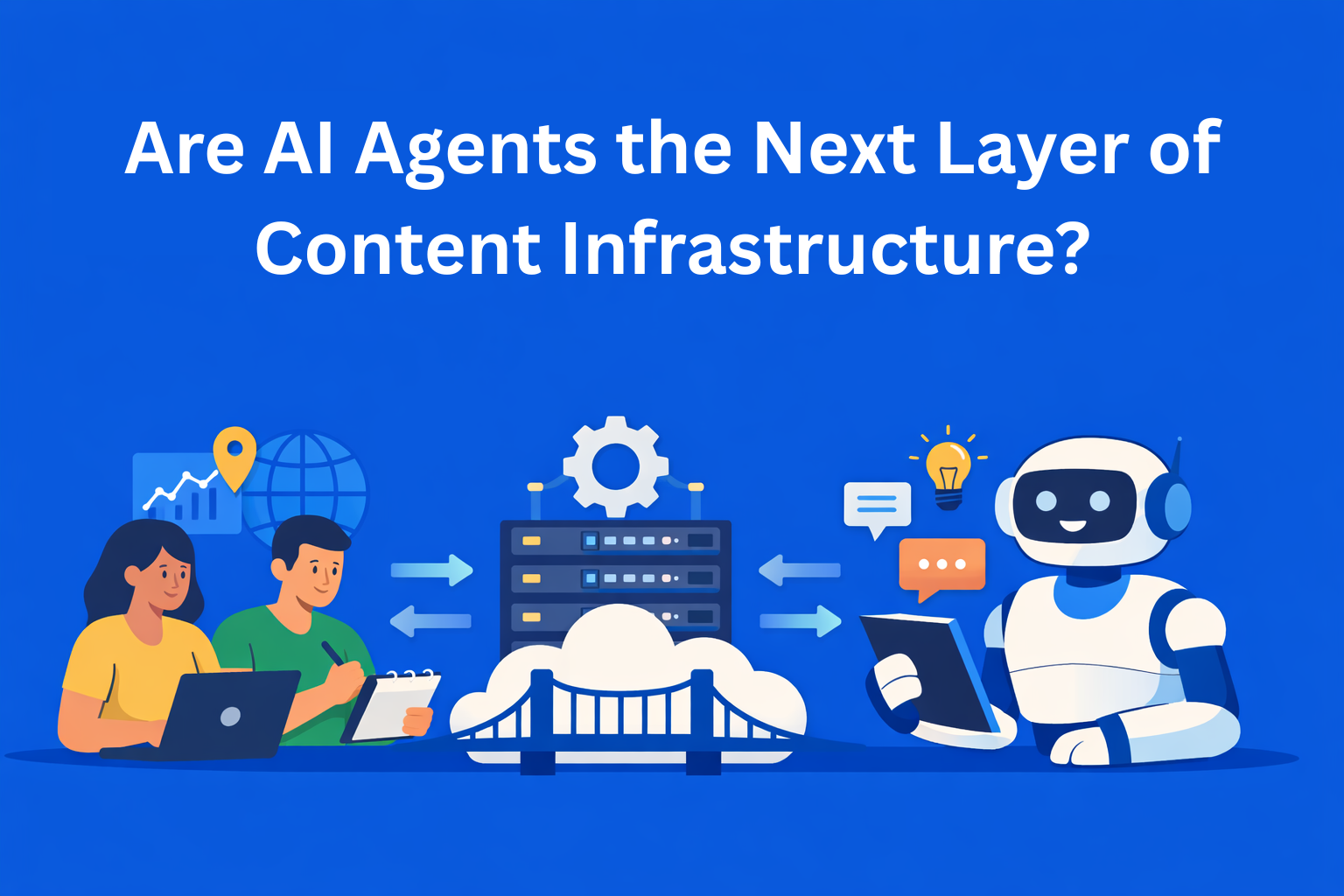
In that context, AI agents are starting to look different. They are not just another tool in the stack. More and more, they are being used as part of the working system itself. Instead of helping with a single task, they become part of the entire workflow and begin to change how content teams actually operate.
Key Takeaways
- Tool stacking doesn’t scale content teams anymore - adding “one more tool” usually creates more handoffs, context switching, and process noise.
- AI agents are different from AI tools - agents don’t just generate output; they stay involved across stages and act on workflow context.
- Agents are becoming infrastructure - the shift is from occasional AI help to always-on support that connects planning, production, and management.
- Agents reduce firefighting in content operations - they surface bottlenecks early, track status/ownership, and keep work moving without constant chasing.
- 2026 advantage goes to system-led teams - teams that embed agents into their workflow spend less time on ops and more time on strategy and quality.
How We Have Used AI in Content Teams So Far
Most content teams first encountered AI through very simple use cases. They used it for ideas, first drafts, sentence rewrites, or faster content editing. At that stage, AI was just a helper, something you used when you needed it.
This approach delivered quick wins. Productivity increased, and certain tasks were completed much faster. But over time, problems started to appear. AI tools worked in isolation, without a bigger picture. Each tool had its own role, but nothing was connected into a single system.
In the end, everything feels scattered. Ideas live in one place, drafts in another, comments somewhere else, and planning who knows where. AI helps here and there, but it has no real understanding of how the work actually flows. And that is exactly where the need for a new role for AI agents becomes obvious.
What AI Agents Really Are in Content Operations
AI agents are often confused with traditional AI tools. The key difference is that agents are not designed to perform just one task. They are built to work continuously and to understand a broader context.
An AI agent can follow the flow of work, understand which stage a piece of content is in, and respond accordingly. You do not need to constantly tell it what to do. It is always there, involved in the process, supporting the team from start to finish.
Unlike a basic AI assistant that only reacts when you ask something, an AI agent stays involved. It remembers what was done before, learns how the team works, and adapts over time. That is why it feels more like part of the system than just another tool.
From Tools to Infrastructure
When something becomes infrastructure, it means it is used every day without thinking about it. You do not ask yourself whether you need it, it is simply there and does its job. CMS platforms, task management tools, and analytics are good examples. Today, it is almost impossible to work without them.
AI agents are slowly entering the same category. Instead of being used occasionally, they are becoming part of the core system. They connect planning, production, and content management into a single flow.
How AI Agents Simplify Content Planning
Content planning is often one of the most demanding parts of content operations. Goals, topics, deadlines, and resources all need to be aligned. AI agents can make this easier by helping with organization and decision-making.
For example, an AI agent can collect ideas from different sources, connect them to existing topics, and suggest priorities. Instead of planning based on gut feeling, decisions are made using data and past results.
Because of that, teams rely less on last-minute decisions and guesswork. The team finally has a clear picture of what it is doing, in what order, and why.
The Role of AI Agents in Content Production
During production itself, AI agents can act as constant support. They can help with writing, editing, and adapting content for different formats.
It is important to say clearly that AI agents do not replace people. They simply take repetitive and tedious tasks off people’s shoulders, so humans can focus on work that actually requires thinking and creativity.
As a result, content is produced faster and with less back-and-forth. Everything feels more consistent, keeping the same tone and style from one piece to the next.
Managing Content with the Help of AI Agents
Content management usually means tracking status, deadlines, and collaboration between different team members. AI agents can spot where things get stuck and suggest ways to fix the problem.
For example, an agent can notice that a certain type of content keeps getting stuck in the same stage and alert the team. Instead of discovering issues when everything is already on fire, problems become visible much earlier.
Because of that, everyone has a clearer view of what is happening and who is responsible for what.
How AI Agents Will Redefine Content Operations in 2026
By 2026, it is clear that content teams will need to work smarter, not harder. AI agents will play a key role in that shift.
Roles inside teams will change. Less time will be spent on operational tasks, and more on strategy and creative thinking. Teams that have AI agents built into their infrastructure will have a clear advantage.
They will not just produce more content. They will operate with a more stable and sustainable system.
Conclusion
AI agents represent the next logical step in the evolution of content operations. As they are used more widely, teams will stop seeing them as an add-on and start treating them as a normal part of the system.
For content teams that want to grow without hiring more people, this shift can be crucial. The real question is no longer whether AI agents will become part of the system, but when, and how.