Stop Chasing Clients for Content: Build a Frictionless Collection Process
Stop chasing clients for content and fix your process instead. Learn how to build a simple, frictionless content collection process that gets you faster responses, less back-and-forth, and a smoother content workflow without constant follow-ups.

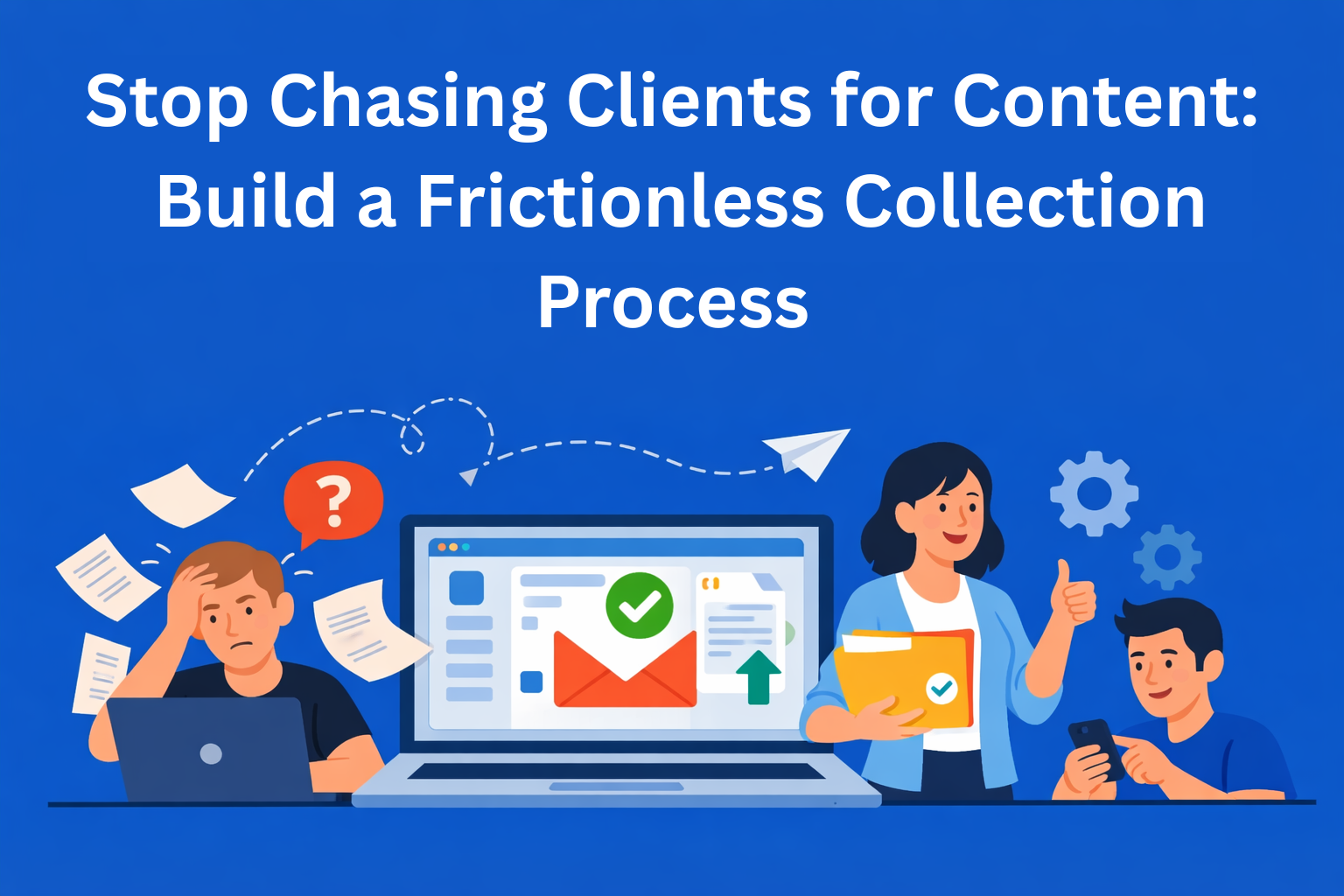
When you work with clients on content, it often ends up the same way: communication drags on, responses come in slowly, and everything takes longer than it should. At some point, you realize you’re spending more time reminding people than actually doing the work.
But the problem usually isn’t the clients. The problem is the process you use to collect content. If you don’t have a good content collection process, you’ll always end up in the same loop, follow-up messages, delays, and frustration.
In this blog, I’ll explain how to build a better process and fix this problem.
Key Takeaways
- Chasing clients is usually a process problem - delays often happen not because clients are difficult, but because the content collection process is unclear, scattered, and full of friction.
- Friction makes clients postpone sending content - too many steps, vague requests, multiple tools, and unclear formats create confusion and slow everything down.
- A good collection process is simple and guided - clients should know exactly what to send, where to send it, in what format, and by when, without having to guess.
- Standard briefs and centralized systems reduce chaos - one repeatable template, one communication location, and structured inputs make content collection much faster and easier to manage.
- Automation removes unnecessary follow-up work - reminders, workflows, and content operations tools help keep projects moving without constant manual chasing.
Why chasing clients doesn’t work
Most people instinctively blame clients: they’re slow, they don’t respond, they don’t send things on time. But often the real issue is that you didn’t give them a clear and simple way to provide what you need.
First, there’s the hidden time drain you don’t even notice at first. Every time you send a reminder, you lose time, you write messages, check your inbox, and think about what’s still missing. When you add it up at the end of the month, it’s a lot of hours wasted. And the worst part is your entire content workflow is stuck because you don’t have the material, you can’t write, you can’t publish, and you can’t finish the job.
Second, clients are not content experts. What’s obvious to you (“send the materials”) is often not clear to them. They don’t know how detailed their answers should be, what matters, and what doesn’t. In the end, you get a half-done response and you’re back at the start.
Third, if you don’t have a system, you get chaos. One time you use email, another time a Google Doc, then Slack messages. Information is scattered everywhere, and it’s completely normal that the client doesn’t know where to send what.
The real problem: friction in the process
The core issue is friction. That’s everything that makes it harder for a client to send you content, too many steps, unclear questions, multiple communication channels, or no clear format.
Imagine this: you send a client an email, then a document link, then extra instructions in another message. They open everything and don’t know where to start. What do they do? They postpone it. The more friction there is in your content collection process, the more likely it is that clients will delay.
What a good content collection process looks like
A good system is simple and guides the client without making them think too much. No guessing, no “what am I supposed to do now?”.
First, you need clearly defined inputs. The client knows exactly what to send, in what format, and by when. The difference between “send something about your product” and “write 3 main benefits of your product in 1–2 sentences” is huge. This is the foundation of any good content brief template.
Next, everything should be in one place. A mix of email + Drive + Slack almost always creates confusion. When everything is in one place, you immediately reduce mistakes and unnecessary back-and-forth.
Also, you need to guide them through the process so they don’t have to think about what to do. Don’t expect the client to know what they’re doing. Your questions should lead them step by step, with short explanations and examples. The less thinking required, the better.
Finally, there has to be a deadline and clear ownership. If there’s no deadline, things drag on. If it’s not clear who is responsible for what, no one feels accountable.
How to build this system (step by step)
You don’t need anything complicated, just a bit of discipline.
First, create a standard brief that you use every time. In it, define goals, target audience, key messages, and references. This is the foundation of your content collection process.
Second, don’t ask too many open-ended questions. They sound nice, but in practice they just create confusion. Instead of “tell me about your brand,” ask “what are 3 reasons people choose your brand?”. You’ll immediately get a usable answer.
Third, don’t use email for this, use a form instead. Things get lost and stretched out in emails, while a form guides people to fill everything in properly. It makes things easier for everyone.
Fourth, centralize communication. Everything should be in one place, without digging through messages or asking “where did you send that?”.
Fifth, automate reminders. You shouldn’t be chasing clients, the system should do that for you. Automated email reminders solve a big part of the problems in your content workflow.
Common mistakes
If you want things to run smoothly, avoid the following:
- too many questions , when you overwhelm someone with questions, they get confused and give up halfway because they don’t have the patience to answer everything.
- too much freedom , when you don’t tell them exactly what you need, they send something that isn’t very useful and you can’t really use it.
- no deadlines , if there’s no clear due date, things will drag on forever because it’s not a priority.
- using multiple communication channels , when everything happens in different places, people get confused and don’t know where to send things.
- no clear structure , when there’s no order or plan, everything becomes messy and you end up wasting time trying to figure out what you even have.
All of this increases friction, and more friction means less content.
How tools can help
You can do all of this manually, but it quickly becomes exhausting. That’s why there are content workflow automation tools that allow you to build your own workflow, create templates, assign roles, send automatic notifications, and keep everything in one place.
For example, platforms like EasyContent let you create a system where content moves from step to step without manual tracking. That means less chasing and more real work.
Conclusion
If you’re constantly chasing clients, it’s not a people problem, it’s a system problem. When you build a proper content collection process, you get content faster, reduce stress, and your projects run smoothly.
At the end of the day, it’s simple: people don’t like complexity. If you make things easy, they’ll do it. If you make things hard, they’ll delay.
So don’t look for better clients, build a better process. That’s the difference between chaos and a system that actually works.