Building a Content Operations Team: From One Person to a Full Department
Learn how to build a content operations team step by step, from doing everything alone to running a structured team with clear roles, processes, and systems that actually scale.

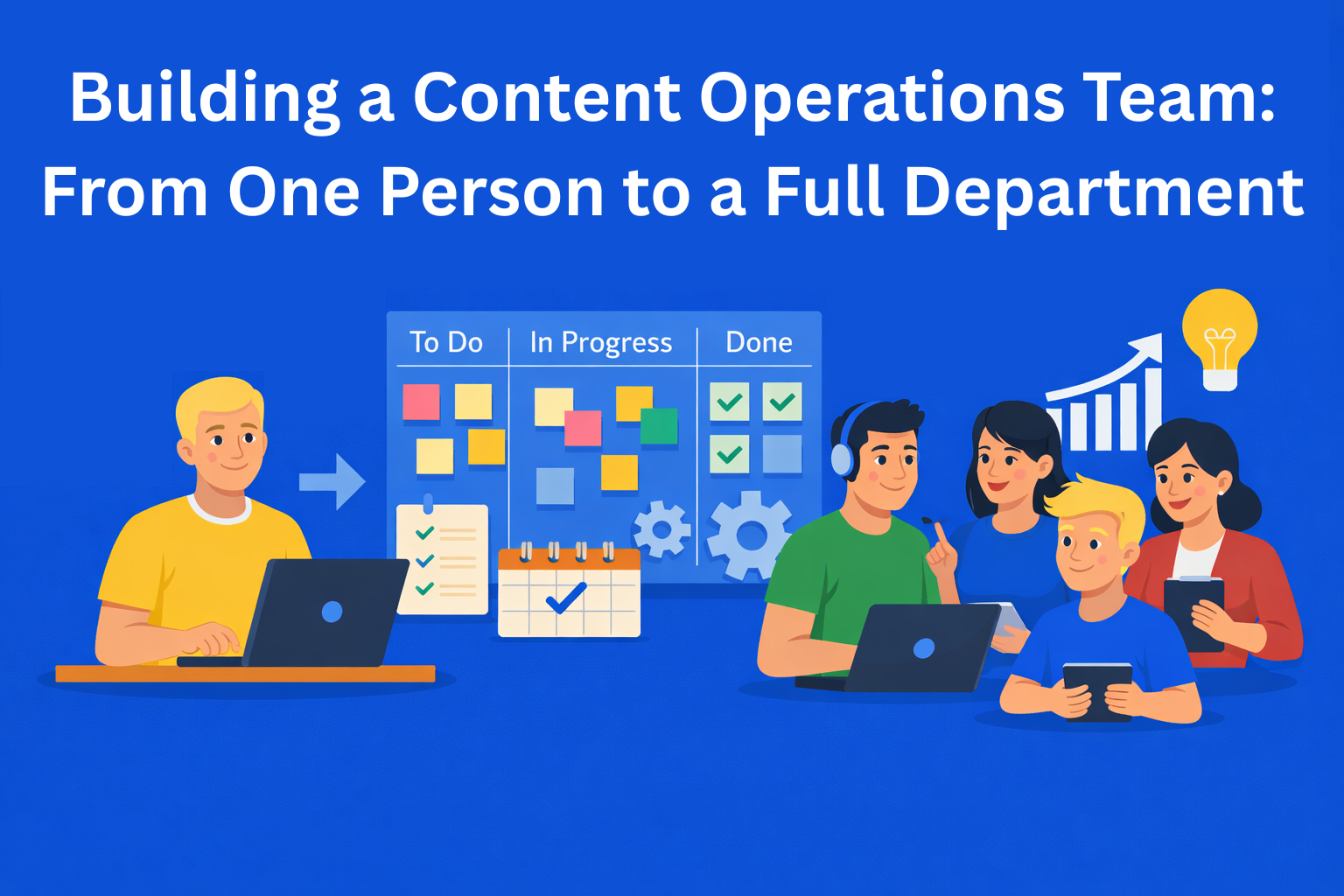
Imagine you're starting a project or a business on your own. In the beginning, you do everything, you come up with ideas, write, publish, talk to people, and track results. Everything is on you. But after some time, as you slowly start to grow, it becomes impossible to keep everything under control, so you start bringing in other people, sharing responsibilities, and putting some order in place. A content team works exactly the same way.
In this blog, we’ll go through how to build a content operations team, from one person doing everything to a full department with clear roles and processes.
Key Takeaways
- Every content team starts with one person - the early stage is about learning every part of the workflow before gradually building structure around it.
- Clear roles matter as soon as the second person joins - writing, publishing, and coordination should be assigned early to avoid chaos.
- Growth requires systems, not just more people - templates, workflows, goals, and briefs keep quality consistent as the team expands.
- Larger teams need specialization - editorial, production, distribution, and analytics functions help scale without bottlenecks.
- Hiring should follow process clarity - before adding people, define ownership, success metrics, and how the new role fits the workflow.
When you're doing everything alone
Every content team starts with one person. That person writes content, posts on social media, tracks results, comes up with topics, communicates with designers, everything at once.
That’s not a bad thing. In fact, this phase is useful because you learn how everything works from the inside. But the problem starts when the workload becomes too much and the quality starts to drop.
Content strategy at this stage doesn’t need to be complicated. A simple plan is enough: what you’re publishing, when, and why. Even a Google Sheet can work as a content calendar.
When you notice that you’re constantly late with things or that you never get around to important tasks, that’s the moment you know it’s time to bring more people into the process.
First hires - you become a team
When you bring in your first or second person, that’s when the first real shift happens. You’re no longer a solo player, now there’s a team, even if it’s small.
At this stage, three roles matter the most:
1. Someone who writes and edits, the foundation of every content team. Without good content, everything else falls apart.
2. Someone who publishes, putting content where it needs to be and when it needs to go out. That can be Instagram, LinkedIn, a newsletter, or Google, it all depends on where your audience is.
3. A strategist or coordinator, someone who keeps everything under control, knows what’s going on, and makes sure nothing goes off track.
Of course, in smaller teams, one person can cover two roles. But it’s important that everyone knows what they’re responsible for.
At this stage, you introduce a content calendar and plan what gets published on which day. This is the first thing that separates chaos from some kind of order.
Mid-sized team - between 5 and 10 people
As the business grows, you can no longer rely on one person doing everything. It’s not enough to have just “someone who writes”, now you need someone for SEO, someone for video, someone for design, and someone to track results.
This is the stage where content starts to look like a real department.
A few things become critical during this period:
Setting measurable goals, everyone on the team needs to know exactly what they’re responsible for and how success is measured.
- Is it how many articles you publish?
- How much traffic comes from Google?
- How many people open your newsletter?
If these things aren’t clearly defined, you’re basically working blindly and have no idea whether you’re moving forward or just spinning in place.
Managing external contributors, freelancers and agencies are normal at this stage, but someone needs to coordinate them, clearly explain what needs to be done, and check if it’s done properly. That’s the job of a content manager.
Processes and templates. As the team grows, there has to be a clear way things are done. For a blog post, it should be clear: who comes up with the topic, who writes it, who reviews it, and who publishes it. If that’s not clear, you’re starting from scratch every time and wasting time.
Larger team - 20+ people
Once your team grows beyond 20 people, you can’t keep everything in your head anymore. You need a clear structure.
A team like this usually has several sub-teams:
- Editorial team, writers, editors, content strategists
- Production team, designers, video producers, editors
- Distribution team, SEO, social media, email marketing
- Analytics team, tracking results, reporting, insights
At the top is the Content Operations Manager, whose job is to work across all these teams and make sure content is delivered on time.
Systems that hold everything together
No matter the team size, there are certain systems you can’t function without.
Content brief, a document that defines what needs to be created: topic, target audience, keywords, tone, format, and deadline. Without a brief, writers are just guessing.
Brand voice document, possibly the most important one. It defines how your brand “sounds”, whether it’s formal or casual, whether it uses humor, how it speaks to the audience. When you have 10 writers, this is what keeps the tone consistent.
Tools you use every day, tools for publishing content, managing tasks, and tracking results. If you choose the right tools, you’ll save a lot of time and frustration. One tool that can help you organize tasks and create content is EasyContent, where you can build your own workflow, track where each piece of content is, assign roles, communicate in real time, create templates, and more.
Common mistakes at every stage
Each growth stage comes with its own typical mistakes. It’s good to know them in advance.
Solo stage, the biggest mistake is not documenting anything. “I know everything in my head” works while you’re alone. As soon as someone joins, problems start because no one else knows how things work.
Small team stage, hiring at the wrong time. Some people wait too long, get overwhelmed, and then hire whoever is available just to get help. Others rush and hire too early, then don’t have enough work for that person.
Mid-sized team stage, no clear goals. The team works and publishes, but no one knows if it’s actually working. That’s why you need to track results constantly, not occasionally, but every time.
Large team stage, everyone works in isolation. Teams don’t communicate, everyone pushes their own priorities. People don’t know what others are doing, there’s no information sharing, and in the end, the content feels disconnected and doesn’t perform well.
How to know you're ready for the next step
There are clear signs that it’s time to grow your team:
- Deadlines keep slipping because there’s too much work and not enough people
- Content quality drops because the pace is too high
- Some things get completely neglected because you simply don’t have time
- One or more team members are close to burnout
When you see these signs, it’s clear, you need another person. You just need to explain to leadership why it matters. In other words, show what you’re losing if you don’t hire, missed opportunities, lower quality, and burned-out team members.
Conclusion
Building a content team doesn’t happen overnight, it’s a process that takes time. You start alone, doing everything, and then gradually bring in people, create structure, and put things in order.
The most important lesson: before you hire someone new, make sure you know exactly what they will do, how their work will be measured, and how they fit into the process.
If you’re just getting started and building content operations from scratch, remember: you don’t need a big team right away. Every step is enough, as long as you’re moving in the right direction.