Can “Traditional” Content Tools Compete in an AI-First World?
In an AI-first world, content tools no longer compete on features, but on how well they fit real team workflows. This article explores whether traditional content tools can stay relevant, how AI reshapes efficiency, and why adaptation requires more than simply adding AI.

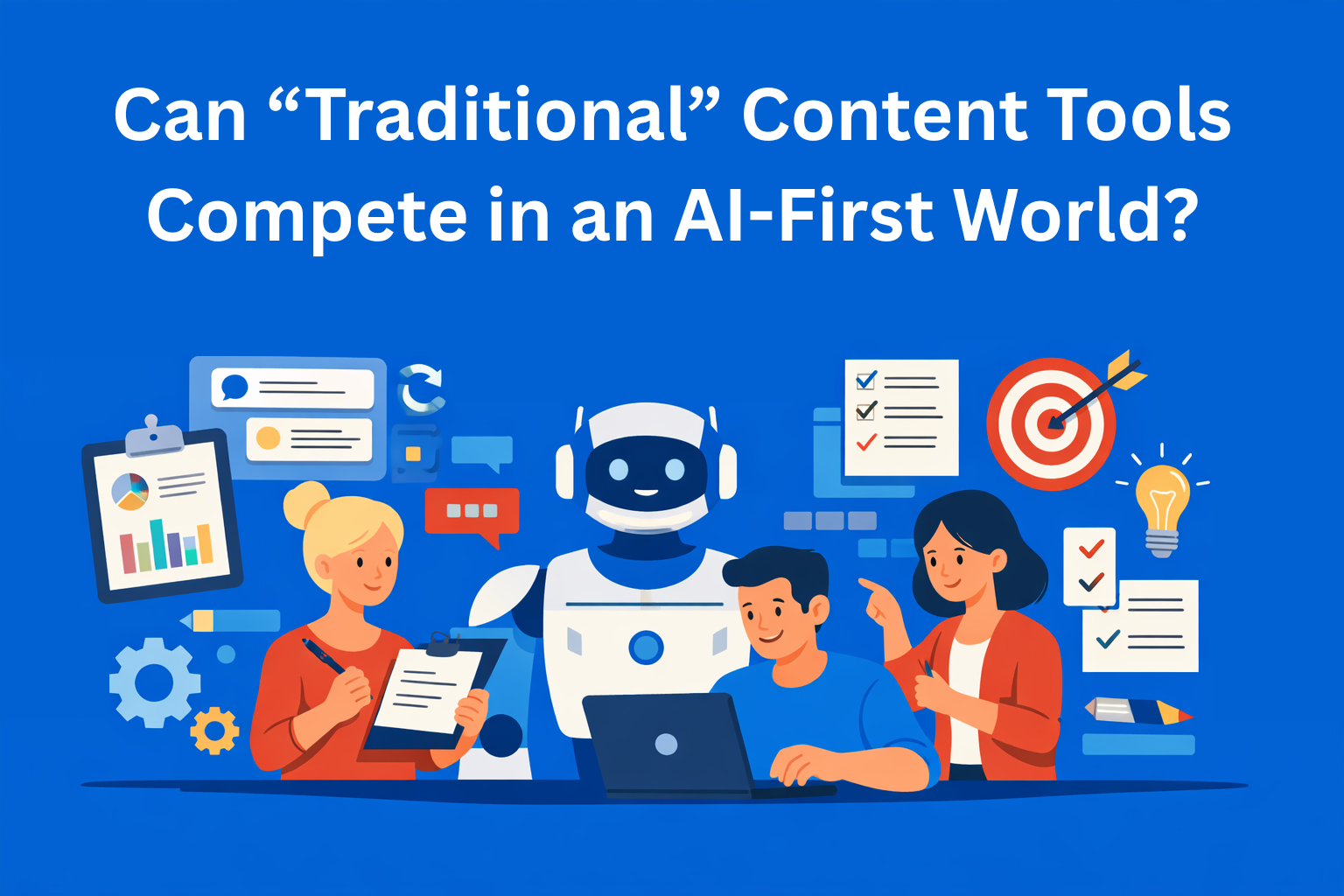
In the past, tools mostly competed on the number of features. Whoever had more options, more buttons, and more possibilities seemed like the better choice. Today, in an AI-first world, that logic no longer applies.
More and more teams are using AI in their day-to-day work. Because of that, competition among content tools is no longer about what a tool can do, but how naturally it fits into the way people actually work.
In this blog, we’ll look at a simple but important question: can traditional content tools remain relevant in an AI-first world, or do they need a complete rethink of how they’re built?
Key Takeaways
- Adding AI as a feature is not enough - tools built for manual workflows struggle when AI is treated as an add-on instead of a core capability.
- AI changes what “efficiency” means - real efficiency now comes from fewer decisions, less rework, and better context preservation, not just faster writing.
- Traditional tools break when context is missing - without goals, structure, and decision history, AI can only help on the surface.
- AI-first tools are designed around workflows - they support planning, structure, feedback, and execution as one connected system.
- The real question isn’t “who has better AI” - it’s which tool fits how teams actually work without forcing constant workarounds.
What we mean today by “traditional” content tools
When we say traditional content tools, we don’t necessarily mean old or bad products. On the contrary, many of them are still very popular and widely used.
These are tools that were created at a time when AI wasn’t part of everyday work. Their way of working is usually simple:
- write the text
- save the document
- send it for review
- receive comments
- make edits
- publish the content
In that world, efficiency meant finishing the job as quickly as possible. AI wasn’t part of the process, so tools were built around manual work and human decisions.
Problems start when these same tools try to adapt to an AI-driven way of working without actually changing how they are built at their core.
The feature trap: why “just adding AI” isn’t enough
Many traditional tools reacted to the rise of AI by adding an AI button, an AI tab, or an AI assistant on the side. On paper, that sounds like progress.
In reality, it often isn’t.
AI is treated as an add-on, not as part of the core way of working. Users have to:
- stop what they’re doing
- activate AI
- copy content
- go back to the main document
This approach often reduces efficiency instead of improving it.
In a world where AI has become the standard, it shouldn’t be a separate step. It should be a natural part of the process, available exactly where it’s needed.
How AI changes the meaning of “efficiency”
Before AI, efficiency was mostly about speed. Today, efficiency means something very different.
The focus is now on:
- people making fewer decisions on the fly
- less context getting lost during work
- the same tasks not being repeated over and over
If AI helps create structure earlier, fix issues before content goes into review, or automatically align tone, that’s real efficiency.
Writing faster isn’t enough if the rest of the workflow still relies on manual, slow, and disconnected steps.
Where traditional tools usually start to break down
The problems with traditional content tools don’t always show up immediately. They tend to appear as teams grow or as content volume increases.
The most common breaking points are:
Planning and structure
Most tools only see the document itself, not the bigger picture. That means the tool (and the AI inside it) only sees the text you’re writing, but not the things that matter most in real work.
For example, AI often doesn’t know:
- who you’re writing for (the target audience)
- why you’re writing (the goal: sales, SEO, education, brand)
- what already exists (previous content, messaging, tone, terminology)
- what’s been agreed on (outline, brief, key points, rules, guidelines)
- what’s changing and why (feedback from teammates and the reasons behind edits)
When AI doesn’t have this context, it can only help on the surface. It can rewrite a sentence, shorten a paragraph, or suggest a headline, but it doesn’t understand the bigger picture and can’t really help with planning or managing the full process.
That’s why, in traditional tools, AI often feels like an extra feature rather than real support, because it’s missing the broader context.
Feedback and revisions
Comments, versions, and edits tend to get complicated over time and become hard to follow.
One person leaves a comment, another makes an edit, a third adds another comment, and after a few rounds it’s no longer clear who asked for what, whether something has already been fixed, which version is the latest, or whether a final decision has actually been made.
On top of that, changes are often spread across different places: some in comments, some in messages, some in email, some in Slack. Later, someone opens the document and only sees changed text, without clearly seeing why it was changed.
In this situation, AI only sees the final result (for example, a new paragraph), but doesn’t understand the reason behind the change. It doesn’t know whether the edit was made because the text was too long, didn’t match the brand tone, or someone simply wanted a different style.
That’s why AI can’t do much in this kind of process. It can suggest a new version of the text, but without clear reasons and context, it often misses what the team actually needs, which leads to yet another round of comments and edits.
Alignment with goals
Traditional tools don’t know the real goal of the content. Because of that, the AI inside those tools doesn’t have enough information to help in a meaningful way.
In systems like this, AI doesn’t fix existing problems in how work gets done. It just speeds up what already isn’t working very well.
What AI-first content tools look like
AI-first content tools aren’t different just because they include AI. The real difference is how they’re designed from the start.
In these tools, AI is part of every step, context is preserved throughout the entire process, and structure comes before writing.
Instead of helping only with the text itself, AI supports the whole way of working. It knows which stage the content is in, what it’s for, and who’s working on it.
Because of that, these tools feel easier and more natural to use, and they produce better results.
Can traditional tools adapt?
In theory, yes. In practice, it’s much harder.
For a traditional tool to truly compete in an AI-first world, adding another AI feature isn’t enough. It requires:
- redefining core workflows
- changing how context is stored and used
- accepting that AI has to be a central part of the system
That often means deep changes to the product’s architecture. Some tools can do this. Many can’t.
This is where the difference between gradual evolution and a full redesign becomes very clear.
The real question teams should be asking
When choosing tools, many teams ask: “Which one has the best AI?”
But the more important question is this:
Does this tool fit the way our team actually works?
The best AI content tool isn’t the one with the most features, but the one that requires the least adjustment from the people using it.
If a tool makes work easier, helps keep context from getting lost, and allows teams to work more clearly and comfortably, it has an advantage, no matter how it’s marketed.
Conclusion
In a world where AI has become part of everyday work, the winners won’t be the tools with the most options. They’ll be the tools that fit most naturally into how teams actually work.
Traditional tools can still be used, but only if they’re willing to change their core way of working. Simply adding AI to an existing tool isn’t enough.
Real adaptation means designing the entire way of working around AI, not just adding AI as another feature.
That’s where the real competition between tools is happening today.