Content Brief Template: How to Write Briefs That Get Results from Writers
Struggling with unclear briefs and endless revisions? Learn how to create a content brief template that gives writers clear direction, saves time, and improves content quality, without overcomplicating the process.

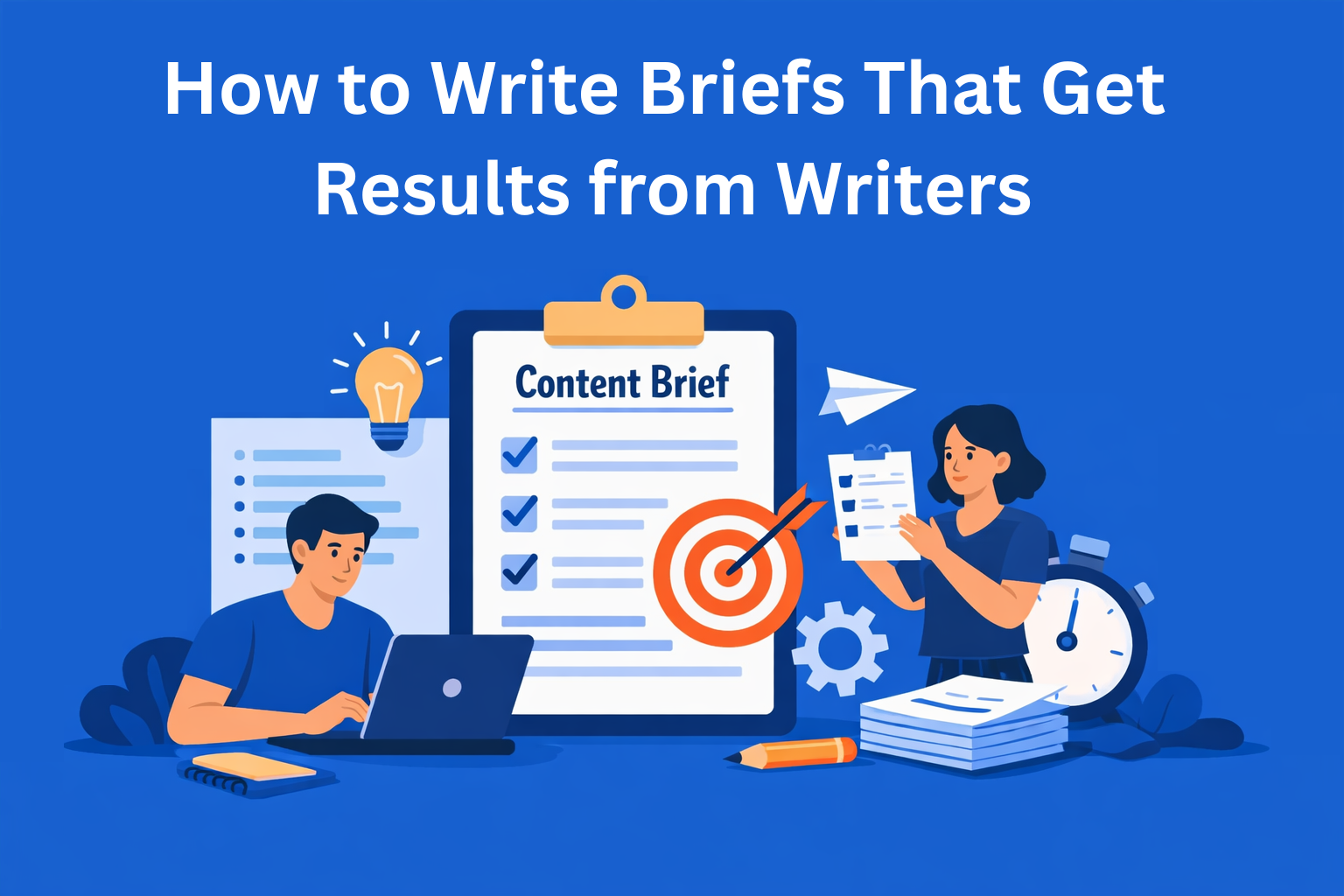
If it often happens that you get a text from a writer and, on the first read, you can tell it’s not quite right, not terrible, but not what you had in mind either, you start fixing it, send it back, tweak it again… and end up spending more time than if you had just explained everything properly from the start.
The first thing that usually comes to mind is that the writer is the problem, but much more often the issue is the brief. If the brief is unclear, the result will almost always be average. If it’s clear and specific, even an average writer can produce a solid piece.
That’s why a good content brief template is one of the most valuable things you can introduce into your process. Not because it’s a “nice document,” but because it removes guesswork.
In this blog, we’ll cover why briefs often don’t work, what actually makes a good brief, and how to create a template that gets results.
Key Takeaways
- The quality of content depends on the quality of the brief - unclear briefs lead to average results, while clear and specific instructions help writers deliver exactly what you expect.
- A good brief removes guesswork before writing starts - when writers know the goal, audience, and structure upfront, the process becomes faster with fewer revisions.
- Simple elements make the biggest difference - defining the goal, audience, search intent, keywords, and structure covers most of what’s needed for a strong brief.
- Structure and examples guide better output - outlines and reference examples help writers understand expectations and produce more aligned content.
- Consistency and standardization improve team performance - using the same content brief template across all projects creates clarity, speeds up workflows, and reduces confusion.
Why most content briefs don’t work
The most common scenario looks like this: “Write a blog about content marketing.” No goal, no audience, no structure. The writer then has to make ten decisions you could have defined upfront.
When there’s no clear direction, people start guessing and filling in the gaps on their own. And that guessing rarely ends well.
The most common problems in a bad content brief are:
- overly broad guidelines (a topic without a clear angle) , you say “write about marketing,” but you don’t define the angle, the audience, or the focus, so the writer has to guess the direction.
- unclear goal (what the text should achieve) , if it’s not clear whether the text should sell, educate, or drive traffic, the writer won’t know what to prioritize or how to shape the piece.
- no target audience , when the writer doesn’t know who they’re writing for, they can’t judge how simple or deep to go, so the text ends up being “neither here nor there.”
- no suggested structure , when there’s no plan (headings and sections), the writer wastes time figuring out the flow instead of writing, and the result often feels messy and unstructured.
- no examples of what “good” looks like , if you don’t show what you like, everyone has a different idea of “good,” and later you won’t be aligned on what the result should have been.
Because of this, a content brief template often exists just for the sake of it, without actually improving results. In practice, it’s just a task with no real guidance.
What a good content brief actually does
A good content brief isn’t there to “start the writing.” It’s there to remove confusion before writing even begins.
When the brief is good, the writer knows:
- exactly what to write
- who they’re writing for
- which problem they’re solving
- what the text should look like
Which immediately means fewer revisions, less back-and-forth, and a faster process.
What a good content brief template must include
You don’t need a complicated document. You need a few clear elements that remove the biggest uncertainties.
Content goal
If you don’t know why you’re writing the piece, you don’t have direction. One piece should have one main goal, rank for a specific phrase, drive traffic, or educate the reader.
For example: the goal is to show up on Google for “content brief template” and bring people to your site without ads. That’s clear and easy to measure.
Target audience
Who are you writing for? A beginner, a marketing manager, or a business owner?
This directly affects language and depth. If you’re writing for beginners, you keep it simple and explain the basics. If you’re writing for experienced readers, you can go deeper and skip fundamentals.
Search intent
Search intent sounds technical, but it’s simple: what someone actually wants when they type something into Google.
If someone searches for “content brief template,” they probably want a template and an explanation of how to use it. If you only give theory, you miss the point.
Keywords
This is the SEO part, but it doesn’t need to be complicated. You have one primary keyword (e.g., content brief template) and a few supporting ones. They should appear naturally in the text, without forcing them.
Structure (outline)
This is a big win. Instead of the writer figuring everything out from scratch, you give them a plan for how the text should flow. You don’t need to write a novel, just outline the main sections and what goes into each.
Tone and style
How should the text sound? Professional, casual, educational?
One sentence often solves it: “Write like you’re explaining this to a teammate.”
Examples and references
People understand best through examples. Share 2-3 links and explain what you like about them (structure, clarity, way of explaining).
SEO guidelines
If you want the text to show up on Google, you need to guide it a bit, define the approximate length, where to place the main keyword, and whether to link to other pages on your site.
CTA (call to action)
At the end, what do you want the reader to do? Sign up, click, download something? Without this, you lose part of the value.
Additional notes
This is where everything specific goes: what to avoid, brand style, special requirements.
Simple content brief template (copy-paste)
Title:
Primary Keyword:
Content Goal:
Target Audience:
Search Intent:
Outline:
- H2:
- H2:
- H2:
Tone of Voice:
References:
SEO Notes:
CTA:
Additional Notes:
This covers 90% of what you need.
How to implement briefs in a team
If you have multiple people, the key is standardization. No more “everyone does it their own way.”
- use the same content brief template for everything
- define who writes the brief
- define who approves it before writing starts
- keep all briefs in one place
Tools like EasyContent can help a lot here, because you can create briefs inside the platform and make sure everything stays in one place, accessible to everyone with all the necessary information. You can also build your own workflow, assign roles to team members, create customizable templates for any type of content you’re working on, and communicate in real time, just a few of the features that make team content creation much smoother.
Most common mistakes
People usually go too far in one of two directions: they either overload the writer with information or give them almost nothing.
A good content brief template is about balance, enough detail to remove confusion, but not so much that it blocks the writing.
Another common mistake is not defining what’s “must-have” versus “nice-to-have.” When everything is equally important, nothing is actually a priority.
Conclusion
A content brief isn’t some annoying thing you have to do just to check a box, it’s the foundation of the entire piece.
If you want a better result, explain what you want more clearly in the brief.
If you want things to move faster, use the same template every time.
If you want to grow without chaos, put a clear system in place.
At the end of the day, the kind of brief you give is the kind of text you’ll get back.