Content Cluster Strategy: How to Build Topical Authority at Scale
Content cluster strategy helps you build topical authority by connecting pillar and cluster posts into one system. Learn how to structure your content, choose the right topics, and grow organic traffic step by step.

Imagine you own a shoe store. Your neighbor owns a store that sells everything - from shoes to kitchen appliances. Who will a customer ask for advice when they need to buy shoes?
Of course, you.
Google thinks the same way. It’s no longer enough to write just one good article. Google prefers websites that have multiple articles on the same topic and cover it from all angles. This is called topical authority.
And this is exactly where content cluster strategy comes in - one of the best ways to turn your website into the place people go to when they need something about a specific topic - even if you don’t have a big budget.
Key Takeaways
- Topical authority beats one-off articles - Google rewards websites that cover one topic from multiple angles instead of publishing isolated keyword posts.
- Pillar + cluster posts create the system - one comprehensive pillar article supported by focused subtopic posts builds trust with both readers and search engines.
- Internal links are the invisible growth engine - every cluster post should connect back to the pillar, while the pillar links out to every related supporting article.
- Scaling requires repeatable planning - list subtopics, prioritize by opportunity, use publishing cadences, and standardize article templates for consistency.
- Measure clusters like a long-term SEO asset - track organic traffic, keyword rankings, bounce rate, and authority growth over 3-6 months.
What is a content cluster, really?
Let’s break it down in the simplest way possible.
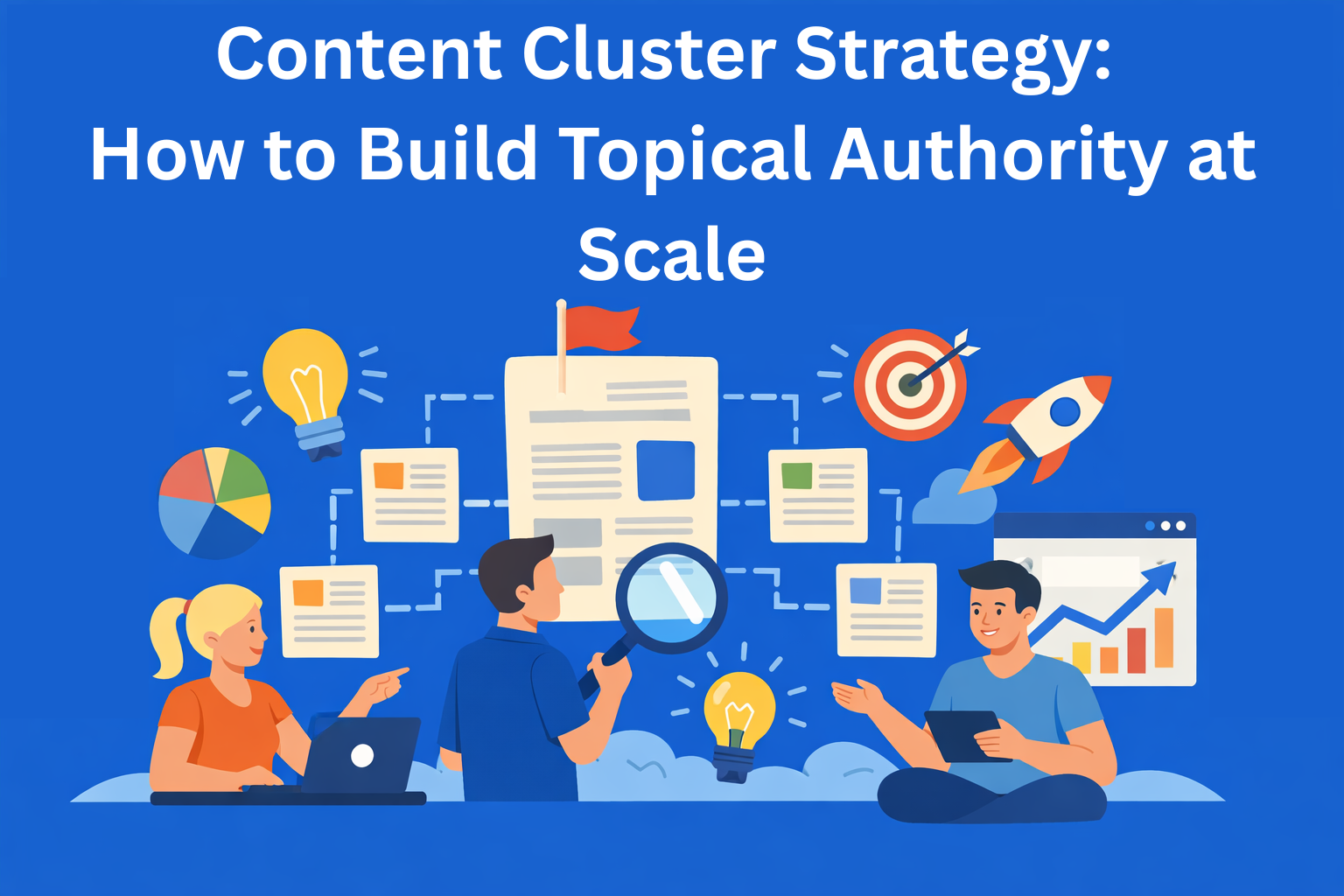
Imagine you have one main article that explains the entire topic - it’s longer and gives a big-picture overview. That’s your pillar post. Around it, you write multiple shorter articles, each explaining one specific part of that topic. Those are your cluster posts.
All of these articles are connected to each other and all lead back to the main article. Google sees this and basically says: “Okay, these guys really know what they’re doing.”
How to choose the right topic
This is the step many people skip - and later wonder why nothing works.
Before you write a single word, you need to know: what exactly do you want to be known for?
Your topic needs to be:
- Broad enough to have multiple subtopics (not “how to write one ad”, but “Google Ads for beginners”)
- Specific enough so you’re not competing with Wikipedia
- Relevant to your business and the people you’re trying to reach
Once you choose your main topic, you can use tools like Ahrefs or Semrush to see what subtopics people are searching for. Each of those subtopics can become a cluster post.
For example, if your main topic is “Google Ads for beginners”, your cluster posts could be: how to create your first campaign, how to choose keywords, how to write ads that convert, how to set a budget, and how to analyze results. All of these articles together build your topical authority in Google Ads.
Pillar post - the core of the system
A pillar post is not just a regular blog article. It’s one big piece of content that explains the topic from all angles - usually around 2,000 to 4,000 words.
Its goal is not to go deep into every subtopic (that’s what cluster posts are for), but to give a complete overview of the topic and guide the reader toward more detailed articles.
A good pillar post:
- Has a clear structure (table of contents) at the beginning
- Touches on all key subtopics - briefly
- Includes links to every cluster post
- Answers the question: “Everything I need to know about Google Ads as a beginner”
Think of it like a map of a city. It doesn’t show every street in detail - but it shows where you can go and how to get there.
Cluster posts - where the real value happens
Each cluster post focuses on one specific subtopic and explains it in detail. This is where you go deeper, give examples, steps, and practical advice.
The key thing - every cluster post must link back to the pillar post. This isn’t just a technical thing. It sends a signal to Google: “These articles are part of the same topic.”
And that’s where the real power of content clusters comes from: no article stands alone. They all work together to build authority.
Imagine a SaaS company that offers a project management tool. Their pillar post could be “The Complete Guide to Project Management”. And their cluster posts could be things like how to create a project timeline, how to delegate tasks, tools for remote teams, how to track productivity, and so on.
Each article is useful on its own - but together, they build expert-level credibility.
How to plan a cluster at scale
Once you understand how this works, the next question is: how do you organize all of this - especially if you’re publishing regularly or working with a team?
Here’s a simple approach:
Step 1 - List all subtopics. Use Google, forums, Reddit, or keyword tools. Ask yourself: what would someone who’s just starting want to know?
Step 2 - Prioritize them. Start with subtopics that have higher search volume and lower competition. That’s where you can gain traction faster.
Step 3 - Create a publishing plan. It’s better to publish one article per week than to publish five at once and then disappear for a month. The point is to stay active - that’s how you build topical authority over time.
Step 4 - Use a template. Every article should follow the same structure: explain the problem at the beginning, show how to solve it in the middle, and end with what to do next. This makes writing easier and improves quality.
Internal links - the invisible engine
If you don’t connect your articles, a content cluster is just a bunch of unrelated blog posts. Internal links are what turn it into a system.
But there’s a common mistake: people add too many links that go outside their website, and forget to link within their own site.
The rule is simple: every cluster post should link to the pillar post. And the pillar post should link to every cluster post. This creates a network that Google can crawl and understand as one connected topic.
One more detail people often miss: anchor text - the text you click on - should be descriptive and natural. Not “click here”, but something like “learn more about pre-workout nutrition”. This gives context to both Google and the reader.
How do you know if it’s working?
This is the part many people ignore - but without measuring, you don’t know if you’re on the right track.
Here are a few things to track:
Organic traffic - how many people are coming to your site from search? If your cluster is working, this number should gradually grow over 3 to 6 months.
Keyword rankings - are you ranking better for important keywords? Use Google Search Console (free) to track this.
Topical authority score - tools like Semrush estimate how relevant you are for a specific topic compared to competitors. This is a long-term metric.
Time on site and bounce rate - if people read multiple articles in one session, it’s a good sign your cluster is well-connected and useful.
Don’t expect results overnight. Content cluster strategy is a marathon, not a sprint. But once results start coming in, they’re hard to stop - because you’ve built a system, not just a single article.
Conclusion
Let’s sum it all up in five steps:
- Choose a topic you want to be known for
- Write a pillar post that covers that topic from all angles
- Create cluster posts for each subtopic
- Connect them with internal links in both directions
- Measure, adjust, and expand - a cluster is never truly finished
What’s great about this approach is that over time, your website starts working for you. New articles that build on an existing cluster immediately benefit from the support of the whole system.
You don’t need to be a big company or have a huge budget. You just need a plan, consistency, and an understanding of how Google works.
And now you have both.