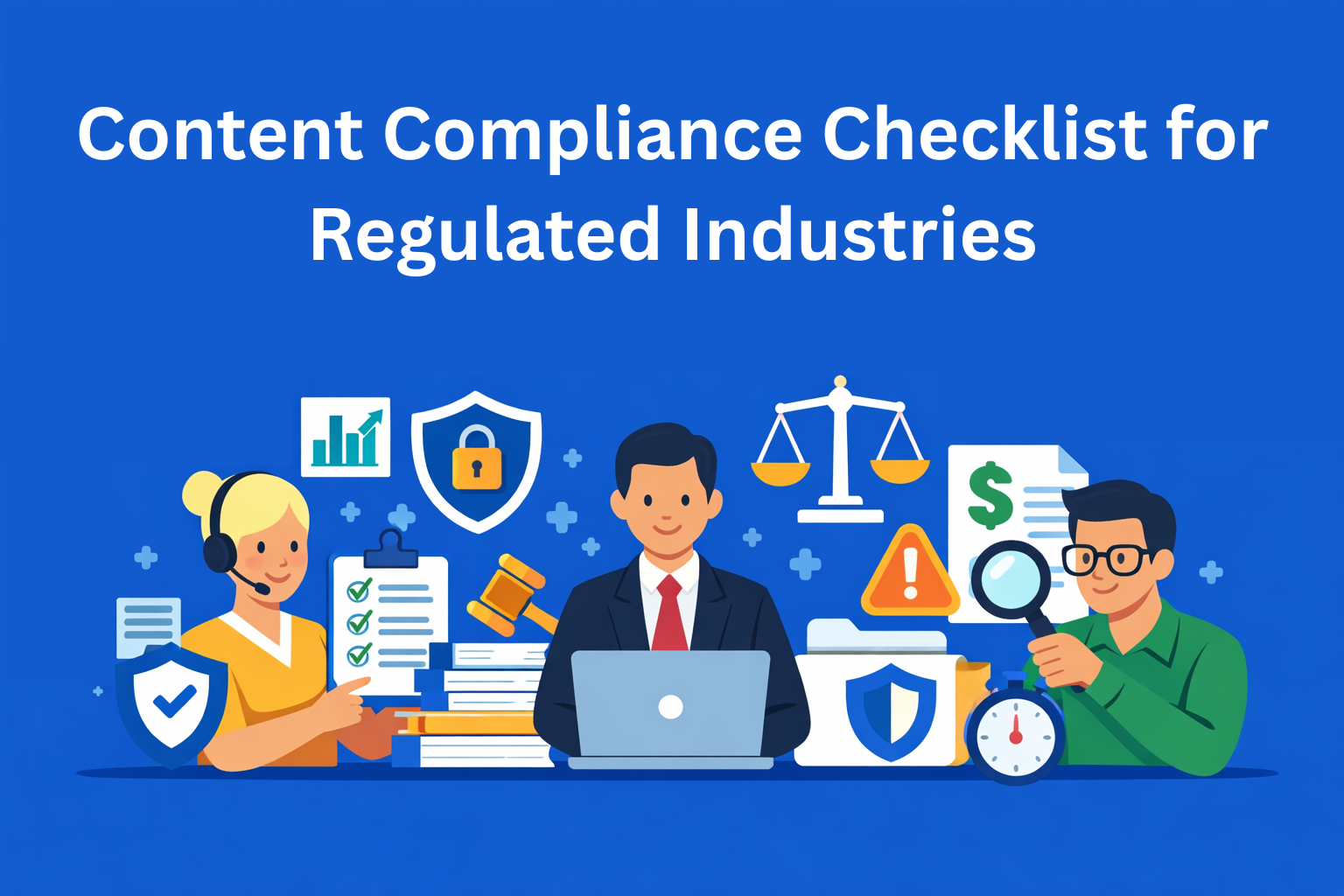
Content Compliance Checklist for Regulated Industries
If you create content in finance, healthcare, legal, or SaaS, you cannot ignore content compliance. This blog explains how to build a simple content compliance checklist, protect your brand, avoid legal risk, and create a clear content workflow that keeps your marketing team fast and safe.

Creating content is exciting. You explore ideas, write useful insights, design visuals, and publish something you are proud of.
But if you work in finance, healthcare, legal services, insurance, or any other regulated industry, there is one more important thing you must not ignore: checking whether your content follows rules and laws (content compliance).
In this blog, we will explain what a content compliance checklist is, why it matters, and how to set up a simple process that protects your company without slowing down your marketing team.
Key Takeaways
- Compliance must be built into the workflow - in regulated industries, content cannot be checked only at the end; rules should be included from the brief stage.
- Accuracy and proof protect your brand - every claim, number, and promise must be verifiable to avoid legal risk and maintain credibility.
- Clear ownership prevents delays and mistakes - one defined approval owner ensures content is reviewed properly before publishing.
- AI content requires human verification - AI drafts must be reviewed for factual accuracy, tone, regulatory limits, and data protection compliance.
- Documentation and templates reduce risk - structured checklists, version tracking, and recorded approvals create an audit trail and long-term protection.
What Is Content Compliance (and Why It Matters)
Content compliance means that before you publish anything, you check whether it follows laws, professional regulations, and your company’s internal rules.
This applies to everything you publish - blog posts, website pages, ads, emails, social media posts, videos, and even texts created by AI.
In regulated industries, marketing is not just writing and design. It is also a serious responsibility for which a company can be held legally accountable.
For example:
- A financial company is not allowed to promise “guaranteed returns.”
- A healthcare brand cannot make medical claims without proof.
- If you run a SaaS company and work with user data, you must respect privacy regulations such as GDPR.
If you publish something that does not follow the rules, you can receive fines, face lawsuits, and damage your reputation.
That is why a clear and well-structured content compliance checklist is not a luxury, but something you must have as part of your everyday work.
Why Content Teams Struggle with Compliance
Many content teams see compliance as something that shows up only at the very end.
First, they write everything nicely. Then they send it to the legal team. And then they wait for confirmation.
This can often be frustrating:
- Long delays
- Major edits
- Rewrites
- Tension between marketing and compliance teams
The real problem is not compliance itself. The problem is that people remember it only after everything is finished.
If you do not think about the rules from the start, but only at the end, compliance becomes a brake instead of support.
Another common issue is unclear responsibility. Who approves the final version? Marketing? The legal team? A compliance manager? Without a clear decision-maker, decisions get delayed and publishing slows down.
If you use AI to write your content, you need to be even more careful. AI can sound convincing, even when it is saying something that is not true. If you do not have a clear review process before publishing, a serious mistake can easily slip through.
That is why you need a clear and repeatable content compliance process.
Basic Content Compliance Checklist
Below is a simple and practical checklist you can use before publishing any content in a regulated industry.
1. Checking Claims and Accuracy
Start with the basics.
Ask yourself the following questions:
- Are all the claims accurate?
- Do we have evidence to support them?
- Are we careful not to exaggerate or promise everything under the sun?
Words such as “guaranteed,” “always,” or “100% safe” can create legal risk.
If you mention numbers, clearly state where they come from. If you are praising a product, make sure what you say can actually be proven.
This step protects your brand and builds trust. Accurate content is not only compliant - it is also credible.
2. Legal and Regulatory Check
Every regulated industry has its own rules, and there is not much room for improvisation.
Your content compliance checklist should at least cover the following:
- Have you included all mandatory notices and warnings? - This means checking whether you clearly stated everything the law requires. If you leave something out, it could later be interpreted as if you were trying to hide something.
- Are you using the correct terms and expressions required by regulations? - In some industries, it really matters how you say something. One wrong word can change the meaning and create problems, so use expressions that are allowed and precise.
- Have you checked the rules for the market where you are publishing? - The rules are not the same in every country. What is allowed in one place may be forbidden in another, so always check what applies specifically to the market you are targeting.
For example, in finance you often must clearly state that there is risk involved. In healthcare, you cannot use medical claims without proper approval. If you work with user data, you must respect privacy regulations.
Do not simply copy notices from old content and assume that is enough. Rules change. That is why you need to do the check properly every time.
3. Data Protection and Privacy Compliance
If your content includes personal data, customer stories, or testimonials, you must seriously check the following:
- Do we have the user’s consent? - This means the person must clearly agree that their data or story can be used publicly, and you cannot just assume that they are fine with it.
- Is personal data hidden? - If it is not necessary to show someone’s name, surname, or other personal information, simply leave it out. The point is to protect the person so that they cannot easily be identified.
- Is the content aligned with our privacy policy? - Everything you publish must follow the rules you have stated in your own privacy policy.
In other words, you cannot use someone’s data or story just because it sounds good in marketing.
Privacy compliance is especially important in digital marketing and SaaS companies.
Real customer examples may sound great in marketing, but if you do not have their permission, you can get into serious trouble.
That is why data protection should not be an afterthought, but a mandatory part of your review before publishing anything.
4. Brand and Ethical Guidelines
Compliance is not only about the law. It is also about brand responsibility.
Review your content from the following perspectives:
- Is the language clear and respectful? - Write in a way that everyone can understand and that does not make anyone feel targeted or insulted. If your text could sound offensive to someone, rewrite it.
- Is the tone fair to everyone? - Be careful not to use expressions that put down any group of people. The idea is that your content should be honest and respectful toward everyone.
- Are you presenting the product or service honestly? - Do not polish things just to make a sale. Clearly explain what the product is, but also what its limitations are.
The point is to write honestly and without cutting corners. People may not immediately notice if you slightly “polish” things, but in the long run trust is built only on honesty.
Your content compliance checklist should cover not only what the law requires, but also what is simply common sense.
5. Checking AI Content
If you use AI tools for content, this step is crucial.
AI can quickly generate drafts, but it can also create:
- Incorrect information
- Made-up numbers
- Statements that sound confident but can actually mislead people
Before publishing AI-generated content, check:
- Has a human done the final review? - This means someone from your team actually sits down, reads the entire text, and thinks about whether everything makes sense. AI can make mistakes, so the final word should always belong to a human.
- Are all claims verified? - Do not trust the text at first glance; check the numbers, data, and sources. The goal is not to publish something that sounds correct but is actually wrong.
- Is the tone aligned with compliance requirements? - Look at whether the text exaggerates or promises more than it is allowed to. The point is that the writing style must follow the rules, not just sound good.
AI should support your content workflow, not replace responsibility.
How to Build a Compliance-Friendly Content Workflow
Now that you have a checklist, the next step is to build a system around it.
Here is how you can structure a simple content compliance workflow.
1. Include Compliance in the Brief
Do not wait until the content is finished.
When creating a content brief, include:
- Regulatory requirements - This means checking in advance which rules and laws apply to the topic you are writing about. The point is to know what you are allowed to say and what you are not before you even start writing.
- Mandatory notices - These are short warnings or explanations that the law requires to appear next to the text. The idea is that the reader receives all important information and that nothing is left out.
- Sensitive topics - Some topics are sensitive and can easily create problems, such as earnings, health, or safety. The point is to be extra careful with such topics and double-check everything.
If the rules are clear from the very beginning, the people writing the text can create it correctly right away, without later corrections and problems.
2. Define a Clear Approval Owner
Each piece of content should have one person who has the final say - it goes live or it does not.
This does not mean others are not involved, but in the end someone must make the final decision.
When it is clear who decides, there is no dragging things out, no waiting around, and no shifting responsibility.
3. Use Templates and Structured Processes
Instead of random checks, use structured templates that include compliance points.
For example:
- A place where all legal notices are written
- A section where you check whether the data is accurate
- A section where you clearly state the sources of information
When compliance becomes part of your template, it becomes part of your regular content production process.
4. Document Everything
Keep records of:
- Approved versions
- Reviewer comments
- Final approvals
This creates an audit trail. If questions arise later, you can prove that compliance procedures were followed.
Documentation is often ignored, but it is essential in regulated industries.
All the steps we mentioned above can be implemented very easily if you use tools such as EasyContent. In the documentation section, you can write down all the important rules that need to be followed, and you can also assign roles to team members in order to clearly define who is responsible for making decisions. You can also create your own templates, so if you produce different types of content, each type can have its own specific template. As for documentation, you do not need to worry because everything is automated; you can track all content versions, add comments directly inside the text, and monitor changes in the text editor.
Most Common Content Compliance Mistakes to Avoid
Even experienced teams make mistakes.
Here are the most common content compliance risks you should pay attention to:
Publishing Without Final Approval
If you publish a text without a proper review, you can easily create problems. Even the smallest change in a sentence can pull you into legal complications.
Overpromising in Marketing
When you overdo strong marketing language, you can easily go too far and make it sound like you are misleading people.
Feel free to be persuasive, but be careful not to promise more than you can actually deliver.
Ignoring Regional Differences
The rules are not the same in every country. If you work with international markets, you must make sure your checklist follows the rules of that specific country.
What is allowed in one market may not be allowed in another.
Relying Too Much on Old Content
Old blog posts, pages, and ads may no longer follow the new rules.
From time to time, sit down and review what you have previously published and update it if necessary.
Compliance is not something you do once and then forget about, but something you must continuously pay attention to.
Simple Pre-Publish Compliance Framework
Before you click “publish,” ask yourself these four questions:
- Is everything written actually true?
- Does the text follow the rules and laws?
- Is people’s data safe and protected?
- Has the responsible person given the green light?
If you do not have a clear answer to any of these questions, do not rush - it is better to double-check than to fix mistakes later.
This short check can save you from major problems.
Conclusion
Many marketing teams see compliance as something that slows them down. But in reality, it is something that has your back.
When you build rules into the way you work from the very beginning, it does not slow you down - on the contrary, it makes your work easier.
When the rules are clear, there is no guessing. When everyone knows who does what, there is no waiting. When there is order, there is no chaos.
Regulated industries will always have strict rules, and that is simply how it is.
But you can change the way you deal with those rules.
Instead of running around fixing problems after publishing, it is better to create a clear checklist in advance and work calmly and confidently.
At the end of the day, good content is not only interesting. It must also be accurate, honest, and compliant.
That combination is exactly what makes the difference between short-term marketing and a brand that people trust in the long run.