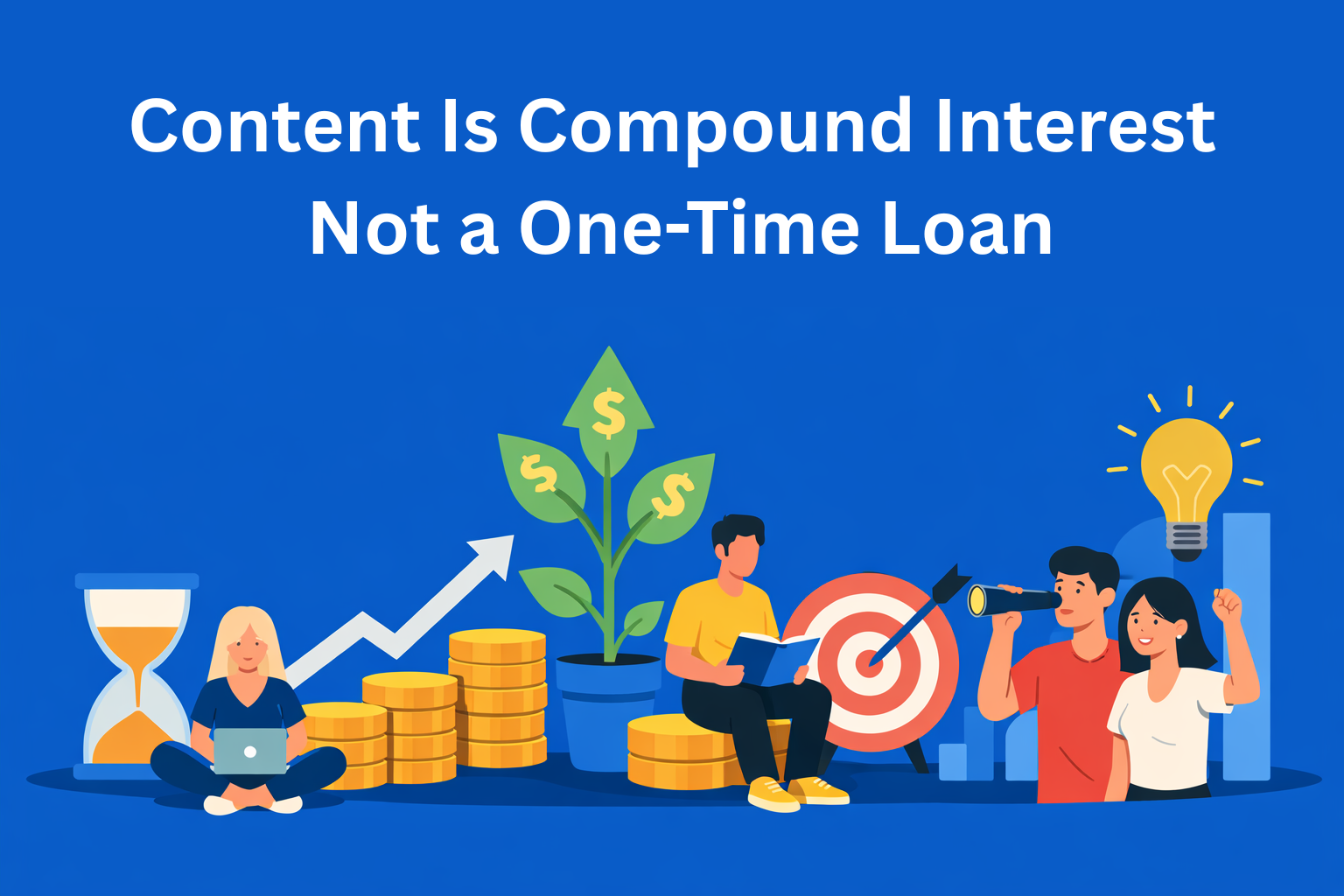
Content Is Compound Interest, Not a One-Time Loan
Content marketing does not deliver instant spikes like paid ads. It works like compound interest, slowly building SEO visibility, organic traffic, trust, and authority over time. When you treat content as a long-term investment, you create sustainable growth instead of chasing short-term results.

When most people think about marketing, the first thing that comes to mind is speed. Launch a campaign, run paid ads, boost a post, and watch traffic jump immediately. Everything feels fast. The numbers show up right away. Clear as day.
But content marketing usually does not work like that.
A blog post almost never “blows up” the moment you publish it. A piece of content will not bring you a pile of leads overnight. And a resource page will not make people fully trust you in just one day.
In reality, content does not work as an instant effect. It behaves like compound interest - it slowly builds up and grows over time. When you look at content this way, it can become one of the main drivers of growth in your business.
Key Takeaways
- Content behaves like compound interest - it rarely delivers instant spikes, but steadily grows visibility, authority, and traffic over time.
- Short-term spikes don’t build assets - paid campaigns stop working the moment you stop investing, while evergreen content keeps producing results.
- SEO rewards patience and consistency - rankings, domain authority, and topical expertise strengthen gradually as content accumulates.
- Trust compounds through repeated exposure - multiple touchpoints, consistent messaging, and helpful resources build credibility layer by layer.
- Updating and repurposing multiplies returns - improving old articles and adapting them across channels increases long-term value without starting from zero.
The Problem: We Expect Instant Results
Many teams look at content as just another campaign that needs to be pushed out quickly and show results immediately.
They publish something and instantly check the numbers:
- How many views did we get?
- Are we ranking on Google yet?
- Did this blog post bring any leads?
If the results are small in the first few weeks, they assume the content “did not work.”
That is where the misunderstanding begins.
Paid ads are like a loan. As long as you are paying, things are moving and you see results. The moment you stop putting money in, everything drops off.
Content works differently. It does not give you everything right away. It slowly builds value over time. You become more visible online, people find you more easily on Google, and little by little they start to trust you.
But this only works if you give it time to slowly build up and grow.
What Does “Compounding Content” Actually Mean?
In finance, compound interest means you do not earn only on what you first invested, but also on the earnings that keep building up over time.
The same idea applies to content.
Every blog post you publish adds something:
- One more page people can find through Google
- One more way for someone to reach your site without paid ads
- One more chance for someone to hear about you for the first time
- One more piece of content that shows you know what you are talking about
One article on its own might not seem like anything special.
But when you have ten articles on a similar topic, it already becomes clear that you know what you are doing.
And when you have fifty, people start taking you seriously and begin to trust you.
That is how sustainable growth in content marketing happens.
SEO: Why Content Needs Time to Grow
SEO is one of the clearest examples of compounding content.
When you publish a blog post, Google does not rank it at the top immediately. It takes time for search engines to:
- Index the page
- Understand the topic
- Evaluate the quality
- Compare it to other content
Sometimes this process takes months.
But if you keep publishing useful, structured, and clearly focused content, something interesting starts to happen.
Your domain authority grows. Your internal linking becomes stronger. Your topical expertise becomes clearer.
Older articles begin to rank better. New articles start ranking faster.
That is content compounding in practice.
Each new piece strengthens the entire system.
Trust Builds Slowly - But Deeply
People rarely buy after reading just one article.
They might discover you through a blog post. Then they read another piece. Later, they subscribe to your newsletter. Weeks after that, they download a guide.
That is how content marketing builds trust.
Each interaction adds a layer of familiarity. Each useful article increases credibility. Each consistent message strengthens your authority.
When someone finally becomes a customer, it may feel sudden. But in reality, that decision was built over time and through multiple touchpoints.
That is the power of a long-term content strategy.
Trust compounds.
Repurposing Content Multiplies Its Value
Another reason content behaves like compound interest is repurposing.
One blog post does not have to live in just one place.
You can turn it into:
- A LinkedIn post
- A newsletter issue
- A short video
- A carousel
- A sales asset
Now that single idea is working across multiple channels.
And every time you reuse or improve a piece of content, you increase its return.
That is why content optimization matters.
Updating older articles, improving structure, adding new examples, or refreshing keywords can significantly increase traffic over time.
You are not starting from zero each time.
You are building on what already exists.
What Happens When You Chase Short-Term Spikes
Let’s compare this to short-term marketing.
You launch a paid campaign. Traffic jumps. Leads increase.
Then you stop the budget. Traffic drops. Leads disappear.
The growth was temporary.
There is nothing wrong with paid promotion. It can be very effective. But it does not create lasting digital assets in the same way evergreen content does.
If your marketing strategy depends only on spikes, you are constantly starting over.
But if you consistently invest in content marketing, you build a foundation that supports everything else.
Organic traffic continues. Brand visibility grows. Authority increases.
The growth curve becomes more stable and more sustainable.
Content Is Infrastructure, Not an Expense
Many companies treat content as a cost.
They ask, “How much did this article make?”
But that question misses the bigger picture.
Content is not just a post. It is infrastructure.
It supports:
- Search visibility
- Brand positioning
- Customer education
- Sales conversations
- Product understanding
When you see content as infrastructure, you stop expecting instant ROI from every single piece.
Instead, you measure direction.
Is organic traffic growing month over month? Are you ranking for more relevant keywords? Are more people discovering you through search engines?
These are signs of compounding results.
The Hidden Power of Updating Content
Compound growth does not come only from creating new content.
It also comes from improving what already exists.
Updating an old blog post can:
- Improve rankings
- Increase engagement
- Refresh outdated information
- Add new internal links
Many businesses ignore older content because it feels “finished.”
But in reality, content maintenance is one of the strongest growth strategies in SEO.
Small improvements across dozens of articles can lead to significant traffic increases.
Again, this is compounding.
You are not building from scratch. You are strengthening what you already have.
How to Start Thinking Like an Investor
If you want content to compound, you need to change the way you think.
Here are simple steps to get started:
1. Choose Core Topics
Focus on a smaller number of key topics that matter to your audience. Build depth instead of writing random posts.
2. Create Connected Content
Link related articles together. Build topic clusters. Help search engines understand your expertise.
3. Stay Consistent
Publishing once and stopping will not create compounding results. Consistency builds momentum in content marketing.
4. Update Regularly
Schedule time to improve older content. Optimization increases long-term results.
5. Measure Trends, Not Just Spikes
Look at organic traffic growth and keyword rankings over a 6- or 12-month period. Sustainable growth takes time.
Why This Approach Leads to Sustainable Growth
Sustainable growth is not one viral post.
It is an ecosystem of valuable resources.
Over time, your website becomes:
- A trusted source
- A searchable knowledge base
- A place people return to
This does not happen in one quarter. It happens over years. But once it is built, it becomes hard for competitors to copy quickly. That is the strategic advantage of compounding content.
Conclusion
If you treat content like a one-time loan, you will always chase the next quick result.
If you treat it like compound interest, you will build digital assets that continue to grow even when you are not actively promoting them.
Content marketing rewards patience. It rewards structure. It rewards consistency. The companies that win are not always the loudest or the fastest. They are the ones that keep publishing useful content, keep improving it, and keep connecting it over time.
And slowly, almost without noticing, their growth becomes steady. That is the real power of compounding content. Not a spike. Not a shortcut. But long-term, sustainable visibility, authority, and trust.