Content Pillar Strategy: How to Organize Content for Topical Authority
Struggling to rank on Google? The problem might not be your content, it’s your structure. Learn how to use a content pillar strategy to build topical authority, organize your content, and start getting consistent organic traffic.

Imagine you have a blog or a website where you regularly publish content. You’re posting consistently, your topics are good, and yet - Google ignores you. No traffic, no rankings, no results.
Why?
The most common reason isn’t poor content. This usually happens when there’s no clear structure or content governance in place. Your articles are scattered across different topics-there’s no system, no logic. Google can’t understand what you’re actually writing about or whether you’re an expert in anything specific. That’s where a content pillar strategy comes in-a way to organize your content so both Google and your readers can immediately see that you truly understand the topic you’re writing about.
In this blog, I’ll explain what it is, why it matters, and how to apply it step by step.
Key Takeaways
- Structure matters more than volume - publishing a lot of content without a clear system won’t help you rank; organization is what makes content work.
- Topical authority beats random content - covering one topic deeply builds trust with both Google and readers, which improves rankings over time.
- Pillars + clusters create a clear system - one main page supported by focused articles makes your content easier to understand and navigate.
- Interlinking is what connects everything - linking pillar and cluster content shows Google the structure and strengthens overall performance.
- Start small and build consistently - focus on 1-2 topics first, expand them properly, and results will compound over time.
1. What is Content Pillar Strategy?
Imagine a library. Books aren’t thrown into a pile - each one has its place, its shelf, its category. You can easily find what you’re looking for because there’s a system.
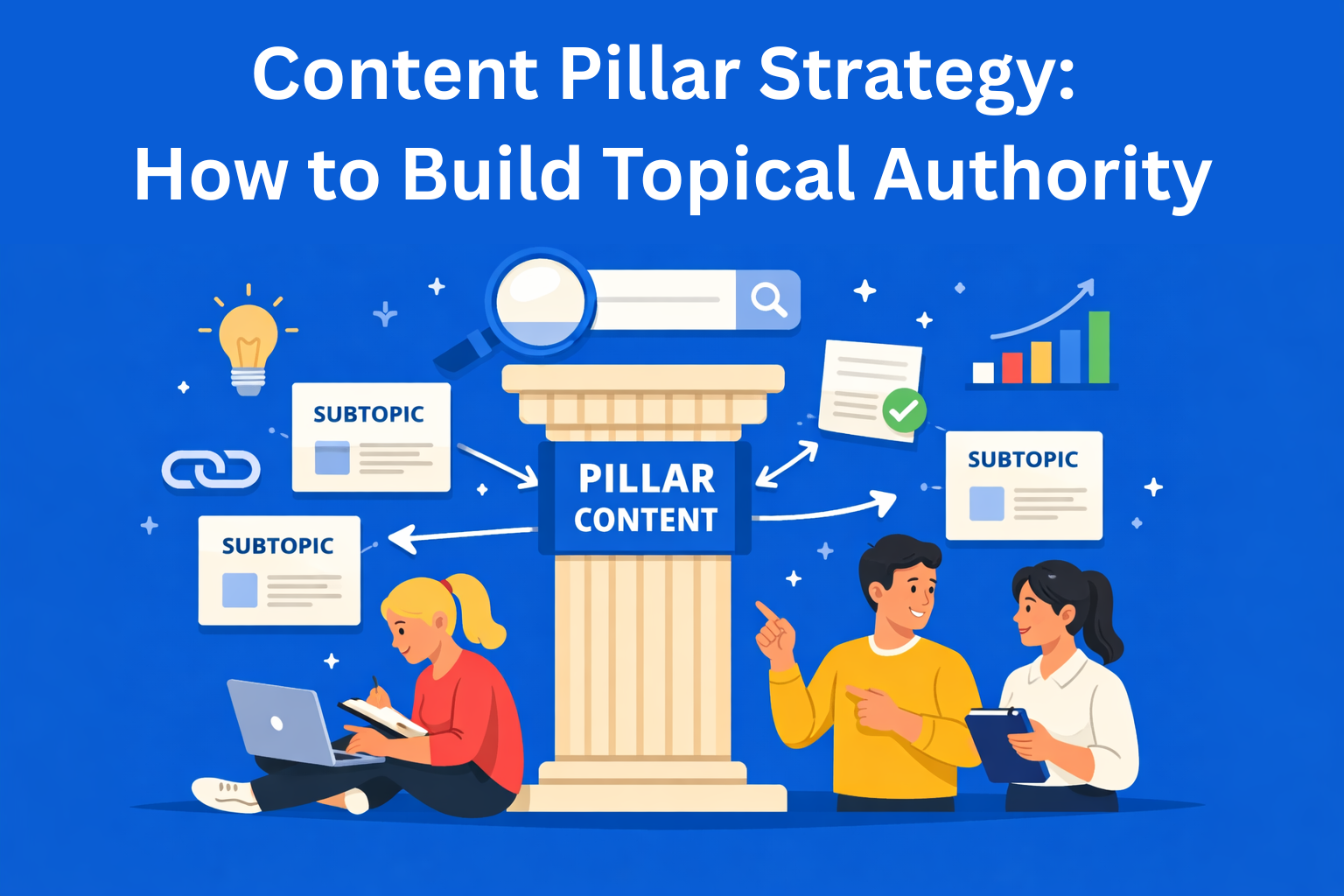
Content pillar strategy works the same way. Content pillar (a core topic) is one large, comprehensive piece of content that covers a broad subject. If your team doesn’t have a clear process for creating and managing this structure, things can quickly become messy.
For example: “Everything about Instagram marketing.” Around that main piece, you create smaller articles that cover specific parts of the topic - how to write captions, how to use reels, how to grow followers, and so on. These smaller articles are called cluster content or cluster posts. Everything is connected through links. This model is often called hub-and-spoke - the main article is the “hub,” and the smaller ones are the “spokes.”
When you apply a content pillar strategy, your site gets a clear structure that both readers and search engines can easily understand.
2. Why is Topical Authority Important?
A few years ago, SEO was relatively simple: repeat a keyword as many times as possible, get backlinks, and you’d rank. That doesn’t work anymore.
Google has completely changed how it evaluates websites. Now it looks at whether you truly understand a topic - whether you have enough content that covers it from all angles. That’s called topical authority.
Google is essentially asking: “Does this site cover this topic in depth, or just superficially?” That’s why random content without a clear structure often struggles to rank.
On top of that, Google uses a concept called E-E-A-T - which stands for experience, expertise, authority, and trustworthiness. Websites that demonstrate these qualities through well-organized content get an advantage in search results.
A good example is specialized medical sites, financial portals, or technical blogs. They don’t write about everything - they focus on their niche and cover it thoroughly.
That’s why they rank high on Google. When you build topical authority, you basically become the place people go to when they’re interested in that topic.
3. How to Choose Your Content Pillars?
This is the most important step, and a lot of people get it wrong because they try to cover too much at once.
Step 1: Define your niche
Be specific. “Marketing” is too broad. “Instagram marketing for small businesses” is something you can actually work with. Ask yourself: “What do I know well enough to write 20-30 articles about?”
Step 2: Keyword research
Use free tools like Google Search or Google Keyword Planner to see what people are searching for. Look for groups of related terms that revolve around the same topic. For example, everything around “email marketing” can be one main topic (pillar).
Step 3: Analyze competitors
Search your topic on Google and see who shows up first. Look at what those sites are writing about. And more importantly, see what they’re missing. That’s your opportunity.
Step 4: Check demand
There’s no point writing about something nobody is searching for. Make sure there’s actual search demand before investing time into a content pillar that no one will look for.
Start with 2-3 pillars max. It’s better to cover 2 topics really well than 10 topics superficially.
4. How to Build a Content Cluster Around Each Pillar?
Once you choose your main topic (pillar), the next step is to build a cluster around it. Pillar page is a longer piece - usually 2000-3000 words - that gives an overview of the entire topic. It doesn’t have to go into extreme detail, but it should cover all key points and lead to more detailed articles. Cluster articles are shorter and more focused - each one goes deep into a specific aspect. For example:
Pillar: “Email Marketing - Complete Guide”
Clusters: “How to write subject lines that get opened”, “How to build an email list from scratch”, “Which email tool to choose as a beginner”, “How to measure email campaign performance”…
Each cluster article should link back to the main (pillar) page, and the pillar page should link to all cluster articles.
This is called interlinking - content pieces connect with each other and help each other perform better on Google.
How many cluster articles do you need?
There’s no exact number, but a good starting point is around 8-15 articles per topic.
The most important thing is that each article answers a real question people are searching for.
5. How to Organize and Plan Content?
Having a strategy in your head isn’t enough - it needs to be written down (or tracked somewhere).
Content gap analysis means identifying what you’re missing.
Make a list of all the topics you should cover within one pillar and mark what you already have and what you still need to create.
Those gaps in content are missed opportunities.For organization, you don’t need expensive tools.
A simple Excel sheet or Google Sheets is more than enough. Columns can include: article title, keyword, status (written/not written), and link.
If you prefer more advanced tools, Notion or Airtable are great for managing your content plan.
When it comes to prioritization, always start with the pillar page.There’s no point writing cluster articles if they don’t have a central page to connect to.
6. Mistakes to Avoid
Here are the most common mistakes beginners (and even experienced people) make:
- Too many pillars at the start. If you’re just beginning, don’t create 10 pillar topics. This often happens when teams don’t have a clear review or publishing process. Focus on 2-3 and build them properly. It’s better to be strong in one area than average in ten.
- Clusters without a pillar page. Many people write smaller articles but don’t have a central piece that connects them. That’s like having bicycle spokes without the wheel hub - it doesn’t work.
- Poor or no interlinking. Writing content and not connecting it is like building rooms without doors. Internal links are what show Google the structure and logic of your content.
- Ignoring search intent. Every article needs to match why someone is searching for that keyword. Are they looking for information? Trying to buy something? Comparing options? If your content doesn’t match the intent, it won’t rank - no matter how well it’s written.
7. How to Measure Progress?
The good thing about content pillar strategy is that results do come - it just takes time.
What to track:
- Organic traffic - how many people are coming from Google. You can track this in Google Analytics.
- Keyword rankings - where your content appears in search results. For this, use Google Search Console (free) or tools like Ahrefs and Semrush.
- Crawl activity - whether Google regularly visits your site and indexes new content. You can check this in Google Search Console (Indexing → Pages).
Don’t expect results overnight - SEO is not a quick win.
There’s no universal or 100% precise timeline, but you can expect the first results in about 3-6 months after you start applying the strategy seriously.
New websites may take even longer, but once it starts working, growth becomes organic and stable - unlike paid ads that stop the moment you stop paying.
Conclusion
This isn’t rocket science - it’s basically common sense applied to content creation.
Instead of spreading yourself thin and writing about everything, you focus on a few topics, develop them properly, and organize your content in a way that makes sense to both people and Google.
Don’t wait for everything to be perfect.
Start with one pillar. Write the main page and the first 5 articles around it. That’s more than enough to get going.
This doesn’t happen overnight.