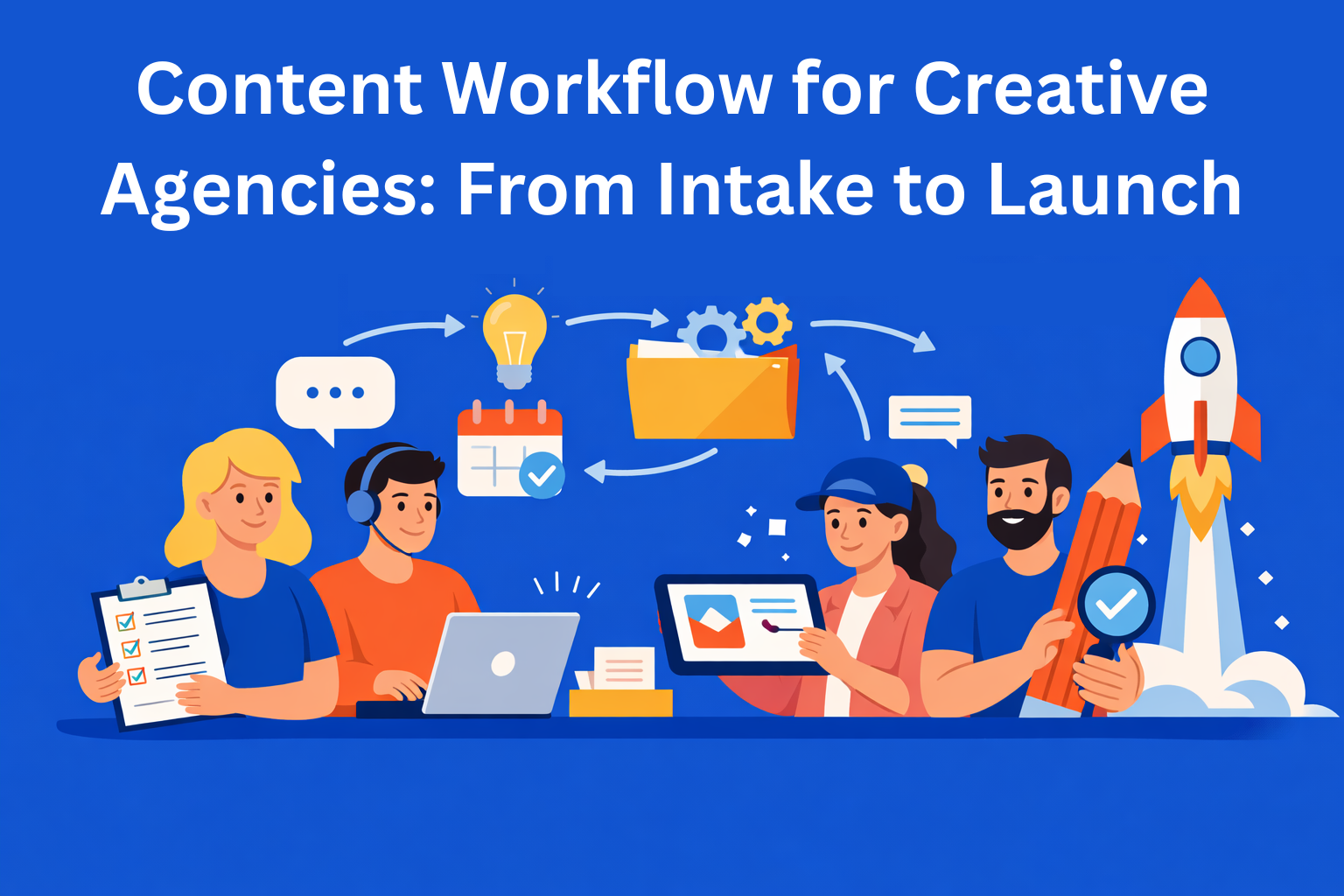
Content Workflow for Creative Agencies: From Intake to Launch
Most agencies struggle with messy projects because there’s no clear content workflow. This guide breaks down a simple content process, from intake to launch, so you can organize work, reduce revisions, and deliver faster without the chaos.

Imagine this: a client messages you at 11 PM asking where their website is,the one that was supposed to be finished a week ago. You don’t know who last worked on it, the files are scattered across three different folders, and no one ever got final approval from the client.
This is not a rare situation. Most creative agencies operate without a clear content workflow.
In this blog, we’ll walk through every phase of that process, step by step, so you can understand what well-organized work in an agency actually looks like.
Key Takeaways
- Most agency chaos starts with a missing workflow - when projects begin without a clear intake, planning process, and defined responsibilities, delays and confusion become normal.
- Every project needs structure from day one - a clear brief, deadlines, roles, and goals make content production much easier to manage.
- Review and approval need clear rules - without a revision policy and one place for feedback, projects quickly get stuck in endless changes.
- Launch is not the end of the process - quality checks, coordinated publishing, and post-launch review are all necessary if you want work to run smoothly.
- A good workflow speeds up creative work - strong processes do not slow agencies down, they reduce chaos and create more space for better content.
1. Intake Phase
Intake is the beginning of working with a client. It’s that moment when a client comes in with an idea or a problem, and you’re trying to figure out what they actually want.
The biggest mistake in this phase? Work starts before anyone is really sure what needs to be done.
Imagine someone tells you: "Make something nice for Instagram." Okay… but what does "nice" even mean? How many posts? What colors? What tone? Who are we talking to? Is there a budget for a photographer?
If you don’t have answers to these questions, everything you’re doing is shaky.
The solution is simple, create a standard questionnaire that every client fills out before you start working. Through that, you find out what they want, when they need it, who their target audience is, what their goals are, and what the budget is. That’s your content brief, and it’s the foundation of every project.
Tools like Google Forms or Notion work great for this. What matters is that every project starts with clear answers, not assumptions.
2. Planning
Once you have a completed brief, you move into the planning phase. This is probably the most important part of the entire content workflow for agencies, and at the same time the most skipped one.
What do you plan?
- First, deadlines. Who does what and by when? If it’s not written down, it doesn’t exist. As strict as it sounds, without clear deadlines projects drag on for weeks.
- Second, roles. Who is responsible for writing? Who for design? Who talks to the client? Who gives final approval? When roles are clear, no one can say "I thought someone else was handling that."
- Third, project goals. Does the client want more website traffic? More sales? Better brand awareness? Every piece of content needs a clear purpose.
At the end of planning, you should have a task list, deadlines, a clearly assigned owner for each task, and a defined project goal. Only then do you move into production.
3. Content Creation
This is the part most people imagine when they think about working in a creative agency, writing, designing, shooting. And yes, it is, but it’s not just that.
When content is done properly, everything follows a clear order. First you have the brief, then you do some research, then you create the first version (text or design), and then the team reviews it internally before it moves forward.
Content creation without a clear process leads to endless changes. A designer creates a visual, a copywriter writes something that doesn’t match it, the client sees something completely different, and you’re starting over again.
Introduce a simple rule: the first version is a draft and stays internal until the team reviews it. This saves both your time and the client’s time.
If you work with freelancers, give them a clear brief: examples, tone, and format. The less guessing, the better the result.
4. Review and Approval
This is the phase that kills more projects than any other. The client doesn’t respond on time, the internal team can’t agree, and a new round of changes starts that was never planned.
Imagine you created a great blog post. The text is solid, the design looks good, everything is ready. And then the client says they want to change the font. And that’s when things start dragging endlessly.
To avoid this, you need to agree on the rules with the client upfront. How many revision rounds are included? Who on the client side gives final approval? By what deadline do they need to send feedback?
These rules are called a revision policy, and they should be part of the contract or at least agreed on in an email before the work starts.
For the review process, you can use Google Docs comments for text, or tools like EasyContent where you can track changes in real time and access all content versions directly in the editor. What matters is that all feedback stays in one place.
5. Final Prep and QA
QA is the moment before you send anything to the client or publish it publicly, where you check everything:
- Are all texts grammatically correct?
- Do all links work?
- Are images sized correctly for all platforms?
- Is the client’s logo used correctly?
- Is the content adapted for each channel?
This might feel boring, but it’s really important. One broken link, one bad image, or one mistake in the text can ruin the overall impression, even if everything else is done well.
Create a simple QA checklist, a list of things you check before every launch. It can be a Google Sheet, a Notion table, or even EasyContent. What matters is that it exists and that you actually use it every time.
6. Launch
Launching is not just clicking "Publish." It’s a coordinated action involving multiple channels and multiple people at the same time.
On launch day, you should know: who publishes on the website, who sends the newsletter, who schedules social posts, who runs ads if there are any. Everything needs to happen at the right time and in the right order.
A launch checklist, a list of tasks for launch day, is what keeps things under control. Same format every time, same order of steps. That’s how you make fewer mistakes when the pressure is highest.
After launch, monitor the first 24 to 48 hours. Is the website working? Are posts getting engagement? Are there any technical issues?
7. After Launch
Many agencies finish a project and immediately jump to the next one. That’s a mistake.
After every launch, take time for a short review. What went well? What was delayed and why? Where was the most time lost? Is the client satisfied?
The answers to these questions help you make every next agency project better, faster, and less stressful. This is called a "lessons learned" document, and it should exist for every major project you complete.
On top of that, share results with the client. How many posts were published? How much traffic did the site get? How did the ads perform? Clients appreciate this, it shows that you deliver value and that you track what you’re doing.
Conclusion
This might sound like a lot of process and structure. But look at it this way, every time something breaks, every time you panic before a deadline, every time you end up working weekends, it’s because you don’t have a solid process.
A good content workflow for creative agencies doesn’t slow things down. It speeds everything up. It gives your team clarity, builds trust with clients, and gives you the freedom to focus on creative work.
Start small. Introduce a brief template. Create a QA checklist. Agree on a revision policy with your next client. Step by step, disorganization turns into a system.