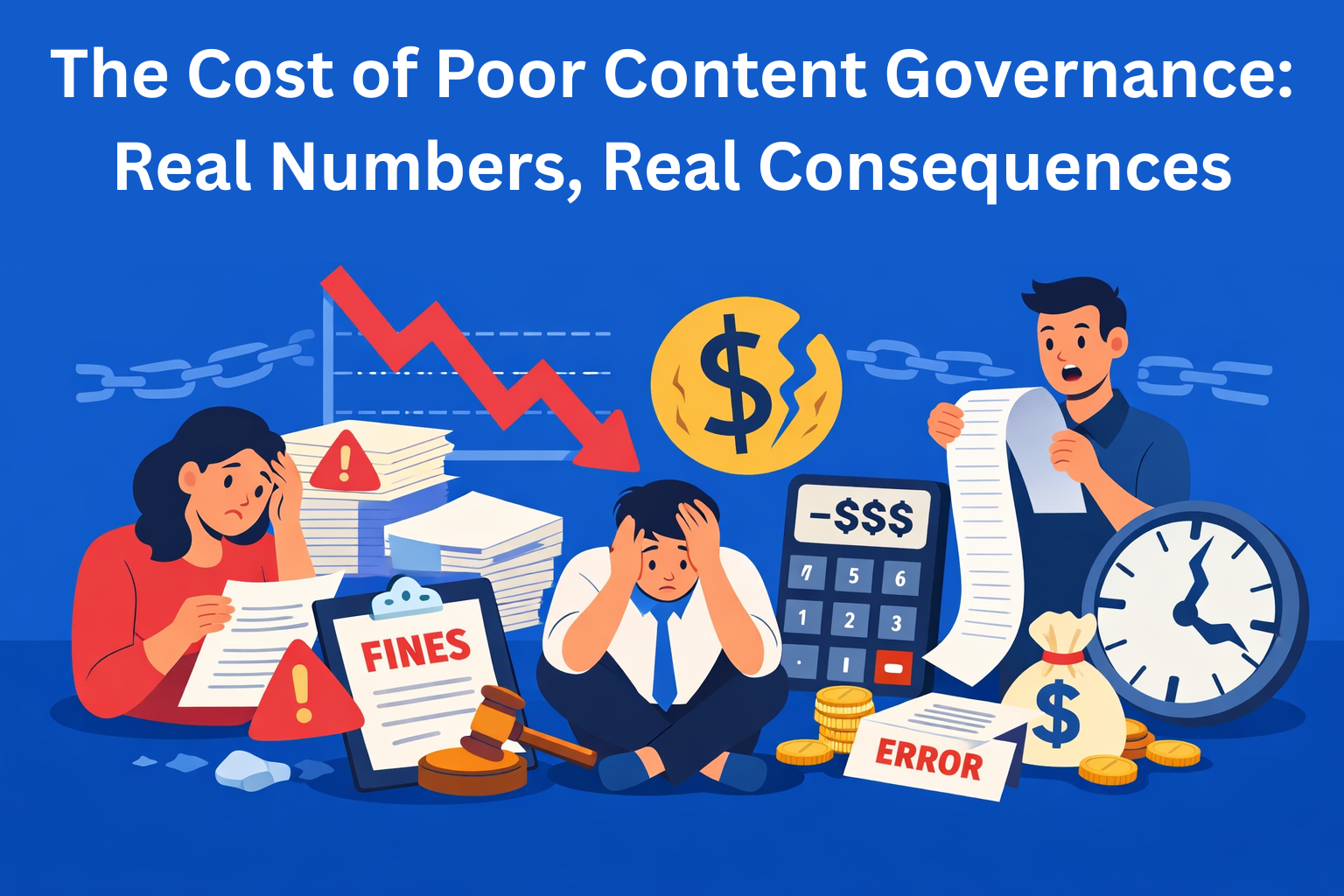
The Cost of Poor Content Governance: Real Numbers, Real Consequences
Poor content governance quietly drains your time, money, and trust. From lost documents to costly mistakes, small daily issues turn into big problems. Here’s what it’s really costing you and how to fix it before it gets worse.

Imagine a company spending months creating content. And then it happens, a wrong document leaks out. Or an audit comes in and you realize nobody has a clue where the latest versions are. And the worst part is when people spend years working by outdated rules because no one sat down to update the handbook.
And this happens every day, to companies of all sizes. And it all comes down to one common thing, poor content governance.
Key Takeaways
- Poor content governance has real financial impact - lost productivity, compliance fines, and duplicated work can quietly cost companies thousands every year.
- Lack of structure leads to daily inefficiency - unclear ownership, scattered documents, and missing processes create constant confusion across teams.
- Reputation damage is the biggest hidden risk - one wrong or outdated piece of content can quickly destroy trust built over years.
- Legal exposure increases without control - audits and regulations require clear documentation, ownership, and version tracking for all content.
- Simple rules solve most problems - defining ownership, lifecycle, access, and a central content system is enough to bring order and reduce chaos.
What is "content governance" really, and why should you care?
Content governance is, in the simplest possible terms, a set of rules and processes that define who creates content, who approves it, where it’s stored, and when it’s updated or removed.
Think of it like house rules. In every well-organized home, there are rules, who pays the bills, who cleans, what goes where. The same principle applies to content inside any organization.
Many people think content governance is "something for the legal team" or "something only big corporations deal with." That’s a mistake, even a small company with five employees can make an expensive error if it’s not clearly defined who is responsible for content.
How much is this actually costing you? Numbers speak for themselves
According to research, the average company loses between 20% and 30% of productivity due to poorly organized information. Employees search for documents, send emails asking "what’s the latest version of the presentation," redo content someone else already created, all of that costs time, and time is money.
But that’s just the tip of the iceberg when we talk about the cost of poor content management.
There are also direct financial hits. Companies that don’t comply with regulations like GDPR (the European data protection law) can face fines of up to 4% of their total annual revenue. Meta paid a €1.2 billion fine in 2023 for violating GDPR rules. Of course, your company probably isn’t Meta, but proportionally, the penalties hurt just as much.
There is also what experts call "content debt." Just like companies accumulate financial debt, they also accumulate content debt: outdated documents, conflicting information on the website, inconsistent tone of communication. And like any debt, the longer you wait, the more expensive it becomes to fix.
Reputation: when one mistake destroys what you built for years
Money can be recovered. Reputation, much harder.
- One incorrect medical text on your website.
- One outdated, invalid product specification reaching a customer.
- One campaign where you’re telling a different story on every channel.
All of this directly hits trust, and trust is the hardest currency to earn and the easiest to lose.
Social media has amplified this problem to the extreme. A mistake that twenty years ago might have gone unnoticed can now spread across the internet in a matter of hours. Fixing a mistake is always slower than the mistake spreading, that’s almost a law of nature in the digital world.
Pepsi had a well-known marketing mistake in the 1990s in the Philippines where a promotion was communicated incorrectly, which led to lawsuits and mass protests. Bad content + poor communication organization = a reputational and financial disaster. Content management in that case wasn’t a luxury, it was a necessity.
Legal and regulatory consequences: when messy documents end up in court
This is the part where many managers start paying serious attention.
There is a whole range of laws and regulations that require companies to maintain accurate, organized, and accessible content. GDPR in Europe, HIPAA in the U.S. healthcare sector, SOX for financial reporting, all of them, in some way, regulate how information is stored, who can access it, and how it is updated.
When an audit or investigation happens, regulators don’t ask "did you intend to make a mistake?" They ask: "Where is the documentation? Who approved this version? When was it last updated?"
If there are no clear answers to those questions, the problem becomes yours. And that problem can cost far more than setting up a proper system on time.
Poor document management directly increases a company’s legal exposure, even when the mistake itself wasn’t intentional.
A particularly sensitive area is internal data leaks, confidential documents ending up in the wrong place because no clear rules were set about who can access what.
Hidden operational costs: time that "disappears" every day
There are costs you see on paper, and there are costs you never measure directly, but you feel them every day.
How many times per week do your employees ask each other:
- "What’s the final version of this document?"
- How many new employees spend their first few months working with outdated instructions because no one got around to updating them?
- How many times do you recreate the same marketing material from scratch because no one knows it already exists somewhere?
According to IDC research, employees spend an average of 2.5 hours per day just searching for information. When you multiply that by the number of employees and working days in a year, you get a number that is far from insignificant.
These aren’t big, obvious problems that happen once and you notice them. These are small losses happening every day, a bit of time, a bit of energy, a bit of money. And precisely because they are small and constant, you usually don’t notice them until they become a serious problem.
What good content governance actually looks like
You don’t need a complicated system to start getting things in order.
A few key principles that apply to companies of all sizes:
1. Every piece of content must have an owner. Not a team, not a department, a specific person responsible for that document or page. When no one is responsible, everyone is responsible, which means no one actually is.
2. Define the content lifecycle. Every document should have a date when it needs to be reviewed and updated if necessary. A policy from 2019 shouldn’t still be active in 2025 just because no one removed it.
3. Clear access rules. Who can edit what? Who approves before publishing? These things need to be written down, not just exist in someone’s head.
4. A central place to store content. Whether it’s Google Drive, SharePoint, or a specialized tool like EasyContent, the important thing is that there is one place, not ten different folders scattered across laptops.
This isn’t rocket science. This is basically house rules, just applied to company content. A content management strategy doesn’t have to be complicated, it just needs to make sense and actually work.
Conclusion
When you hear the word "governance," you might think of bureaucracy, paperwork, and processes that slow things down. That reaction is understandable. But look at what you’ve just read.
Good content governance isn’t a cost, it’s an investment. It pays off every time someone finds what they need quickly instead of wasting hours. Every time you pass an audit without stress. Every time everything you publish looks clear, consistent, and professional.
Start small. Make a list of all the content your company uses. Add the name of the person responsible for each item. Set a date for the next review. That’s already content governance, and it works.
Because at the end of the day, the question isn’t if poor content management will create a problem. The question is only when.