Designing AI as a Senior Editor, Not a Junior Writer
Most teams use AI to write faster, but the real problem starts after the draft. This article explains why AI works best as a senior editor - setting direction, structure, and standards, so content teams reduce revisions and stay in control.

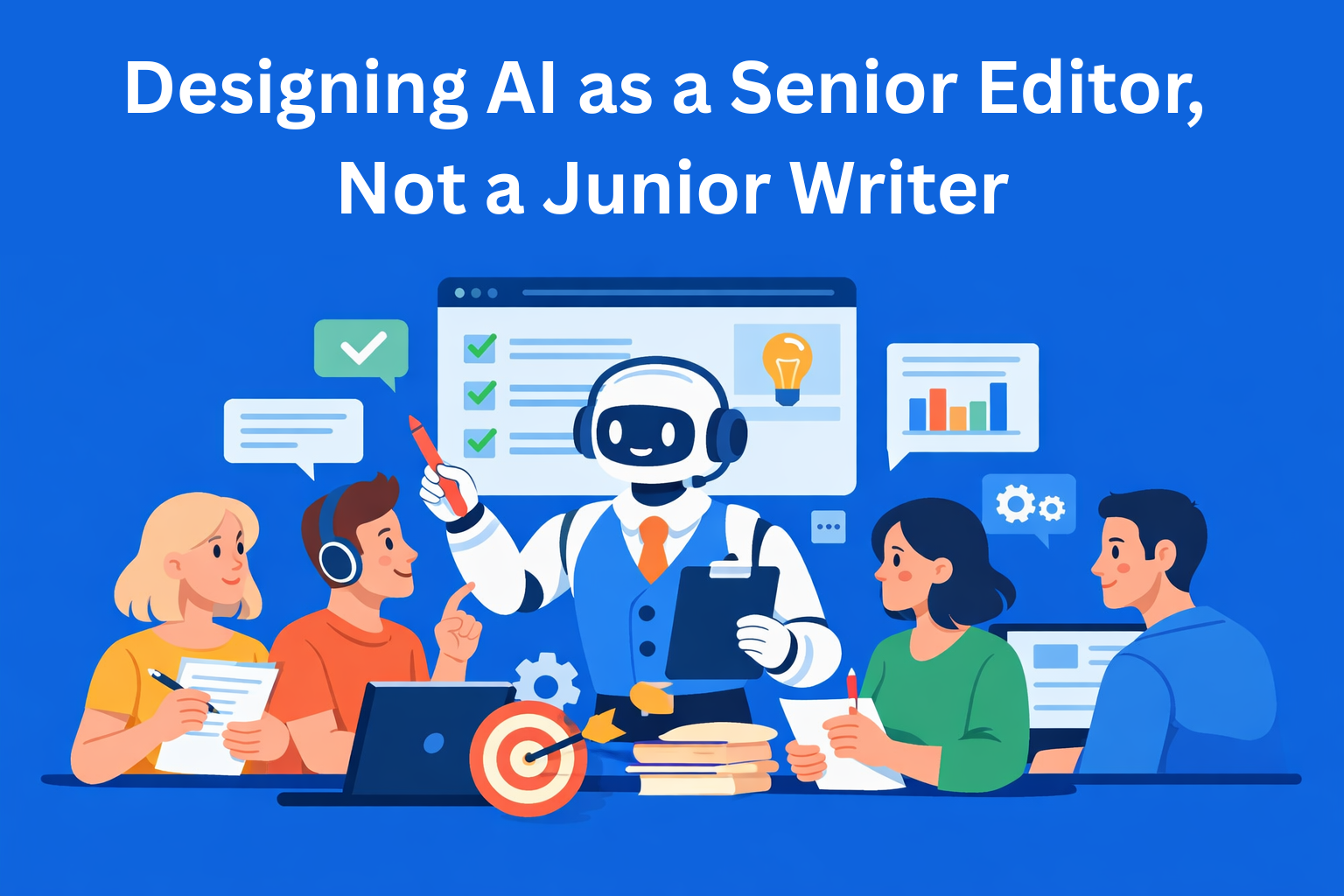
Most teams today use AI as a tool for fast writing. You enter a prompt, you get a text, and that’s it. But in reality, it’s rarely that simple. The text almost always goes through several more rounds of edits, comments, and fixes (or at least it should). People get tired, feedback keeps repeating, and deadlines start to slip.
The problem is not that AI “writes badly.” The real problem is how AI is positioned in the process. When AI works like a junior writer, it only produces text and cannot understand the bigger picture or the context. In this blog, I’ll explain why it’s much smarter to design AI as a senior editor, not just as someone who writes the first draft.
Key Takeaways
- The real bottleneck isn’t drafting - it’s revisions: most time is lost after the first draft, when direction, structure, and feedback get messy.
- “Junior-writer AI” executes without context: it writes fast, but it doesn’t challenge the brief, spot missing focus, or prevent the text from drifting.
- “Senior-editor AI” thinks before it writes: it helps evaluate the idea, set a clear message, define what to exclude, and lock the outline early.
- Outline-first workflows create the biggest quality jump: strong structure prevents later rewrites and turns editing into small improvements instead of major rework.
- This approach improves consistency and team calm: tone and standards stay stable, people make key decisions earlier, and the whole process becomes predictable.
The problem isn’t writing speed, but what comes after
At first glance, AI looks like a perfect solution. Texts are created quickly. A blog post that used to take several days can now be written in an hour. However, most teams quickly realize that writing speed is not the biggest problem in the content process.
Problems like content being sent back for rework, unclear or conflicting feedback, changing focus in the middle of the work, and people not knowing what the “final version” is usually appear later.
In those situations, AI did exactly what it was told to do, it wrote the text. But no one stopped to check whether this was the right text to write in the first place. That’s where the gap between speed and quality appears, and where the difference between a junior writer and a senior editor becomes obvious.
What AI looks like in the role of a junior writer
When we use AI as a junior writer, we expect it to start writing immediately. The prompt often looks something like: “Write a blog post about topic X, in tone Y, for audience Z.” And AI does it quickly. But a junior writer, whether human or AI, doesn’t think about questions like:
- Why is this text being written?
- What is the main message?
- What should be left out?
- Where could this text go in the wrong direction?
The result is content that looks fine on the surface but has no clear point or direction. This is one of the main reasons why AI-generated content so often requires many revisions. In this role, AI simply executes a task, without understanding the wider content workflow.
How a senior editor thinks
A senior editor doesn’t start by writing the first sentence. Their value is not in typing faster, but in making decisions. First, they try to understand what the goal of the content is, who it’s for, and which message must remain clear.
Only when these things are clear does structure and writing come into play. A senior editor thinks ahead and tries to prevent problems before they appear.
That’s exactly why the senior editor metaphor fits AI so well in modern content teams. AI delivers the most value when it helps with decision-making, not when it only produces text.
What it means to design AI as a senior editor
Designing AI as a senior editor means changing the order of steps in the process. Instead of writing first, AI thinks first.
In this role, AI helps to:
- evaluate the idea – does the topic make sense, is it useful, and is it right for the intended audience
- define the direction – what the main message is and which direction the text should follow, so the writing doesn’t drift
- create a clear structure – how the text is organized from start to finish, what sections it has, and in what order they are read
Writing comes later. In this approach, AI helps with decision-making and maintaining control over the content, not just “spitting out text.” That difference has the biggest impact on quality and significantly reduces the number of revisions.
Setting direction before writing
One of the most important roles of a senior editor is setting direction. This means answering simple but critical questions:
- What is the point of this text?
- What should the reader understand by the end?
- What should not be included in this text?
When AI performs this function, it helps the team stay focused. Instead of the idea getting diluted during writing, the direction stays clear from the very beginning. This is especially important in larger content operations teams, where multiple people are involved in the same process.
Structure as the foundation of quality content
Most content problems don’t come from bad sentences, but from poor organization. When a text doesn’t have a clear order and flow, readers get confused, and teams receive feedback that’s hard to fix.
A senior editor always insists on an outline. The same applies to AI in this role. Before a single sentence is written, it’s important to clearly define:
- text sections – the introduction, main sections, conclusion, and what each part explains
- idea order – the sequence in which ideas are presented and whether one naturally leads to the next or jumps around unnecessarily
- logical flow – a clear beginning, middle, and end that readers can follow easily without getting lost
This step often feels like extra work, but in practice it saves the most time. A good outline means fewer revisions later and a more stable content workflow.
Quality and consistency standards
Another key responsibility of a senior editor is maintaining standards. This includes tone of voice, terminology, and consistency across all content.
When AI works as a junior writer, style often changes from one piece to another. When it works as a senior editor, it helps keep the same tone, use consistent terminology, and avoid contradictions with existing content.
This is especially important for brands that care about long-term consistency, not just fast output.
Why this approach reduces revisions
Most revisions in content teams happen because important decisions are made too late. The text gets written first, and only then does the team realize that the direction or structure is wrong, so everything has to be reworked.
When AI acts as a senior editor, these issues are caught earlier. Feedback happens during planning, not after the text is already written. In practice, this means:
- less frustration and stress
- less going back and fixing the same things
- a clearer and calmer working process
This is where the real value of AI in the content process becomes visible, not in writing faster, but in preventing unnecessary work.
This way of working can be supported by EasyContent as well. Instead of using AI as a separate tool, EasyContent offers features like EasyAI Writer and AI Editor directly inside the platform and the content workflow. With clear statuses, agreement on the outline, comments, and a structured setup, the team first agrees on what they’re writing and why. Only after everyone is aligned does the writing begin. This allows issues to be spotted early, while they’re still small and easy to fix, rather than at the end when everything needs to be redone.
How people’s roles in the team change
This approach doesn’t take control away from people, it gives it back. Content managers spend less time fixing chaos and more time making decisions. Writers get clear guidelines and write with more confidence.
AI takes over repetitive and mentally draining thinking, while key decisions remain in human hands. This is the balance most teams are looking for, but rarely achieve.
Conclusion
Writing is the most visible part of the content process, but it’s not the most expensive one. The biggest losses of time and energy come from confusion, poor direction, and late feedback.
That’s why AI should be designed as a senior editor, not a junior writer. When AI helps set direction, structure, and standards, the entire team works more calmly, faster, and with fewer mistakes.
At that point, AI stops being just a writing tool and becomes a true partner in building high-quality content.