Healthcare Content Approval Workflows: Balancing Speed and Compliance
Healthcare content approval workflows often get stuck due to emails, unclear roles, and slow approvals. Here’s how to speed things up, reduce revisions, and stay compliant without the chaos.

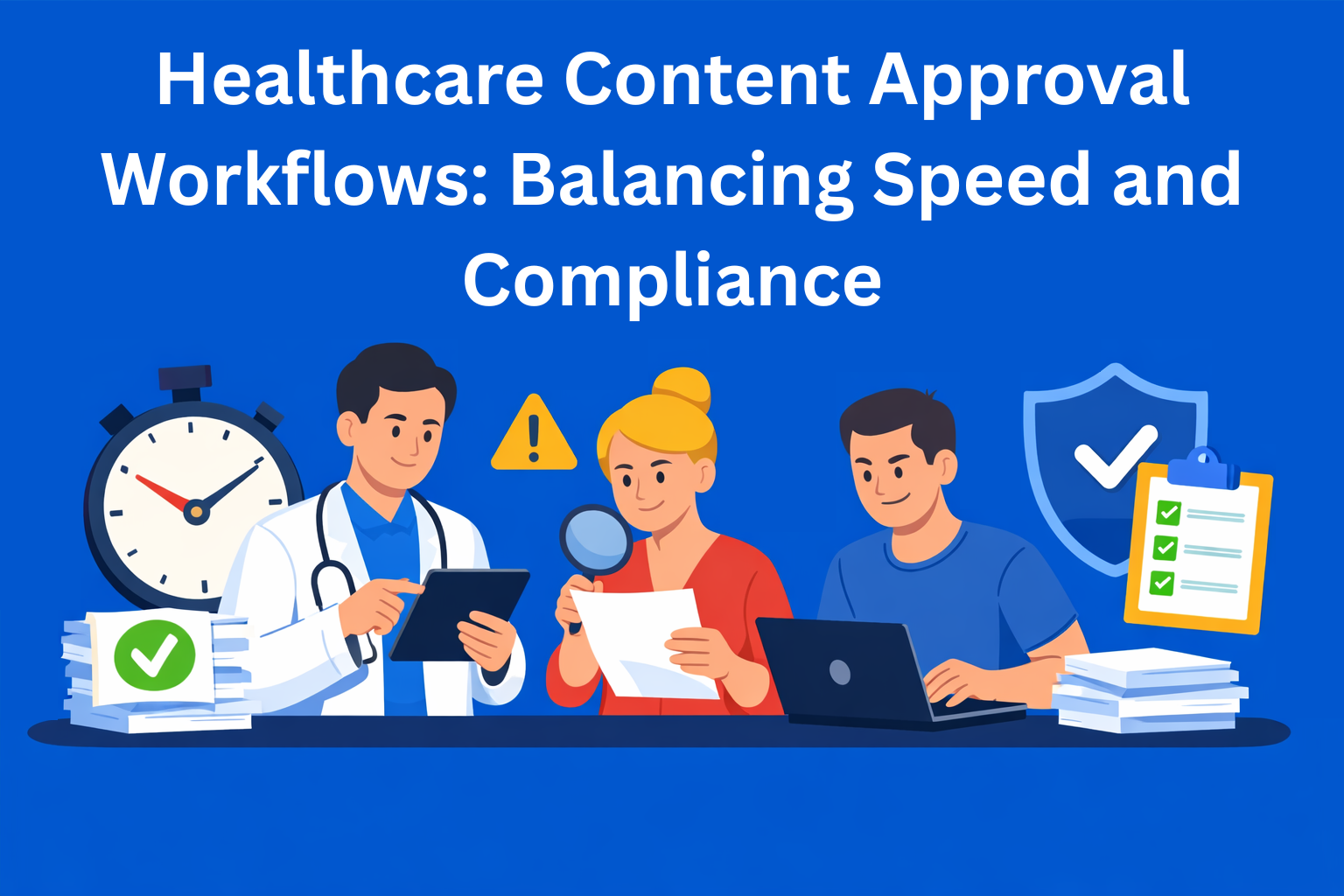
Imagine that your marketing team has just finished a great piece about a new drug or medical service. Everyone is excited, the deadline is in two days, and then, the content goes for approval. And it waits. And waits. And waits.
This is the everyday reality in healthcare companies around the world. A healthcare content approval workflow, or, more simply, the process that every piece of content must go through before publishing, can be a real nightmare if it is not well organized.
On one side, you have a marketing team that wants to publish quickly and stay relevant. On the other side, you have lawyers, doctors, and a compliance team that has to check every word. And in between? A pile of emails, waiting, and frustration.
In this blog, I will explain why this process is so complicated, where it most often gets stuck, and how to fix it so that everyone is satisfied.
Key Takeaways
- Healthcare content needs strict review - compliance exists to protect patients, but without structure it quickly turns into delays and frustration.
- The biggest issues are process-related - unclear roles, too many stakeholders, and scattered communication slow everything down.
- Not all content needs the same level of review - categorize content by risk to avoid overcomplicating simple pieces.
- Clarity and alignment speed everything up - define roles, set deadlines, and involve legal and medical teams early in the process.
- Systems and tools support efficiency - centralized workflows, templates, and audit trails help teams stay compliant while moving faster.
Why content in healthcare is a special case
When a company that sells sneakers makes a mistake in an ad, it is unpleasant. When a healthcare company makes a mistake in content, the consequences can be much more serious.
There are strict rules and laws that regulate what can and cannot be said when talking about drugs, medical devices, or healthcare services. In the United States, for example, the FDA (Food and Drug Administration) and HIPAA (Health Insurance Portability and Accountability Act) set clear boundaries. In Europe, there are similar regulations.
Content compliance in healthcare is not there without a reason. The rules exist to protect people. If information about a drug is not accurate, it can endanger a patient. If you exaggerate or wrongly present how much a treatment helps, people can be misled. And publishing patient data without permission is illegal.
That is why every piece of content, whether it is a social media post, blog, or brochure, must be properly reviewed before it is published. That is actually a good thing. The problem starts when the process is not well organized and everything begins to slow down.
Where things get stuck: Most common problems in the approval process
Let’s be honest. Most companies in healthcare have a content approval process that looks something like this: someone writes the content, sends it by email to 7 different addresses, and then waits. One person says it’s okay, another asks for changes, a third hasn’t even opened the email. The cycle repeats.
Here is where problems most often appear:
- Too many steps, too many people. When content has to go through the hands of five, six, or seven teams before publishing, each of them can slow down the whole process. Everyone has their own questions, comments, and priorities.
- No one knows who does what. If it is not clear who is responsible for which part of the review, content can sit for days, while everyone thinks they are waiting for someone else.
- Email as the main tool. Email is great for many things, but managing an approval process is not one of them. Versions get lost, comments get mixed, and no one has a clear picture of where the content currently is.
- Teams that don’t communicate. Marketing often doesn’t understand what lawyers are actually asking for. Doctors are bothered by marketing language. The compliance team pushes its own rules. In the end, everyone speaks their own language and they rarely align.
The result? A healthcare marketing workflow that is slow, unreliable, and frustrating for everyone involved.
The eternal dilemma: Speed or safety?
This is the core of the problem. And there is no simple answer.
Sometimes speed really matters. If a new disease or epidemic appears, healthcare organizations must communicate quickly with the public. If a competitor publishes something important, maybe you also need to react. If a campaign is time-limited, delays mean lost money.
But sometimes compliance must be the priority, without compromise. When you talk about specific claims related to a drug, how effective it is, what it treats, what the side effects are, every word must be accurate and approved. When you use patient stories as testimonials, there are strict rules about what can be said and how. When you mention specific medical procedures or treatments, you must be precise.
Regulatory compliance in healthcare marketing is not something you can skip, it simply has to be followed. But that does not mean the whole process has to be exhausting and frustrating for your team.
The trick is not to treat every piece of content in the same way.
A smarter way: How to organize the approval process
The good news is that there is a better way. Here is how companies that do this well actually function:
Categorize content by risk
Not every piece of content is equally risky. For example, general advice about diet or exercise is much safer than content that promotes a specific drug. That is why it makes sense to divide content into three groups:
- Low risk, general information, educational content, healthy lifestyle advice
- Medium risk, content that mentions specific services or treatments
- High risk, everything related to drugs, medical devices, or clinical claims
Each group needs a different level of review. A text about healthy eating does not need the same process as an ad for a new drug.
Clearly define who does what
Every person in the process should know exactly their role. The medical review process should go separately from the legal review, and marketing should have its own part separated as well. In short, everyone does their part and knows by when they have to finish.
Set clear deadlines for each step. For example: a simple piece of content should be done within 48 hours, and a more complex one within a few days. When deadlines are clear, the whole process moves much faster and without unnecessary friction.
Include lawyers and doctors from the very beginning
One of the biggest mistakes is when marketing writes the entire piece, and only then sends it to lawyers and doctors for review. That is where delays, back-and-forth revisions, and wasted time begin.
It is much smarter to agree on the key things at the start. What are you allowed to say? Which words can cause problems? What must be included in the content? When you clarify that upfront, everything becomes easier, both writing and approval.
Tools that can help
Tools by themselves will not solve everything, but they can make things much easier. There are tools made to help you keep everything in one place and make the process run without delays.
Tools like EasyContent allow you to create your own workflow and track the status of content, assign roles to team members and make sure that everyone does exactly what they are responsible for, communicate in real time, create your own templates for any type of content you work on, and many other useful options.
In addition, more and more companies use AI tools that can “scan” the content and check if there are some basic issues before it even reaches people. It cannot replace a human, but it can quickly remove obvious mistakes and save a lot of time for everyone who reviews the content later.
One of the most important things is also the audit trail, a record of everything that happened to each piece of content. Who reviewed it, when, what they changed, and why. In case a regulator ever asks a question, you have clear proof that everything was done properly.
What teams that do this well actually do
Companies that have managed to balance speed and compliance usually share a few common habits.
First, they meet regularly in advance. Before a new campaign starts, marketing, legal, and medical teams sit together and talk about what they are planning. That means there are no surprises when the content reaches approval.
Second, they use templates that are already approved. If you have standard formulations for common situations, how to mention side effects, how to describe drug effectiveness, which disclaimers must be included, then writers don’t have to reinvent the wheel, and reviewers have less to check.
Third, they continuously educate the team. Rules change, regulations change, and what was okay a year ago may no longer be. Regular training ensures that everyone stays up to date.
How to know if your process works
It is not enough to just have a process, you need to know if it works. A few simple things can immediately show you where you stand:
- How long does it take from writing to publishing? If the answer is “we don’t know” or “too long,” that is a problem.
- How many times does the content go through revisions? If every piece goes through five or six rounds of fixes, something is wrong at the start of the process.
- Where does it usually get stuck? Do delays always happen with the same team or person? That tells you where you need to intervene.
Track these things, talk with your team about what works and what doesn’t, and adjust how you work. A healthcare compliance workflow is not something you set once and forget, it needs to be continuously refined and improved.
Conclusion
Speed and compliance are not enemies. They are not two opposite sides that have to fight each other.
When you have a well-structured content approval workflow, when everyone knows what they are doing, you have the right tools, and people communicate from the start, everything becomes much easier. You can be both fast and compliant.
Start with small steps. Look at how you currently work and see where you are losing the most time. Who are the people without whom the work cannot be completed? Do you have clear rules for different types of content?
The answers to these questions are the first step to building a process that actually works, faster, simpler, and without unnecessary hassle.