How AI Is Quietly Redefining the Content Manager Role
AI is quietly reshaping the content manager role. Instead of writing everything from scratch, content managers now focus on context, quality, and workflow ownership, guiding AI, reviewing output, and keeping content aligned with strategy and goals.

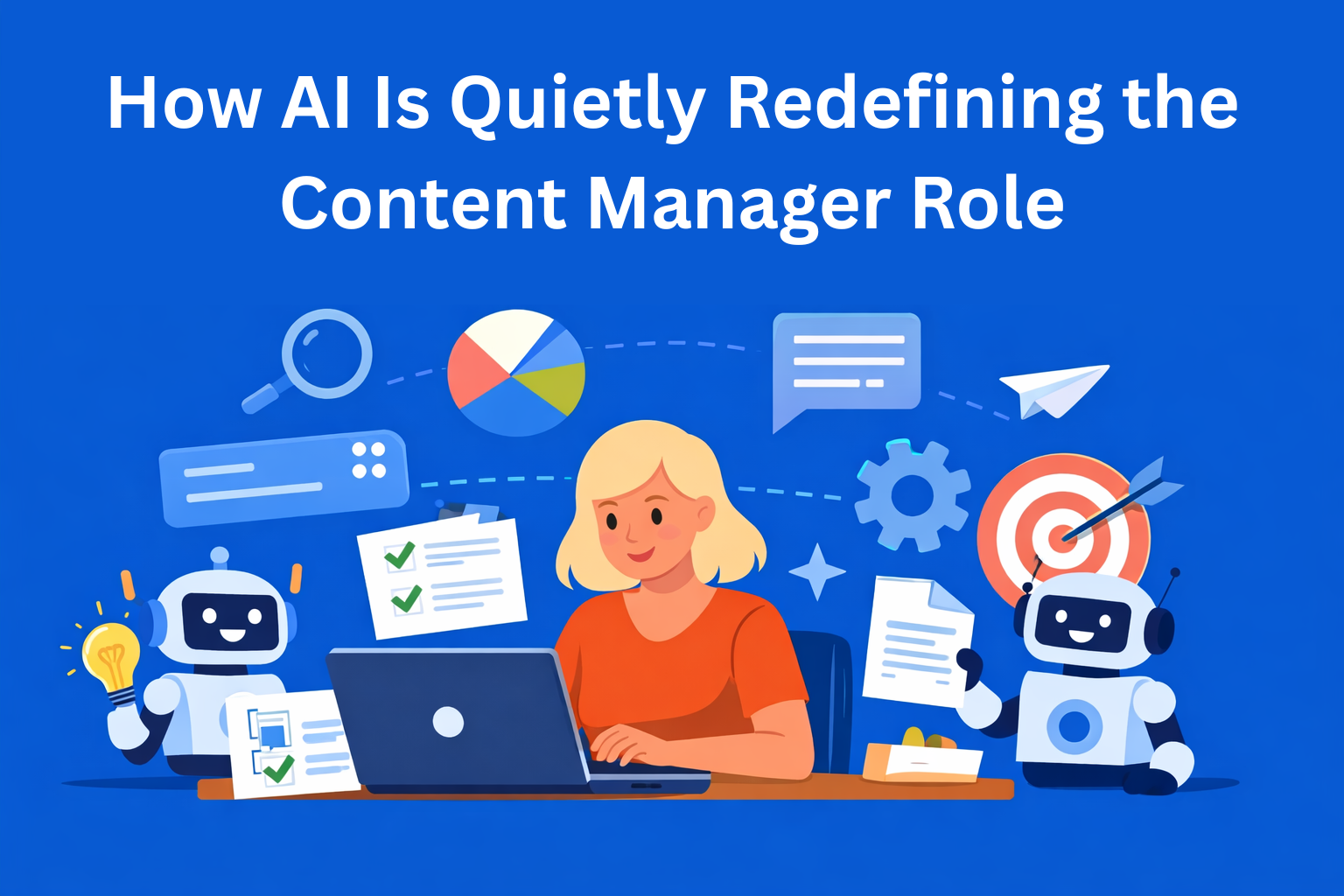
AI did not suddenly arrive and replace content managers. There was no single clear moment when this role stopped being relevant; instead, the change happened gradually. Step by step, task by task, AI started taking over certain parts of the work. Because of that, the content manager role shifted.
Today, many content managers feel that something has changed, even if they cannot immediately explain what it is. They spend less time writing content from scratch and more time reviewing it, guiding it, and organizing the work around it. This is not a step backward. On the contrary, in most cases it is a step forward. AI moves content managers away from repetitive operational tasks and closer to real ownership of the entire content process.
In this blog, I will explain how AI in content management is changing day-to-day work, which responsibilities are becoming less important, which ones are gaining importance, and why managing context, quality, and workflow has become the core of this role.
Key Takeaways
- AI didn’t replace content managers - it reshaped the role by moving focus from writing drafts to guiding, reviewing, and organizing content.
- Decisions matter more than writing speed - value now comes from setting direction, refining output, and ensuring relevance.
- Managing context is critical - clear briefs, templates, and style guides help AI produce content that fits the audience and goal.
- Human quality control is non-negotiable - clarity, accuracy, tone, and strategic alignment still require human judgment.
- Content managers become workflow owners - structure and ownership keep fast AI-driven production from turning into chaos.
What the Content Manager Role Used to Look Like
Before AI tools became common, the content manager role was primarily operational. Most of the day was spent writing, editing, and handling small details. Content managers often wrote blog posts themselves, polished other people’s texts, fixed formatting, and manually tracked deadlines.
They had to make sure content was written on time, posts were scheduled, and feedback and changes from different stakeholders were properly applied. In many teams, content managers were also the main content creators.
This way of working made sense because content production was slower. Writing a single blog post required time and focus. There was not a large volume of content being produced at once, so it made sense for one person to be involved in every step. The content creation process was simple, clear, and predictable. AI changed this significantly.
Where AI Entered Everyday Content Work
AI did not enter content teams as a replacement for people. It entered as a helper. At first, it was used to generate ideas, outlines, or first drafts. For example, in tools like EasyContent, AI is embedded directly into existing projects, templates, and workflows, which means content is not created “outside the system,” but in the same place where it is reviewed and approved. Over time, it became normal to use AI to rewrite parts of text, shorten content, or adapt the same content for different channels.
This significantly sped up content production. A single content manager can now oversee much more work than before. However, speed also introduced a new problem. When output increases, complexity increases as well. Suddenly, there are more drafts, more versions, and more decisions to make.
At that point, many teams realize that AI content workflows require clearer structure, not more freedom. If processes are not clearly defined, AI simply creates a bigger problem instead of delivering better results.
Tasks That Are Becoming Less Important
One of the biggest changes is that writing the first draft is no longer the most valuable skill of a content manager. AI can handle that part reasonably well. It can produce an acceptable starting version in just a few seconds.
Other tasks are also losing importance. Manual formatting, repeatedly rewriting the same sentences, and endless back-and-forth over small edits no longer justify a content manager’s time. These activities still exist, but they are no longer where real value is created.
This does not mean writing skills have become irrelevant. On the contrary, they are still essential. But instead of writing everything themselves, content managers now focus on
- improving,
- shaping, and
- guiding AI-generated content.
The role shifts from creator to editor. In modern AI-driven content teams, value comes from decisions, not from typing speed.
Responsibilities That Are Becoming More Important Than Ever
As some tasks fade into the background, others move to the forefront. The most important change is responsibility. Content managers today are no longer responsible only for producing content, but for its overall quality and direction.
They decide what content should exist, why it exists, and who it is for. They create briefs that give AI and writers the right context. They make sure content aligns with business goals, audience needs, and brand tone.
Because of this, content management with AI is less about tools and more about thinking. EasyContent is a good example of this approach, since AI operates within clearly defined templates, guidelines, and approval processes instead of producing content without context. AI follows instructions. If the instructions are unclear, the output will be unclear as well. The content manager becomes the person who defines those instructions clearly and precisely.
Managing Context: The Most Underrated Skill
Context includes the audience, the goal, the tone of communication, and the stage of the user journey. Humans understand context naturally. AI does not.
If you tell AI to “write a blog post,” it will do exactly that, but without understanding why the text exists or who it is meant for. That is why briefs, templates, and style guides become a crucial part of the process, because they store all the information needed to create content: who the audience is, what the brand voice sounds like, and what the goal of the content is. When all of this lives in one place, as it does in EasyContent, content managers have far less to worry about. This is why managing context has become one of the most important skills in AI content management.
Today, content managers spend more time explaining the background before content is written at all. They define what problem the content solves, what the reader already knows, and what action should come next. The clearer the context, the better the result.
Quality Control in an AI-First Environment
AI can generate large amounts of content very quickly, but it does not understand whether something is truly useful, accurate, or strategically aligned. That responsibility remains with humans.
Because of this, quality control becomes a central part of the content manager role. Reviewing AI-generated drafts is not about fixing grammar. It is about checking clarity, relevance, and intent. Does the content answer the right question? Does it actually provide value?
In AI-driven content workflows, human review is not optional. EasyContent, for example, uses AI as an assistant that suggests changes, while the content manager retains full control. They review the content, compare versions, and ultimately decide whether the text is ready. That step is what turns fast AI output into high-quality content.
Workflow Ownership as a Core Responsibility
As AI speeds up production, workflow becomes increasingly important. Without clear steps, content quickly turns chaotic. Drafts pile up, feedback gets lost, and no one is sure what is ready to be published.
At that point, content managers take on a new role: workflow owners. They define how content moves from idea to draft, through review, and finally to publication. They decide who is involved at each stage and what it actually means for something to be “done.”
From Content Producer to Process Architect
In the past, success was measured by how much content one person could produce. Today, success is measured by how well the entire system works. Content managers set up processes that help teams grow while keeping content consistent.
They think about how work can be repeated without constantly explaining the same things. They document rules and create simple templates and standards that make writing and reviewing content easier. In this way, content managers gradually take on the role of people who build the process.
This shift is natural. As AI takes over task execution, people focus more on how the overall system works. The content manager role moves away from individual output and toward long-term, sustainable content processes.
What This Means for Content Teams in the Future
Content teams will continue to change as AI becomes more present. Roles may become more specialized. Writers will focus more on research and insights. Content managers will coordinate strategy, quality, and workflow.
Successful teams will be the ones that use AI as part of everyday work, not as a shortcut. Clear processes, solid documentation, and clear ownership will become the norm. In that environment, the content manager will often be the person connecting everything.
Understanding AI in content management is no longer an extra skill. Today, it is the foundation for normal operation in modern content teams.
Conclusion
AI has removed a large portion of repetitive tasks from content work. What remains is the most important part: thinking, decision-making, and guiding content. This change has not reduced the role of the content manager. On the contrary, it has made their real value clearer.
The future of content managers is not about writing faster, but about managing context, quality, and the entire workflow more effectively. AI helps with execution, but people still make decisions and give meaning to content.
That is why AI did not quietly replace content managers. It quietly showed why they are still essential.