How AI Reduces Decision Fatigue in Content Teams
Content teams don’t burn out from writing too much, but from making too many decisions. This article explains how AI reduces decision fatigue by removing small, repetitive choices from content workflows, helping teams work with more clarity, focus, and consistency.

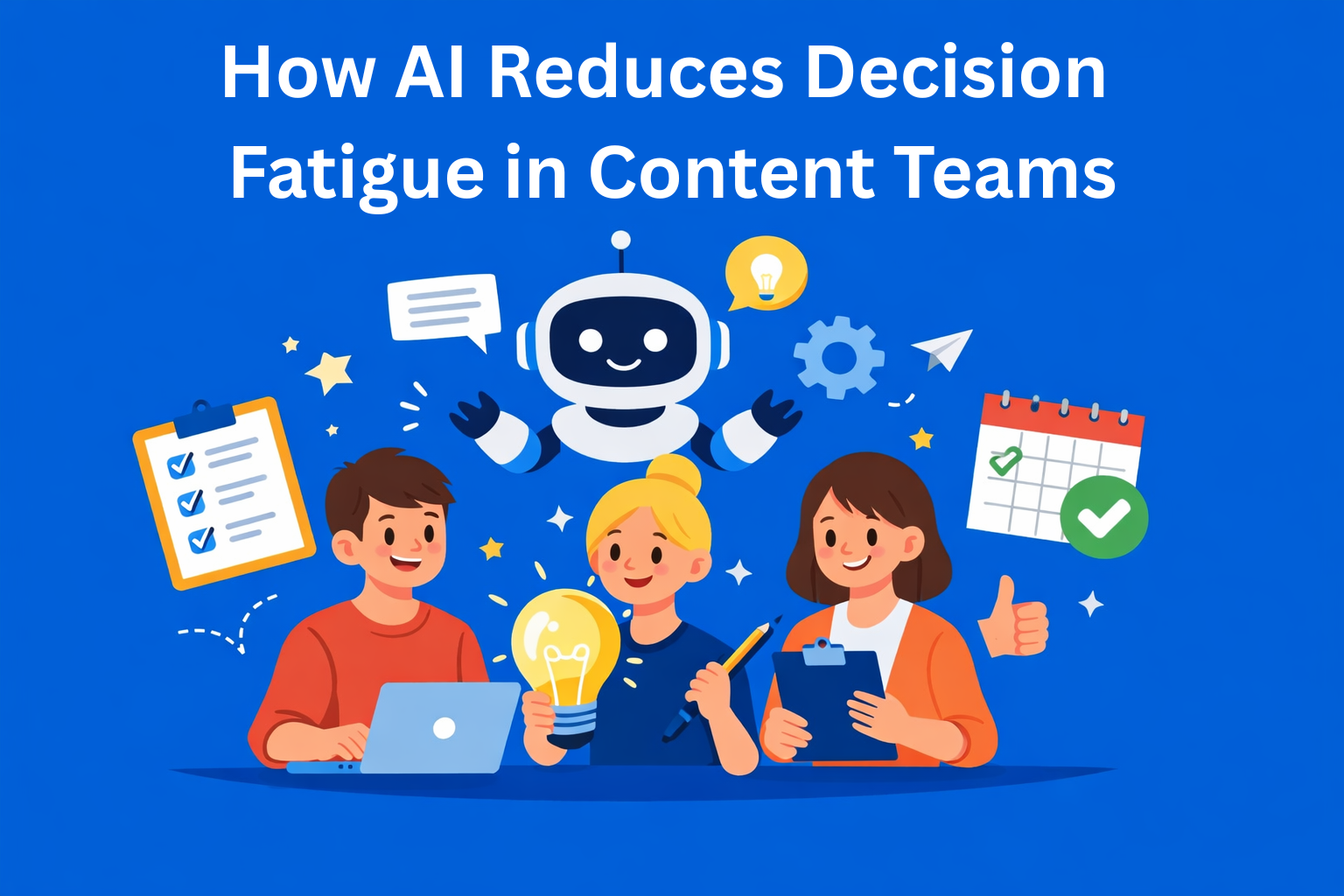
Most content teams don’t feel tired because they write too much. The fatigue comes from having to make too many decisions.
Every working day is filled with small choices. What should we work on next? Is this good enough to send for review? Who needs to see this content? Should we change the headline or leave it as it is? None of these decisions is big on its own. But together, they slowly drain focus and energy.
This is where decision fatigue appears in content teams. And this is exactly where AI in content workflows can make a real difference.
Key Takeaways
- Decision fatigue comes from constant micro-decisions - not from writing itself, but from repeatedly deciding what to do next, who’s involved, and whether something is “done.”
- Creativity suffers when energy is spent on operations - switching between creative thinking and procedural choices quickly drains focus and motivation.
- AI reduces fatigue by creating clarity, not speed - when embedded in workflows, AI helps teams understand context, next steps, and status without extra thinking.
- AI should remove low-value decisions - outlines, structure, status visibility, and summarized feedback are better handled by systems, not people.
- Less decision noise leads to better content - when teams save mental energy, they produce clearer, more consistent, and higher-quality work.
A typical day in a content team
The day usually starts with good intentions.
You open your task list. Several pieces of content are waiting. A blog draft, a social media post, maybe an email campaign. The work is there, but before you write a single sentence, you already start thinking:
- What should I work on first?
- Is this brief clear enough?
- Do I need to check something with the team before I continue?
You still haven’t written a single sentence, yet you’ve already made several decisions. As the day goes on, this continues.
You move from task to task. You reply to messages. You review comments. You make small edits. You constantly evaluate whether something is good enough or needs another round of changes. By the end of the day, the work may be done, but you are mentally exhausted.
This isn’t a motivation problem. This is a decision fatigue problem.
What decision fatigue really looks like in content work
Decision fatigue doesn’t look dramatic. It shows up quietly. You start postponing tasks that should be easy. You read the same paragraph over and over again. You feel blocked, even though you know the topic well.
In content teams, this happens because the work is full of constant micro-decisions. Not creative decisions, but operational ones.
For example: what status the content is in, whether it’s a draft or a final version, who should review it next, and how much feedback is “enough.”
Each decision uses a small amount of mental energy. When there are too many of them, fatigue builds up quickly.
That’s why many content teams feel busy all the time, yet still feel like they are constantly behind.
The real problem isn’t creativity
When content teams run into problems, creativity often gets the blame.
You hear things like:
- “We’ve run out of ideas.”
- “We need better writers.”
- “We need more inspiration.”
But in many cases, creativity isn’t the problem at all.
The real issue is that creative energy is spent on decisions that shouldn’t require creativity.
Deciding how to shape a message for an audience is creative work.
Deciding where a file lives or who approves it is not.
When content teams are forced to constantly switch between these two ways of thinking, decision fatigue grows very quickly.
Why adding more process often makes things worse
When teams feel overwhelmed, the first reaction is usually to add more meetings, more rules, or more documentation.
The intention is good. Everyone wants clarity. But without the right support, this often creates even more decisions.
People now have to decide which document is the latest, which rule applies in a given situation, and whether something is an exception. Instead of relieving the team, everything becomes heavier.
Content teams don’t need more things to think about. They need fewer decisions they’re forced to make.
Where AI fits into this picture
Many people think the main role of AI is to help them write faster.
But the biggest benefit of AI for content teams isn’t speed. It’s clarity.
That means AI shouldn’t be a separate tool on the side, but part of the actual work process. For example, in the kind of setup EasyContent uses, AI features are built directly into content workflows, templates, and approval flows, not added afterward.
When AI is used properly, it helps answer questions like:
- what the next step is
- what already exists
- what usually works in this situation
In this kind of system, AI can provide context directly inside the content itself, without jumping between documents, messages, and tools, an approach EasyContent follows in practice.
This alone can reduce decision fatigue more than most teams expect.
AI as a guide, not a decision-maker
The core idea is simple.
AI shouldn’t decide what matters. It should decide what doesn’t.
For example, AI can:
- suggest a blog structure
- help you start immediately instead of facing a blank page
- briefly explain the context without extra searching
This is visible through AI features like AI Writer and AI Editor, which within the EasyContent platform help from zero to a first draft, and later with editing and optimization, all within the same workflow.
This removes the initial block and makes it easier to get started. Instead of asking “Where do I begin?”, content teams can move straight to “Is this good?”
That single shift saves a significant amount of mental energy.
Small decisions AI can take off your plate
Many decisions in content workflows are repetitive.
They happen again and again, almost in the same way.
AI can help with things like:
- suggesting a tone or format that makes the most sense
- summarizing comments into clear next steps
- clearly showing a content item’s status without manual tracking
Within EasyContent, all of this happens directly on the content you’re working on. Templates clearly show what needs to be written and in what order, AI helps fill in or refine parts of the text as you write, and approval statuses clearly show whether content is in progress, under review, or ready to be published. Because of this, there’s no guessing, no extra questions, and no manual tracking, the system removes those small, repeated decisions on its own.
What still requires human decisions
Not everything should be automated.
Content strategy, priorities, and audience understanding must remain human responsibilities.
AI can help in these areas, but it can’t fully understand context, nuance, or long-term goals.
People still need to decide which topics matter most, what fits the brand’s tone, and what makes sense for the audience.
The goal isn’t to make fewer decisions overall, but to stop wasting energy on decisions that don’t have real impact.
The long-term impact on content quality
When there’s less decision fatigue, work quality naturally improves.
Mental energy is no longer spent on small operational choices, but stays available for thinking, editing, and improving ideas. Content becomes more consistent, messages clearer, and collaboration easier because expectations are shared and understood.
AI doesn’t create better content on its own, but it helps create the conditions where good content can exist.
AI as a noise filter
A useful way to think about AI in content teams is as a filter.
It removes uncertainty around routine tasks, highlights what needs attention, and hides what doesn’t. When that happens, people don’t feel rushed, even when deadlines exist. They feel guided.
Conclusion
For content teams, working faster isn’t the most important thing. Working with clarity is.
Decision fatigue is one of the biggest hidden problems in modern content work. It slowly drains energy, focus, and motivation.
AI helps by reducing the number of decisions competing for attention.
Not by replacing people, but by supporting them.
When clarity increases, better focus, collaboration, and content follow naturally.