How Content Loses Value After It’s Published
Publishing content isn’t the end of the job, it’s just the beginning. Over time, blog posts can lose value due to neglect, outdated information, and lack of ownership. Learn how to maintain, update, and reuse your content to protect long-term SEO performance.

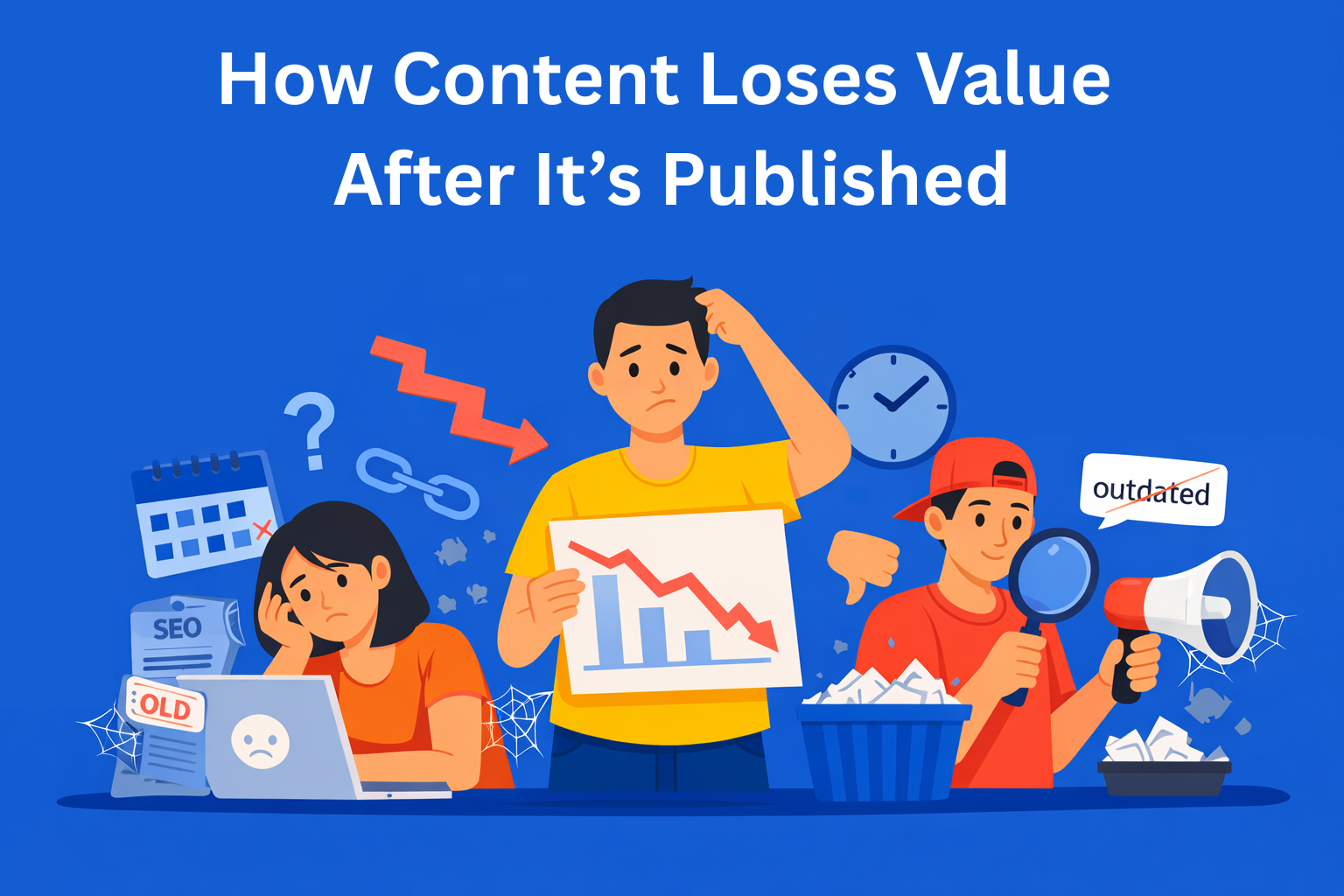
When you publish a piece of content, it feels like you’ve completed something big.
You come up with a topic. You write the text. You edit it. You add images. You adjust it a bit for SEO. And in the end, you click “publish.” And you think that’s it, it’s done.
But in reality, that’s when the real work begins. When you publish content, it’s not the end of the story, but the beginning of a new part of the process. And that’s exactly the part many teams completely skip.
When a piece of content goes live and becomes available to everyone, sometimes it immediately grows. But much more often, little by little, it starts losing value.
In this blog, we will talk about how content loses value after it’s published, why this happens, and what you can do to protect your content marketing efforts in the long run.
Key Takeaways
- Publishing is only the beginning - content starts its real lifecycle after it goes live, and value depends on what happens next.
- Content decay happens gradually - rankings drop, competitors update, and outdated information slowly makes your page less relevant.
- Neglect and unclear ownership reduce impact - without regular maintenance and clear responsibility, even strong content loses performance.
- Outdated details damage credibility - broken links, old statistics, and irrelevant examples weaken trust and SEO authority.
- A lifecycle approach protects long-term value - measure, update, reuse, merge, or remove content to keep your strategy strong over time.
Publishing Is the Beginning, Not the End
Most teams think the most important thing is simply to keep producing new content. They constantly push out new blog posts, landing pages, videos, and social media posts.
But content has its own lifecycle.
It doesn’t stop living once you publish it. That’s actually when it starts showing what it can really do.
If no one looks at it, updates it, or refreshes it from time to time, even a good piece of content slowly starts to weaken. Fewer people visit it. It gets read less. And in the end, it brings fewer results.
That’s how content marketing slowly loses strength, not because the text was bad, but because no one maintained it or kept track of it.
Content Rarely Fails Overnight
When content starts losing value, it doesn’t happen all at once. There’s no big crash overnight.
A text that used to rank well on Google slowly begins to drop. Meanwhile, competitors update their articles and add new data. New tools appear, trends change. And then your text, which once was really useful, starts to look like it’s a bit behind the times.
The content is still there. It still looks fine. But it’s no longer as useful.
Search engines give priority to updated information. Readers trust newer statistics more than old numbers. If your SEO content stays the same while the world around it changes, it becomes less relevant.
Content doesn’t disappear. It becomes invisible.
Reason #1: Neglect
One of the biggest reasons content loses value is simple, neglect.
Many teams follow a “publish and forget” approach. They focus on creating new texts instead of maintaining the existing ones.
Over time, small problems start to appear:
- Broken links
- Outdated screenshots
- Old statistics
- Mentioning tools that no longer exist
Each of these problems on its own may not seem serious. But when they pile up, people slowly lose trust in your website.
Neglect also affects how Google sees you. If a text stays the same for years while competitors regularly update and improve their articles, they will easily outrank you in search results.
Maintaining content doesn’t sound exciting. It’s not the creative part of the job. But that’s exactly what protects your strategy in the long run.
Reason #2: Lack of Ownership
Another problem that often slips by unnoticed is that no one actually has long-term responsibility for the text.
When a blog post is first written, it’s clear who stands behind it, a writer, an editor, someone from the team.
But what happens after six months?
- Who checks its performance?
- Who decides whether it needs an update?
- Who improves it if traffic drops?
Often, no one.
When it’s not clearly defined who is responsible for a text, it becomes “everyone’s concern,” but in reality, no one’s obligation.
And then nothing happens to it. It doesn’t change, it doesn’t improve, it just sits there as it was originally published.
When you assign one person to be responsible for a text, someone actually tracks whether it gets traffic, whether it ranks for keywords, and whether people read it. And that small change alone can prevent the text from losing value over time.
Reason #3: Outdated Information
Today, things change faster than ever.
In digital marketing, SEO rules change, AI tools improve, platforms constantly update their algorithms. Data from two years ago often no longer applies.
If old information stays in your text, people notice it quickly.
For example:
- “Best tools in 2023” in the year 2026
- Old pricing plans
- Features that no longer exist
- Outdated tactics
Even if the structure of the text is good, outdated details reduce credibility.
Search engines also prefer fresh content. Regular updates send a signal that your website is active and reliable.
Updating content doesn’t mean you have to rewrite everything. Sometimes small changes, new examples, refreshed screenshots, updated data, are enough to restore its value.
Reason #4: Missed Opportunities for Reuse
Another reason content slowly loses value is simply because we don’t reuse it.
One blog post can be used in many different ways:
- LinkedIn posts
- Newsletter sections
- Short videos
- Infographics
- Internal training materials
But many teams publish content once and that’s it.
If you publish a text and forget about it, it stays where it is and that’s the end of it. Not many people see it, and it easily goes unnoticed.
When you use one text in multiple places, it lives longer. More people see it. And in the end, it brings you much more value than if it had remained just a single blog post.
If you’re already investing time in creating content, it makes sense to adapt it for different formats and channels.
The Hidden Cost: Content Debt
When a text is neglected, becomes outdated, and no one tracks it, another problem appears, accumulated content clutter.
It’s like constantly postponing small repairs in your house.
Nothing seems serious on its own, but when ignored for too long, everything starts piling up and turning into a bigger problem.
Over time, your website becomes filled with:
- Duplicate topics - you write multiple texts about the same thing without even realizing it. Instead of having one strong and clear article, you have several weaker ones competing with each other.
- Shallow articles - texts written just to “fill the blog,” without deeper explanation or real value. People read them and leave because they didn’t get a real answer.
- Conflicting information - one text says one thing, another says something completely different. The reader gets confused and no longer knows what to believe.
- Low-performing pages - texts that barely get any traffic, don’t rank, and bring no results. They just sit on the website and create clutter.
Because of that, it becomes much harder later to review all your texts and organize them properly. It’s harder to optimize them for Google. And people who visit your site get confused more easily.
Instead of having a clean and well-organized blog, you end up with a pile of texts without order.
And once that kind of chaos builds up, it takes much more time and energy to fix everything than if you had maintained it little by little, but regularly.
Content Has Its Own Lifecycle
To prevent content from losing value, it’s important to understand its lifecycle.
A simple content lifecycle model looks like this:
- Creation
- Publishing
- Measuring
- Updating
- Reusing
- Merging or removing
Most teams stop at step two.
But real content strategy continues after publishing.
After publishing, you need to measure performance. Look at traffic, search rankings, and conversions. If the numbers are dropping, find out why.
Then update the content. Improve clarity. Add new information. Naturally optimize keywords.
Sometimes it’s smarter to merge two similar texts into one stronger and more concrete article. And sometimes it’s completely fine to delete what is outdated and no longer serves a purpose.
When you look at content as something that constantly grows and changes, you start treating it differently, not as something finished, but as something that needs ongoing care.
How to Protect Content From Losing Value
The good news is that content decay can be prevented.
Here are simple steps any content team can apply.
1. Assign Clear Ownership
Every important text should have one person responsible for it.
That person checks whether the text gets traffic, whether it brings results, and when it’s time to improve or refresh it.
When it’s clear who is responsible, the text is taken care of. And when it’s taken care of, it keeps its value.
2. Plan Regular Content Audits
You don’t have to review everything every month.
A quarterly or bi-annual content audit is often enough.
During the audit, check:
- Traffic trends - look at whether the number of visits is growing, staying the same, or slowly declining. If you see a drop, it’s a sign that the text may no longer be as interesting or relevant as before.
- Keyword rankings - check whether the text still appears on Google when people search for important terms. If it has dropped to lower positions, competitors have probably surpassed it with better or fresher content.
- Accuracy of information - read the text and ask yourself whether the data, examples, and advice are still up to date. If something is no longer valid, it’s better to fix it than let people read outdated information.
- Broken links - click on the links in the text and make sure they work. If they lead to pages that no longer exist, it leaves a bad impression on both readers and Google.
Small changes during audits can significantly improve SEO performance.
3. Watch for Signs of Decline
Pay attention to warning signs:
- Gradual traffic decline - if you notice that a text is getting fewer visits month after month, it’s a sign something is wrong. It usually means competitors are overtaking it or that it’s no longer as interesting and useful as it once was.
- Lower CTR - if the text appears on Google but people click on it less often, the title or description may no longer attract attention. That means you may need to refresh it and make it clearer and more specific.
- Reduced engagement - if people land on the text but leave quickly and don’t stay long, it’s a sign they’re not getting what they expected. In that case, you should check whether the content is clear enough, useful enough, and up to date.
These signals show that your content needs refreshing.
4. Make Updates Part of Your Workflow
You shouldn’t think about content maintenance only when something goes wrong.
It’s better to decide in advance that updating and refreshing texts is a normal part of the job, just like writing new ones.
When planning new topics, set aside a bit of time to review older texts and improve them if needed.
5. Plan Reuse From the Start
When creating a blog post, think ahead.
Ask yourself:
- Can this become a LinkedIn post?
- Can it be turned into a newsletter?
- Can part of it help the sales team?
Planning reuse from the beginning extends the life of your content.
Conclusion
Writing new content feels like you’re constantly doing something and pushing forward. You see a new text, a new post, new results, and that gives you a sense of progress.
Updating and maintaining older texts is quieter and less visible. But real strength in content marketing doesn’t come only from constantly publishing something new. It comes from continually improving, refining, and strengthening what you’ve already created.
When you publish something, you’ve just opened the door.
If you maintain and improve it later, you can get much more out of that one text than you initially thought.
So don’t look at publishing as the end of the job.
Look at it as the beginning, as something you need to care for and that can keep bringing you results long after you clicked “publish.”