How Many Approval Stages Should Content Go Through? Finding the Right Balance
Too many content approval stages slow you down, kill momentum, and dilute your message. In this guide, learn how to build a content approval workflow that keeps quality high without sacrificing speed.

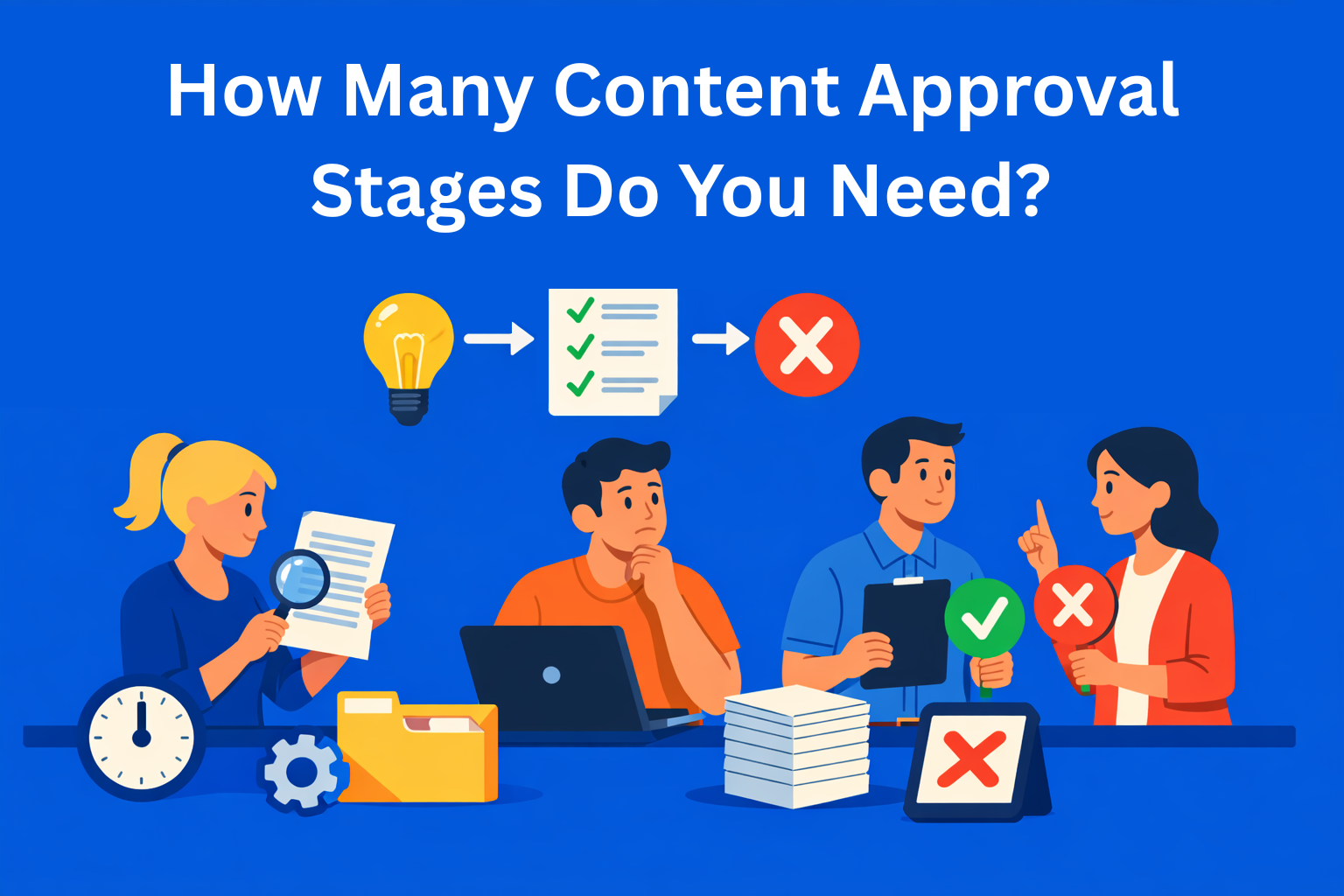
Your team writes a blog post. It’s good, clear, ready to publish. But before it goes live, it has to pass through five different people, a manager, legal team, marketing director, CEO, and one more “supervisor” who doesn’t even know why they’re involved.
And then what happens? The content sits for three weeks, loses its freshness, goes through so many edits that it ends up looking like something ten different people wrote, because they did.
This is the problem with having too many approval stages. But at the same time, too little control can lead to mistakes, wrong messaging, or even legal issues.
So, how many approval stages are actually enough? That’s what we’re going to break down in this blog.
Key Takeaways
- More approvals do not automatically improve quality - too many stages usually slow momentum, dilute the message, and create unnecessary frustration for the team.
- Two approval stages are enough for most content - a writer and editor workflow is usually the best balance between speed, quality, and brand consistency.
- The right number of stages depends on risk - content type, legal sensitivity, publishing frequency, and team size should define the workflow.
- Every approval stage needs a clear purpose - if two people are checking the same thing, one of those stages should be removed.
- Smarter workflows use categories and deadlines - separate approval paths for blogs, social posts, and high-risk campaigns keep content moving faster.
Why do approval stages even exist?
When a company publishes something, a blog, social post, or email, it’s not just text. It’s how the company communicates with people. And every word carries weight.
Approval stages exist for a few reasons:
- First, quality. Nobody is perfect. Every writer can make a factual mistake, miss a typo, or explain something incorrectly. A second pair of eyes always helps.
- Second, brand consistency. Every company has its own style, tone, and message. When someone reviews content before publishing, it makes sure everything that goes out sounds like your company.
- Third, legal protection. Some industries, like healthcare, finance, or law, need to be extremely careful with every word. One wrong claim can be costly.
The problem starts when these stages are done just for the sake of it. Everyone is approving something, but no one really knows what they’re checking. And the content just keeps going in circles for no real reason.
How do you know you have too many stages?
There are clear signs your content approval workflow has a problem.
Content waits for weeks. If you write something today and it can’t be published until next month, and it’s not a book or a serious legal document, something is off.
The same people approve the same thing twice. If a manager and a marketing director are reviewing the same things and saying the same stuff, you’re doing the same job twice for no reason.
Content changes so much it loses meaning. When a piece goes through five people and ends up sounding generic, it means it’s been over-processed.
The team is frustrated and demotivated. When writers see their work sitting for months, they lose motivation. And good content comes from motivated people.
If you recognize any of this, it’s probably time to rethink your content approval process.
What determines how many stages you need?
There’s no single right answer. The right number depends on a few key factors.
Type of content
It’s not the same whether you’re writing a tweet or preparing an annual report. A tweet can go through one or two checks, someone writes it, someone reviews it, and it gets published. But a serious document that goes to clients or the public needs a more careful review.
Different types of content require different levels of review. That’s logical, and it should be built into your process.
Industry and legal requirements
If you work in healthcare, finance, or law, you have less flexibility. There are regulations that require certain content to go through legal review before publishing. That’s not just bureaucracy, it protects both you and your audience.
But if you’re a digital marketing agency writing travel blogs, a legal team is probably not needed for every post.
Team size and company structure
If you have a small team of three to five people, there’s no way, and no need, to run a five-step process. In smaller teams, the writer and editor are often the same person, or there’s one person who reviews and approves everything.
In larger companies with multiple teams, it makes sense to have more steps, but even there, you need to know where to stop.
Publishing frequency
If you publish daily, on social media, blogs, or newsletters, your approval process needs to be fast. A long process for daily content will only slow you down and create unnecessary confusion.
On the other hand, if you publish once a month or work on large campaigns, you can afford a slightly longer process.
Common approval models, and when to use them
Let’s look at what this actually looks like in practice.
Model 1: Writer approves and publishes This only works in smaller companies where the writer is experienced and fully understands the brand. The risk is higher, but the speed is максимална.
Model 2: Writer + editor (2 stages) This is the gold standard for most blogs and social media posts. The writer creates the content, the editor reviews it, and it gets published. Fast, efficient, and enough control.
Model 3: Writer + editor + stakeholder or legal (3 stages) This model works well for campaigns, product-related content, or industries where legal review is required.
Model 4+: More than three stages This only makes sense for high-risk content, PR statements, crisis communication, product launches, or sensitive regulatory topics. Everything else with four or more stages probably has a problem with over-approval.
How to review and fix your current process
If you’re not sure where you stand, try this simple exercise.
Step 1: Map every step. Write down what happens to content from the moment the writer finishes to the moment it’s published. Every person, every email, every revision.
Step 2: Ask, what is each person actually checking? Is the manager reviewing grammar? Is the director checking the same things as the editor? If yes, that’s overlap.
Step 3: Measure time. How long does it take on average for a piece of content to go through all stages? If it’s more than a week for a standard blog post, something needs to change.
Step 4: Remove duplicates. Find where two people are doing the same job and decide who is responsible for what. Clear responsibilities remove unnecessary repetition in the approval process.
How to build a smarter workflow
Now that you know where the problems are, here’s how to fix them.
Create content categories. Not every piece needs the same process. Define it clearly: social posts follow one flow, blog posts another, press releases a third. This automatically speeds things up.
Set time limits. Every stage should have a deadline, for example, give everyone 24 hours to respond. Without a deadline, things just drag on forever.
Use parallel reviews where possible. Instead of the editor waiting on legal and then the manager waiting on the editor, let everyone review at the same time. This can cut time by 50% or more.
Give clear guidelines. Many reviews happen because writers aren’t sure what’s acceptable. Create a clear guide for tone, style, and topics, and you’ll see the number of revisions drop significantly.
Tools that can help
You don’t have to do everything manually. There are tools that automate your content workflow and make it easier to track where each piece is in the process.
Tools like EasyContent allow you to build your own workflow and track content stages, assign roles so everyone knows exactly what they’re responsible for, create customizable templates for any type of content, communicate in real time and much more.
This isn’t a luxury, it saves time and reduces stress for your entire team.
When to add, and when to remove a stage
Add a stage when:
- You’re publishing content on a new channel you’re not fully familiar with
- The topic is sensitive or carries legal risk
- You’re preparing a large campaign or product launch
Remove a stage when:
- The same person is approving something twice in a row
- The review is always just “looks good, publish it” with no real feedback
- Content is delayed because of a stage that doesn’t add real value
Conclusion
At the end of the day, the ideal number of approval stages is the one that protects quality, without killing speed.
There’s no magic number that works for everyone. A small team publishing daily operates very differently from a corporation preparing an annual report. And that’s okay.
What’s not okay is having a process just because “that’s how it’s always been done.” Every stage should have a clear purpose and a person who knows exactly what they’re checking and why.
A good content approval process isn’t the one with the most steps. It’s the one your team can easily follow, that protects quality, and allows you to publish without stress.