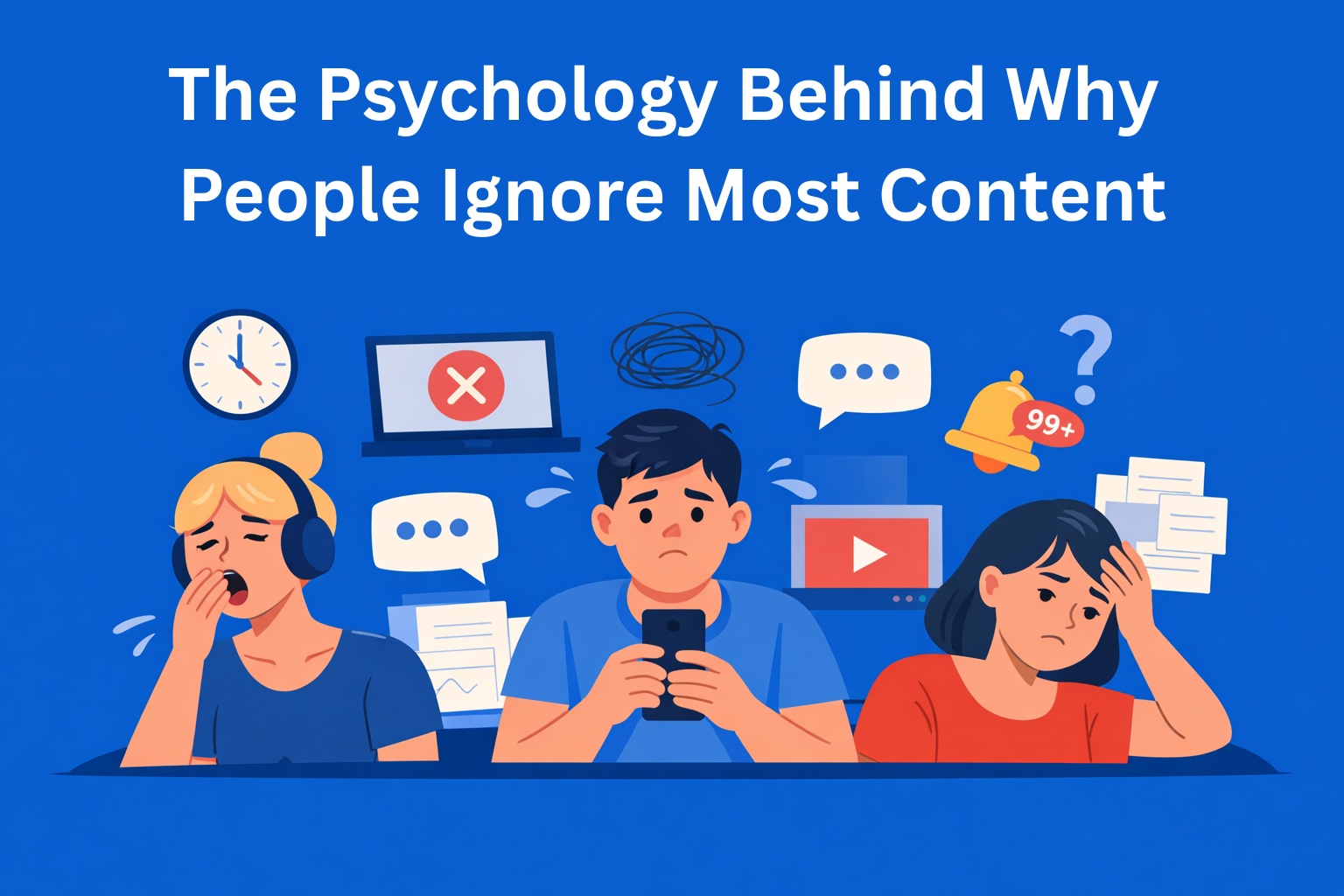
The Psychology Behind Why People Ignore Most Content
People don’t ignore content because it’s bad, they ignore it because there’s too much of it. This article explores the psychology behind why audiences skip most content, from attention fatigue to decision overload, and what content teams can do to actually earn attention.

There has never been more content in history than there is today. Every day people see thousands of posts, ads, blogs, newsletters, and videos. Social networks, search engines, and platforms constantly push new content in front of users.
At first glance, it might seem like the problem is that there isn’t enough content. But people today aren’t overwhelmed because content doesn’t exist, they’re overwhelmed because it exists everywhere and there is simply too much of it.
That’s why people in marketing today often talk about the attention economy. Simply put, there is too much content and user attention has become one of the most valuable resources.
Most content that gets published never actually receives real attention from the audience. People skip it, glance over it quickly, or completely ignore it.
In this blog, we will explain the psychology behind why people ignore most content. We’ll explain how people actually filter content, why their attention runs out quickly, and what content teams can learn if they want people to truly notice and read their articles.
Key Takeaways
- The internet is flooded with content - because thousands of posts, articles, ads, and videos appear every day, people must filter what they pay attention to.
- Attention fatigue limits how much people can process - when users see too much information in a short time, the brain automatically starts skipping most of it.
- The brain quickly recognizes familiar patterns - when content looks similar to things people have already seen many times, they often assume there is nothing new and move on.
- Trust and relevance determine whether content gets attention - audiences quickly judge if something feels useful, authentic, and worth their time.
- Great content earns attention instead of demanding it - clear value, simple writing, original ideas, and practical insights make people far more likely to keep reading.
The Modern Attention Economy
If we want to understand why people skip most content, we first need to look at what the internet and the digital world actually look like today.
Twenty years ago, content was limited. There were fewer websites, fewer blogs, and far fewer posts on the internet.
Today the situation is completely different.
Anyone can publish content:
- companies
- creators
- marketing teams
- influencers
- AI tools
All of that creates an enormous amount of information.
Because of that, people have to filter content, since they simply don’t have time to read everything they see.
That’s why ignoring content has become a normal reaction.
Because of this, content marketing today focuses more and more on how to capture people’s attention and keep it for at least a little longer.
Attention Fatigue: When the Brain Can’t Process Everything
One of the most important psychological reasons why people ignore content is called attention fatigue.
Our brain has a limited amount of attention during the day. When we are exposed to a large amount of information, mental fatigue appears, and this happens to almost everyone.
Think about how you use social media.
You scroll through a feed and see:
- dozens of posts
- ads
- video content
- articles
- comments
The brain simply doesn’t have the capacity to process all that information.
Because of this, people start to quickly scan content, read only headlines, and ignore most posts.
This directly affects content marketing. Even when content is good, people often skip it simply because they no longer have the energy or focus to pay attention to it.
Decision Overload: Too Many Choices
Another important psychological reason is decision overload.
During the day people make a large number of small decisions:
- which email to open
- which post to read
- which video to watch
- which link to click
When there are too many options, the brain looks for the easiest way to save energy. And very often the simplest solution is to ignore most of the content.
This is very important for understanding digital marketing. Audiences often don’t ignore content because it is bad, but because there are simply too many other options.
Because of this, a text needs to immediately show why it is worth reading, otherwise people will simply move on.
Pattern Recognition: The Brain Recognizes Patterns
The human brain is extremely good at recognizing patterns.
When we see content that looks similar to something we have already seen many times before, the brain quickly makes a decision.
For example:
- another "10 tips" article
- another generic marketing post
- another blog that sounds just like all the others
At that moment the brain often decides to skip the content. This happens even when the content itself is high quality.
If the structure, headline, or style looks too familiar, the audience may assume they already know what the article will say.
That is why many texts in content marketing receive very little attention even when they are well written.
Trust Filters: How the Audience Decides What Is Worth Reading
Today people see ads and promotional messages everywhere.
Because of that, over time they have learned to quickly judge whether something is worth reading or if it is just another text trying to sell them something.
So they often ask themselves:
- Is this honest?
- Is this just another advertisement?
- Does the author actually know what they are talking about?
If the content looks too promotional or generic, many people will automatically ignore it (you have probably done this yourself at some point).
Trust is a key factor. Audiences pay attention to content that feels authentic and genuinely useful.
Mental Shortcuts: Quick Decisions About Attention
Because there is too much information, people use so‑called mental shortcuts.
These are quick decision-making processes that help the brain filter content without thinking too much.
When someone sees a new article or post, the brain evaluates within a few seconds:
- does this have anything to do with me
- does it come from a source I can trust
- does it look interesting enough
If the answer is not clear, the content gets skipped.
That is why first impressions are extremely important in content marketing. The headline, introduction, and structure often determine whether someone will continue reading.
What Content Teams Often Get Wrong
Many marketing teams try to solve the attention problem in the wrong way.
The most common reaction is to produce even more content.
They think that if they publish more articles, there is a greater chance that at least one of them will be noticed.
But it doesn’t really work as simply as it sounds.
More content also means:
- more competition, the more people publish content, the harder it is for your article to stand out and get noticed
- more noise, when everyone constantly publishes something, the internet becomes full of information and it becomes harder for people to recognize what is actually worth reading
- even more audience fatigue, when people see too many posts, they simply get tired and start automatically skipping most content
That’s why it is much smarter to focus on making content that is high‑quality, clear, and genuinely useful to people, instead of just publishing as many articles as possible.
How Content Teams Can Earn Attention
Today, when there is too much information everywhere around us, you can’t just demand people’s attention, you have to earn it.
There are several simple things that content teams can do to increase the chances that people will actually notice and read their content.
Clear relevance
The audience needs to quickly understand why the content matters to them. In other words, the moment someone opens an article or sees a post, it should immediately be clear what they can gain from it.
If a reader doesn’t see the value right away, they will most likely continue scrolling. People today decide very quickly whether something is worth their time, and if you don’t show them within the first few seconds why it’s useful, they will simply move on to the next piece of content.
Original perspective
Content that brings a new idea or a different perspective on a topic attracts attention much more easily. When someone reads something they have already heard a hundred times, the brain immediately assumes there is nothing new there and people simply move on.
That is why audiences often ignore articles that sound exactly like everything else.
Specific insights
General advice is everywhere on the internet today. Wherever you go, you can see the same sentences like "be consistent" or "create quality content".
The problem is that this kind of advice often doesn’t tell people what they should actually do in practice. That’s why people value concrete examples and practical insights much more.
When someone shows a real example from practice or explains exactly how something works step by step, readers understand the topic much more easily. Content like that feels more useful because people can immediately imagine how they could apply it in their own work or project.
Simple and clear writing
Content that is easy to read has a much better chance of holding people’s attention. When people open a text online, they usually don’t read every sentence slowly like they would in a book, but instead quickly scan the text looking for key information.
If the text is complicated, full of difficult words or very long sentences, people get tired quickly and simply close it.
For example:
- "Headline optimization requires a strategic approach that involves understanding audience psychology and principles of attention capture."
- "If you want a better headline, write something that will immediately grab people’s attention."
The meaning is the same, but the second sentence is much easier to understand. When people quickly scan text online, they are far more likely to understand and remember a simple sentence than a complicated one.
Conclusion
Today it is completely normal for people to skip or ignore most of the content they see online.
This doesn’t mean every article is bad. People are simply surrounded by an enormous amount of information from all sides, so they have to choose what they will read and what they will skip.
When there is too much content everywhere around us, the brain simply has to quickly decide what is worth paying attention to and what can be ignored.
That’s why successful marketing and content teams today don’t just try to produce more content.
Instead, they try to create content that is clear, useful, and different.
In a world where everyone constantly publishes something new, the most important thing is not who publishes the most content, but who creates content that actually holds people’s attention.