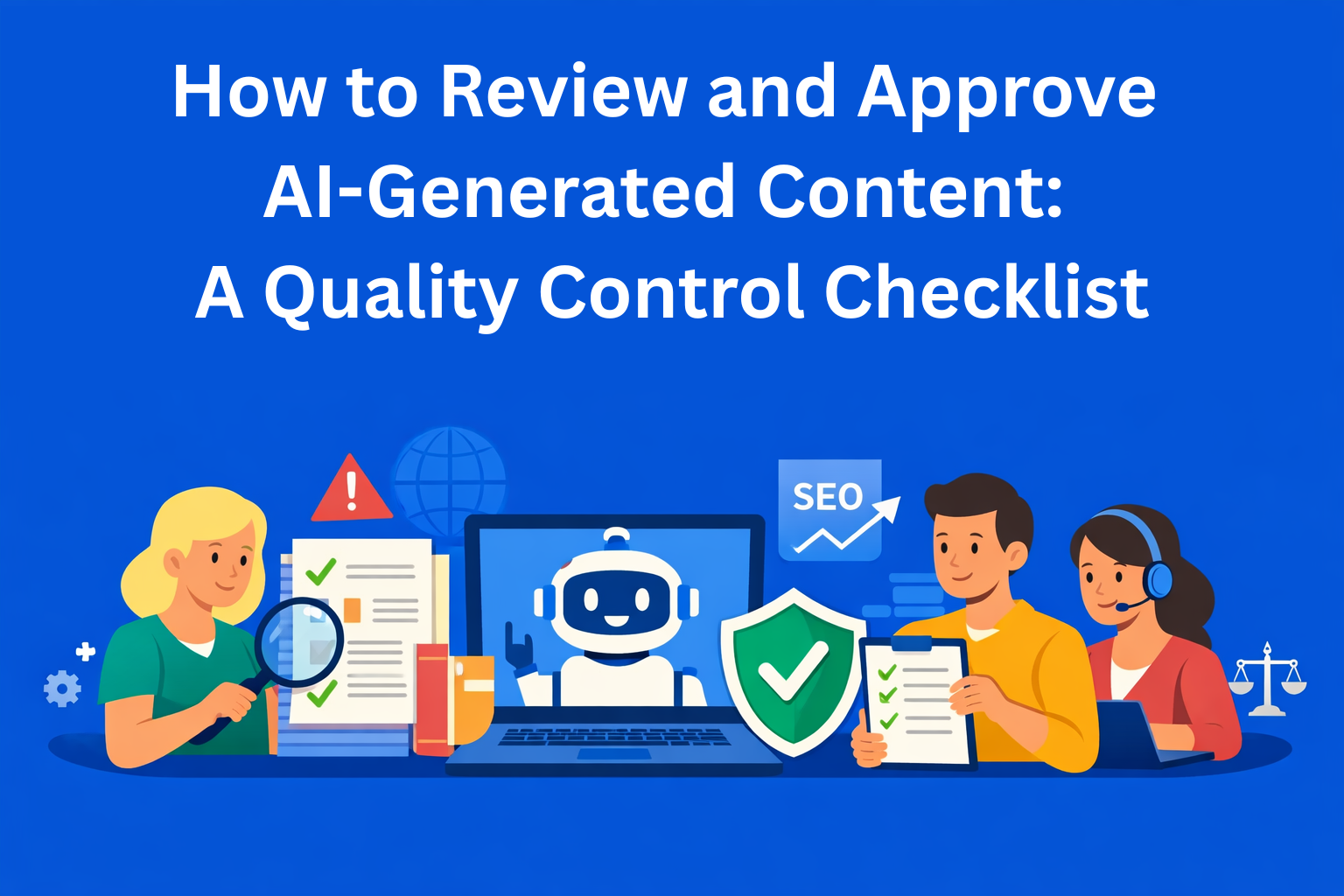
How to Review and Approve AI-Generated Content: A Quality Control Checklist
Learn how to review AI-generated content with a simple, practical checklist. Improve accuracy, tone, SEO, and originality, avoid costly mistakes, and build a repeatable approval workflow that keeps your content trustworthy and on-brand.

More and more companies and freelancers are using artificial intelligence to create texts, blog posts, product descriptions, and emails. AI writing tools have become part of everyday work. And it makes sense why - they are fast, affordable, and can generate text in just a few seconds.
But this is where the problem begins.
AI does not know who you are, what your company stands for, or whether the information it just wrote is accurate. It can invent statistics, misquote sources, or produce text that sounds like it was written by a robot. And if no one checks it before it goes live on your website or reaches your customers - the mistake goes through.
That is why you need a system. A simple, practical process for reviewing AI-generated content that you can use every time, whether you work alone or in a team.
In this article, we will walk through that entire process - from why review is necessary to a concrete checklist of things you need to verify before you click "publish."
Key Takeaways
- AI content always needs human review - speed is useful, but without fact-checking, tone alignment, and legal review, mistakes can easily damage trust.
- Accuracy comes before everything else - verify every claim, statistic, source, date, and link before the content goes live.
- Use a 6-point quality checklist every time - check accuracy, tone, SEO structure, originality, readability, and compliance before approval.
- A clear approval workflow prevents missed errors - define who edits, who fact-checks, who approves, and when content should be regenerated instead of fixed.
- The real advantage comes from repeatable systems - style guides, standardized checklists, and prompt improvements turn AI content review into a scalable workflow.
Why AI content still needs to go through human hands
Imagine you hired an intern who writes incredibly fast, but has never heard of your company, has never read your website, and occasionally makes things up - while being completely confident about it.
That is roughly how AI works.
AI gets facts wrong. This phenomenon is called a "hallucination" - AI simply makes up a number, name, date, or source and presents it with full confidence. If you do not verify it, the reader will take it as truth.
AI does not know how you communicate. Every company has its own tone - some are casual and direct, others are formal and professional. AI will not automatically match your style unless you explicitly tell it how to write.
AI copies patterns. Content generated by AI often sounds similar across different pieces. It is filled with generic phrases like "In today’s fast-paced world..." that do not say anything meaningful and are boring to read.
So, AI-generated content is a great tool for speeding up work - but without quality control, it can harm your brand more than it helps.
Before you start reading the text: preparation is half the job
Before you take an AI-generated text and start reviewing it, ask yourself three questions:
1. Do you know what you asked the AI to do? If you did not have a clear brief - topic, tone, target audience, keywords - it is difficult to evaluate whether the text is good. Without criteria, every text looks acceptable.
2. Who needs to approve this text? For simple content, one editor may be enough. For specialized topics (health, legal, finance), someone with domain expertise needs to review it. Define roles in advance.
3. What tools are you using? It is useful to have at least basic tools - something for grammar checking, something for plagiarism detection, and maybe an SEO tool. We will talk more about tools later in the article.
AI content review checklist: 6 things you must always check
This is the core of the article. Every time you receive AI-generated content, go through these six categories.
1. Accuracy of information
This is the number one priority. Before anything else - are the facts in the text accurate?
- Check every statistic. If AI says "73% of companies use X," look for the source. If there is none - remove it or find the correct data.
- Check names, dates, and company names. AI often mixes up details.
- Check links. AI sometimes includes links that do not exist or point to the wrong pages.
The rule is simple: if you cannot verify a claim from a reliable source, do not publish it. Content accuracy is the foundation of trust with your audience.
2. Tone and writing style
Does the text sound like you - or like a generic blog on the internet?
- Read the text out loud. If it sounds off to you, it will sound off to the reader as well.
- Remove clichés. Phrases like "In a rapidly changing world" or "It has never been more important" are overused and do not add value.
- Adjust the language. If your audience is young entrepreneurs, write directly and informally. If it is corporate managers, the tone can be more formal.
AI-generated content that does not match your brand voice feels cheap, even if the information is correct.
3. SEO and content structure
If you are writing for a website or blog, the content must also be searchable. But SEO optimization is not just about stuffing keywords everywhere.
- Are keywords included naturally? If AI has forced them into every sentence, it looks bad and search engines may penalize it.
- Do headings (H1, H2, H3) follow a logical structure? The text should be organized like a book - introduction, sections, conclusion.
- Is there a meta description? This is the short text that appears in search results - AI often skips it or writes a weak one.
- Are links relevant? Internal links (to your own content) and external links (to reliable sources) support SEO.
4. Originality of the content
AI learns from existing content on the internet. Sometimes that means it can unintentionally replicate parts of existing texts.
- Run the text through a plagiarism checker (Copyscape, Originality.ai, and similar tools).
- Ask yourself: does this content bring anything new? Or is it just repeating what already exists on dozens of similar websites?
Original content is what sets you apart from competitors. If AI creates a copy of someone else’s content, you risk legal and reputational issues.
5. Readability and content flow
Good content is easy to read - it feels like someone is talking to you, not lecturing you.
- Are sentences too long? AI tends to write long, complex sentences. Shorten them.
- Are there smooth transitions between sections? The reader should understand why you are moving from one topic to another.
- Is the call to action (CTA) clear? At the end of the text, the reader should know what to do - sign up, read more, or contact you.
Content readability directly affects how long someone stays on your page.
6. Legal and compliance checks
This is something many people skip - and that is a mistake.
- Does the content include medical, legal, or financial advice without proper disclaimers?
- Are you using images, quotes, or materials without permission?
- Is the content compliant with regulations in your industry?
This is especially important if you operate in sensitive industries. AI does not understand regulations - you do.
What the approval process looks like step by step
Once you have a checklist, you also need a workflow - who does what and in what order.
Step 1: AI generates a draft based on your brief.
Step 2: An editor reviews the content using the checklist and marks what needs improvement.
Step 3: If the topic is specialized, a subject matter expert verifies accuracy.
Step 4: The final version gets approved - or goes through another revision.
Step 5: The content is published.
It sounds simple, but the key is that each step has a clear owner and responsibility. When everyone assumes "someone else checked it" - no one actually did.
When to discard the text and start over
Sometimes editing is not enough. There are situations where it is better to regenerate the content from scratch than to spend hours fixing a poor draft.
Discard the text and regenerate it if:
- It contains more than two or three factual errors - this means AI did not understand the topic properly.
- The tone is so off that you would need to rewrite every sentence.
- A plagiarism checker shows a high level of similarity with existing content.
- The structure is completely chaotic and does not follow the logic of the topic.
Do not get attached to a text just because AI has already generated it. Your time is more valuable than fixing a bad draft.
Tools that make review easier
You do not have to do everything manually. Here are some tools that help with reviewing AI-generated content:
- Grammarly / Hemingway Editor - for grammar and readability
- Copyscape / Originality.ai - for plagiarism detection and AI detection
- Surfer SEO / Yoast - for SEO optimization
- Perplexity / Google - for quick fact-checking
- Readable.com - for readability analysis
These tools do not replace human judgment, but they significantly speed it up.
How to build a system that works long-term
If you work in a team or plan to regularly use AI for content creation, you need a system - not just once, but every time.
- Create a style guide - a document that defines how your company writes. Tone, vocabulary, what to avoid, examples of good and bad content.
- Standardize your checklist - put it in EasyContent, Google Docs, or wherever your team works. Everyone uses the same version.
- Track recurring mistakes - every time you notice the same type of error in AI-generated content, improve the prompt you are using.
- Educate your team - everyone should know their role in the process. Who checks accuracy, who approves tone, who gives final approval.
This approval system becomes valuable only when it becomes a routine - not something you do occasionally.
Conclusion
AI can save you hours of work. But the content published under your name - is your responsibility.
The good news is that reviewing AI-generated content does not have to be complicated. With a clear checklist, a defined process, and the right tools, you can quickly decide whether a piece is ready to publish - or needs more work.
Remember: AI writes fast, you write well. The combination of both is what creates content that people value and that delivers results.