SEO vs Social: Which Content Promotion Strategy Matters More?
Should you focus on SEO or social media to promote your content? This post explains how both channels work, when each one matters more, and why they work best together, helping you choose the right strategy based on your goals, resources, and stage of growth.

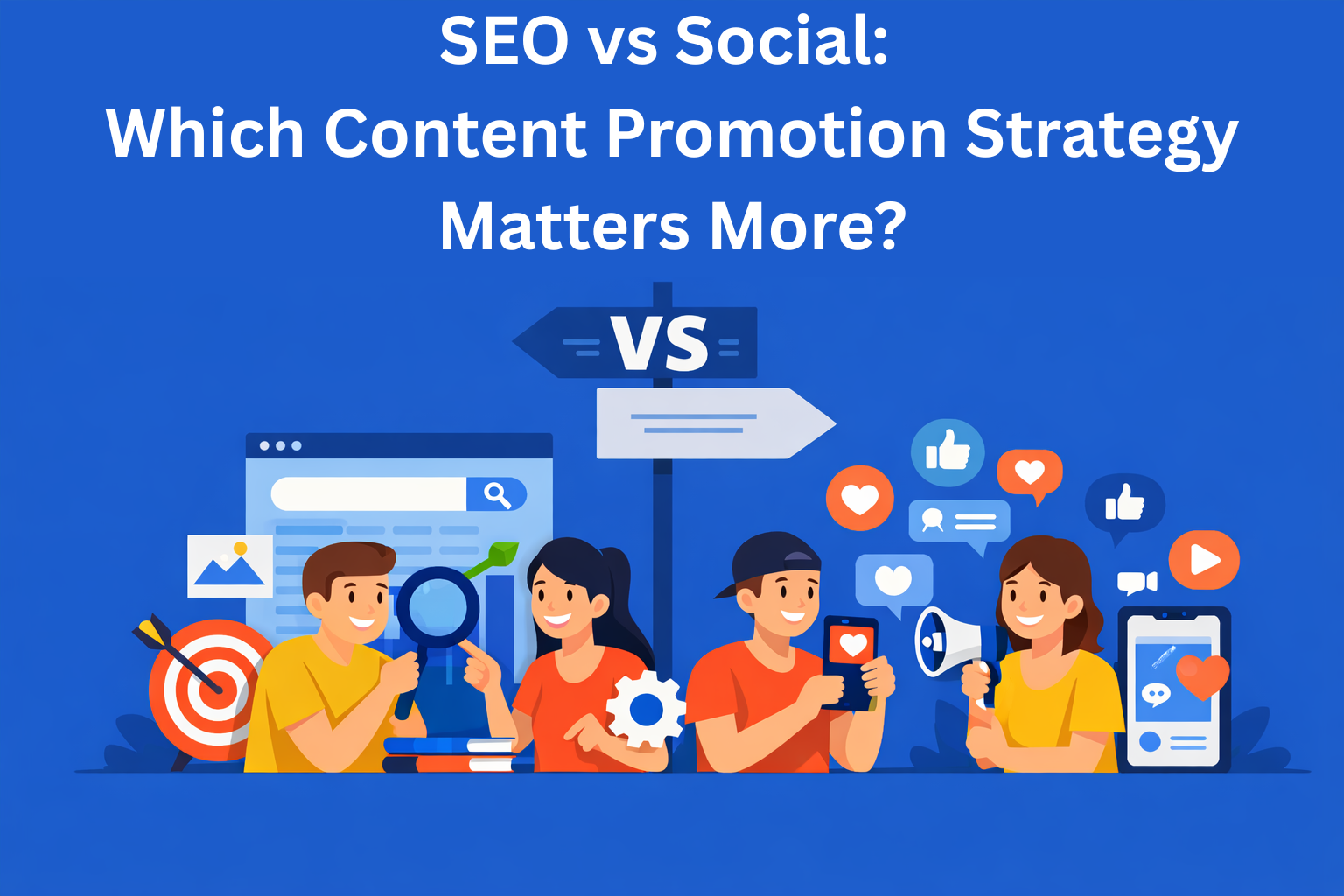
If you have ever worked in or even thought about content marketing, there is a good chance you have run into the same question: is it more important to invest in SEO or in social media? Some people say that without SEO there is no serious, long‑term growth. Others argue that all attention today lives on social media and that Google is slow and overcrowded.
The question sounds simple, but the answer really isn’t. SEO and social media are not enemies, they are just two different ways people discover content. In this blog, I will try to clearly explain the difference between these two approaches.
Key Takeaways
- SEO captures existing demand - it wins when people already have a problem and actively search for answers.
- Social creates demand - it puts ideas in front of people who weren’t searching, and builds awareness fast.
- SEO is durable, social is volatile - rankings can compound over months, while most posts fade in 24-48 hours.
- Use social to test, SEO to scale - validate topics and angles on social, then turn winners into long-term search assets.
- Your “right strategy” depends on the stage - early stage: social for visibility + feedback; later: SEO for steady growth (and keep social for distribution).
What does content promotion mean today?
Content promotion no longer means “publish a blog post and wait.” Today there are massive amounts of articles, videos, and posts, and competition for attention is bigger than ever.
Content promotion means finding a way to make people notice what you created, because if they don’t even know it exists, all that effort was for nothing. This usually happens in two basic ways:
- when someone actively searches for an answer (for example, on Google)
- when someone passively discovers content while scrolling (for example, on social media)
SEO and social media cover exactly these two situations. That’s why it makes no sense to see them as rivals, but rather as two different roles in the same story that work best together.
How SEO works as a promotion channel
SEO, put very simply, helps your content appear in search engines (Google, Bing, and others) at the right moment, when someone already has a question or a problem.
For example, if someone types “what is content marketing,” an SEO‑optimized article has a chance to show up as the answer. At that moment, the person is already motivated to read.
Benefits of SEO
One of the biggest advantages of SEO is that it lasts over time. When an article ranks well:
- it can bring you visitors for a long time
- you don’t have to keep reposting it again and again
- it stays as something that belongs to you, long term
That’s why SEO is often seen as something stable and reliable. It doesn’t bring results overnight, but as time passes, it starts working more and more in your favor.
Limitations of SEO
Still, SEO has its limits:
- results come slowly
- competition is often strong
- it’s hard to quickly test new ideas
If you are just starting out, it can take quite a while before you see real results. That’s why SEO is not always the best choice for short‑term goals.
How social media works as a promotion channel
Unlike SEO, social media works in a completely different way. People don’t come to social platforms to search for something specific, but to scroll and discover content.
In this case, content is “pushed” toward users through algorithms. If people like a post, it can spread very quickly.
Benefits of social media
Social media has a few clear advantages when it comes to content promotion:
- fast reach - If the algorithm picks up your post, it can reach people within a few hours who you would otherwise never reach. You don’t have to wait days or months like with SEO.
- easy interaction with the audience - People can instantly like, comment on, or share what you post. You can clearly see what they like and what they don’t.
- fast feedback - Reactions come almost immediately. If there are no likes or comments, it’s obvious people weren’t interested. If people comment, share, and react, you know you hit the right topic and it makes sense to keep going.
If you post an idea or an article and see people reacting and sharing, you immediately know the topic works. This is especially useful in early stages, when you are still learning what your audience cares about.
Limitations of social media
The biggest downside of social media is how short‑lived content is. Most posts:
- disappear from the feed within 24-48 hours - You post something today and tomorrow almost nobody sees it. If someone wasn’t online at the right time, there’s a big chance they’ll never see it at all.
- depend on algorithms you don’t control - You never really know who your post will be shown to. It can perform great, or the algorithm can simply bury it without a clear reason.
- require constant activity - You have to post regularly. Social platforms expect you to stay active, otherwise both the audience and the algorithm quickly forget about you.
That’s why social media rarely builds something that lasts for a long time. It’s great for visibility, but it’s not a place where content keeps its value over time.
How audience behavior has changed
One of the main reasons people keep debating SEO versus social media is simple: people themselves have changed.
Today, people use Google when they have a clear problem and want a specific answer, while they use social media when they want to see something interesting or get a new idea.
Put simply, SEO helps people find answers they are already looking for, while social media helps put new ideas in front of them. Once you understand this, it becomes clear why choosing only one rarely makes sense.
When SEO has more impact
SEO is especially useful:
- when you create educational content - articles that explain how something works or help people learn something new. People often search for this type of content because they want a clear and direct answer.
- when you solve specific questions and problems - if someone has a concrete problem, their first move is usually to search for it. That’s where SEO has a big advantage, because your content can appear at that exact moment.
- when you want long‑term organic traffic - SEO is a good choice when you want your content to keep working months or even years later. One good article can continuously bring new people without extra effort.
If you write content that gives a clear answer to a clear question, SEO is usually the easiest and smartest way for people to find it.
When social media has more impact
Social media has an advantage when:
- you are just starting to build an audience - When you don’t have many followers yet, social platforms are the easiest way for people to notice you at all. One good post can bring your first followers and start momentum.
- you are testing new ideas and messages - On social media, you quickly see what works and what doesn’t. If people react, comment, and share, you know the idea makes sense.
- you are building a personal or brand identity - Through regular posting, people slowly get to know who you are and how you think. Over time, they start recognizing you and associating you with certain topics or a specific style.
In these situations, speed and visibility matter more than long‑term ranking.
Why SEO and social shouldn’t compete
One of the biggest mistakes in content marketing is treating SEO and social media as opposing strategies.
In reality, they work best together:
- social media can help test ideas
- SEO can scale what proves to work
A strong piece of content can first get attention on social media and then be optimized for search engines to deliver long‑term value.
How to choose the right focus
Before deciding where to invest your time and budget, ask yourself:
- what stage you are in - If you are just starting out, your situation is very different from someone who has been around for years. What works for big, well‑known brands often doesn’t work for small beginners.
- how many resources you have - Some people have full teams, others do everything alone after work. That makes a big difference in whether you can push SEO, social media, or both.
- whether you need fast or stable results - Sometimes you need quick attention, and other times you want to build something that lasts longer.
There is no single correct answer that works for everyone. Your focus changes as your situation changes, just like your goals do.
Conclusion
The real question is not whether SEO is better than social media or the other way around. The real question is:
what matters more right now for your content?
SEO and social media are tools. When used together with a clear goal, they don’t compete, they support each other.
Once you understand their roles, content promotion stops being a dilemma and becomes a strategy.