Setting Goals and KPIs for Your Content Team
Learn how to set clear goals and KPIs for your content team. Discover how to choose the right content performance metrics, align content marketing goals with business objectives, and turn your content strategy into measurable growth.

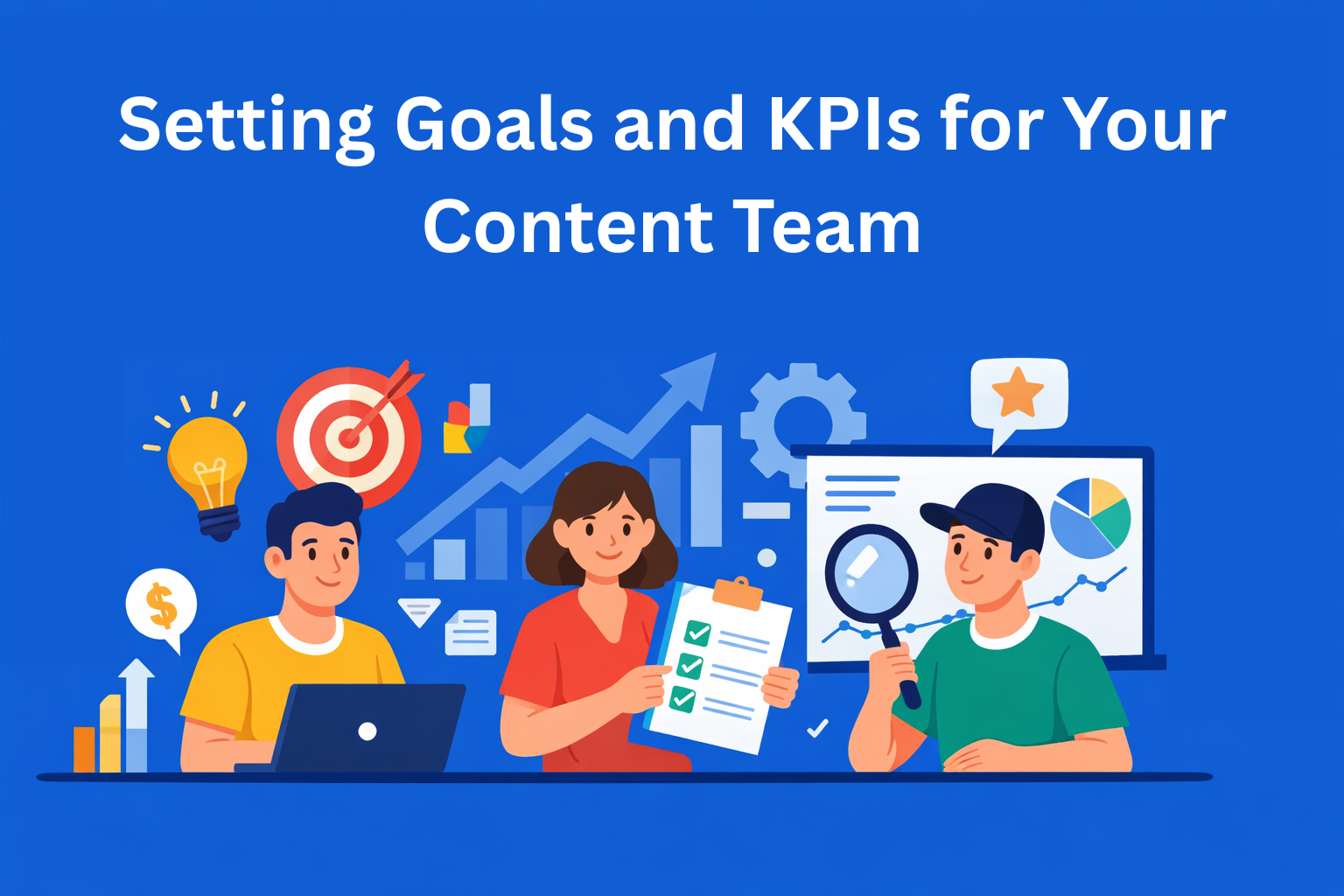
Many content teams work hard every week. They write blog posts, publish on social media, send newsletters, and update website pages. They put in a lot of effort, but often without a clear sense of direction.
If you do not have clear goals and specific KPIs, it is difficult to know whether your work is actually producing results. Traffic may be increasing, but that does not necessarily mean customers are coming. Engagement may be higher, but that does not automatically mean more revenue.
Setting goals and KPIs for your content team is not about adding pressure. It is about creating clarity. When everyone knows what they are working toward and how success is measured, the team becomes more focused, more confident, and more effective.
In this blog, we will explain what content goals are, what KPIs are, how to choose the right content performance metrics, and how to connect your content strategy with real business results.
Key Takeaways
- Goals give direction, KPIs measure progress - content goals define what you want to achieve, while KPIs show whether you are actually moving toward those results.
- Vanity metrics are not real performance indicators - impressions and likes look impressive, but traffic, leads, conversions, and revenue show true impact.
- Content must align with business priorities - your KPIs should directly support revenue growth, retention, product adoption, or market expansion.
- KPIs should match funnel stages - awareness focuses on visibility, consideration on engagement, conversion on action, and retention on long-term value.
- Clarity and ownership drive results - track 3-5 key metrics, assign responsibility, review performance regularly, and turn data into action.
Why Content Teams Struggle Without Clear Goals
Many content teams create a lot of content, but still do not know whether it is truly effective. They are constantly busy, yet they do not have a clear picture of whether they are doing a good job. This usually happens because they do not have clearly defined goals.
Sometimes a goal sounds like this: “Let’s publish more blog posts.” Or: “Let’s be more active on social media.” But those are not real goals, they are simply tasks. Publishing more content does not automatically lead to better results.
When content marketing goals are not clear, teams often focus on so-called “vanity metrics.” These are numbers that look impressive, but do not tell the full story. For example, impressions and likes may increase, but if no one clicks, signs up, or makes a purchase, the business does not grow.
When you clearly define KPIs, it becomes easier to solve this problem. The focus shifts from what you did to the results of what you did. Instead of asking, “Did we publish something this week?”, a more important question becomes, “Did this content actually help us move forward?”
The Difference Between Goals and KPIs in Content Marketing
Before setting anything, we need to understand the difference between goals and KPIs.
What Are Content Goals?
Content goals are the results you want to achieve. They show the direction in which you want to develop your content.
Examples of content team goals:
- Increase organic traffic over the next six months
- Generate 200 new qualified leads per quarter
- Become more recognizable in your industry
- Help users better understand the product and reduce support questions
These goals give direction to your content strategy. They answer the question: Why are we creating content?
Content goals are usually connected to broader business objectives. For example, if a company wants to increase revenue, the content team may focus on generating more leads or improving conversions.
What Are Content KPIs?
KPI stands for Key Performance Indicator. These are specific, measurable numbers that show whether you are getting closer to your goals.
If your goal is to increase organic traffic, your KPIs may include:
- Monthly organic visitors - This is the number of people who come to your website each month through Google search, without paid ads. Simply put, it shows how many people are finding you organically.
- Keyword rankings - This shows the position where your website appears on Google when someone searches for a specific word or phrase. The closer you are to the top of the search results, the higher the chance that people will click on your site.
- CTR (Click-Through Rate) - This is the percentage of people who saw your link on Google and actually clicked on it. If your CTR is low, it usually means your title or description is not compelling enough and needs improvement.
If your goal is lead generation, content performance metrics may include:
- Number of completed forms
- Number of newsletter sign-ups
- Number of demo requests
Simply put:
- Goals show the direction.
- KPIs measure progress.
Both are necessary. Without goals, KPIs have no real meaning. Without KPIs, goals remain just ideas.
How to Align Content Goals With Business Goals
One common mistake in content marketing is that the team works separately from the rest of the company. They write articles and publish content, but it often has little connection to what the company actually prioritizes at that moment.
To avoid this, content team goals must be aligned with business goals.
Ask these questions:
- What does the company want to achieve this year?
- Is the focus on revenue growth, market expansion, or customer retention?
- Which products or services are the priority?
Once you know the answers, you can define content marketing goals that support those directions.
For example:
If the company wants to increase revenue from a new product, the content strategy can focus on educational blog posts, competitor comparisons, and case studies. In that case, KPIs may include product page visits, assisted conversions, and demo requests.
If the company wants to improve customer retention, the content team can create tutorials, onboarding guides, and knowledge base articles. KPIs may include returning visits, user engagement, and reduced churn.
When content goals are aligned with business results, it becomes much easier to measure content ROI. You can clearly see how content contributes to overall growth.
Choosing the Right KPIs for Each Stage of the Funnel
Not all content serves the same purpose. Some content attracts new people. Some helps them make a decision. Some turns them into customers. Because of that, KPIs should match the stage of the funnel.
KPIs in the Awareness Stage
At this stage, the goal is visibility. You want as many people as possible to learn about your brand.
Typical content performance metrics for this stage:
- Organic traffic
- Impressions
- Reach
- New users
These KPIs show whether your content strategy is successfully attracting attention.
KPIs in the Consideration Stage
At this stage, the audience gets to know you better and compares different options.
Relevant KPIs may include:
- Time on page
- Scroll depth
- Newsletter sign-ups
- Content downloads
These metrics show engagement. They tell you whether the audience is interested enough to spend meaningful time with your content.
KPIs in the Conversion Stage
At this stage, the goal is action.
Important KPIs include:
- Lead generation
- Demo requests
- Free trial sign-ups
- Assisted conversions
These content performance metrics are directly connected to revenue.
KPIs in the Retention Stage
Content does not stop after the sale. It can help you retain customers.
Retention KPIs may include:
- Returning visits
- Tutorial views
- Engagement of existing users
When you choose the right KPIs for each stage, content marketing goals become clearer and more realistic.
How to Set Realistic Goals for Your Content Team
Setting KPIs is not just about choosing metrics. You also need to define realistic targets.
A common mistake is setting goals that are too ambitious. For example, doubling organic traffic in one month without additional resources. When goals are unrealistic, the team can quickly become demotivated.
Instead, use data.
Look at your past results:
- How much has organic traffic grown in the last six months?
- How many leads did the blog generate last quarter?
Based on that data, set achievable content marketing goals. If you grew 10% last quarter, aiming for 12–15% next quarter may be realistic.
You can also use industry benchmarks to understand what is standard in your niche. That makes it easier to compare your content performance metrics with competitors.
Finally, define a time frame. Some content team goals are monthly, some are quarterly, and some are yearly. Long-term goals help guide strategy, while short-term KPIs help maintain focus.
Most Common Mistakes When Setting KPIs
Even with good intentions, teams often make mistakes.
Too Many KPIs
If you track 20 different metrics, confusion is inevitable. Focus on a small number of KPIs that truly matter for your content strategy.
No Clear Owner
Every KPI should have a responsible person. Someone needs to track the results and actively work on improvements. Without ownership, numbers tend to be ignored.
Measuring Without Action
Tracking data alone is not enough. If organic traffic drops, what will you do about it? If conversions increase, how will you improve even further? KPIs should lead to real decisions and clear next steps.
Ignoring Quality
Not everything can be measured precisely. Feedback from the sales team, comments from users, and qualitative insights also matter. A balanced approach makes your content team stronger.
How to Create a Simple KPI Dashboard
You do not need complicated tools to measure content performance. Start simple.
Create a dashboard that includes:
- Main content team goals
- 3-5 key KPIs
- Current results
- Target values
You can update the dashboard monthly. It should be easy to read and accessible to the entire team.
When everyone sees the same data, alignment improves. The content strategy becomes transparent. Conversations become more productive because they are based on numbers rather than opinions.
Over time, this practice helps you measure content ROI more accurately. You will clearly see which types of content bring the best results and which ones need improvement.
Conclusion
Content marketing should not be random, like “let’s publish something and see what happens.” It should have meaning and a clear plan.
When you know exactly what you want to achieve and how you will measure it, you are no longer working blindly. You understand why you are doing something, what you expect from it, and how you will evaluate whether it actually works.
The point is not to have more content, but to have better content. Content that truly brings value to the company.
Instead of asking, “Did we publish enough this month?”, it is better to ask, “Did this bring us more customers, inquiries, or sales?”
That difference in thinking creates a significant change.
When you set clear goals and KPIs, content stops being just a creative task. It becomes a tool that helps the company grow.
And when the whole team understands what success means and how to achieve it, everything becomes much easier and more confident.