Should You Hire a Generalist Writer or a Niche Specialist?
Learn whether your team needs a versatile generalist or a niche specialist. This blog breaks down the strengths of both freelance profiles and helps you match your content goals, audience, and project needs with the right writer for the best results.

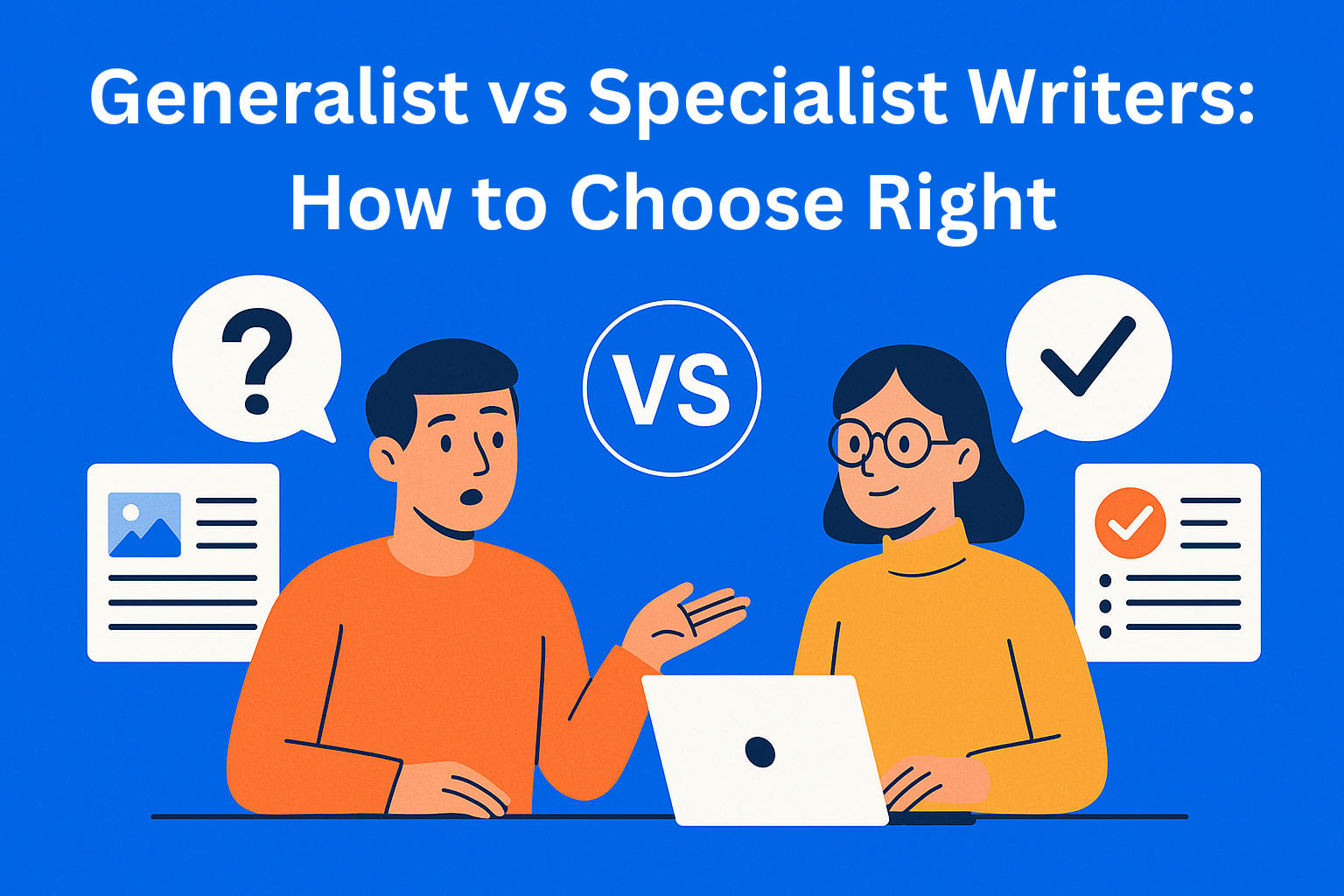
Many teams work with freelancers to create content faster and strengthen their marketing. But very quickly, one question shows up: what kind of writer should you hire? A generalist who can write about many different topics, or a specialist who knows a specific industry in depth? In this blog, we will explain the difference and help you choose the profile that fits your content goals, audience, and type of project.
Key Takeaways
- Generalists bring flexibility - ideal for varied topics, fast timelines, and content that prioritizes clarity over depth.
- Specialists bring depth - best when accuracy, expertise, and stronger authority are crucial.
- Choose based on audience and purpose - broad education fits generalists, while expert-level content calls for specialists.
- Consider risk - if wrong information could harm credibility or outcomes, hire a specialist.
- Many teams benefit from both - generalists handle variety and volume, specialists handle complex or high-impact work.
What Defines a Generalist Writer?
A generalist writer is like a "Swiss army knife." They know a bit of everything and easily adapt to different formats, blog posts, scripts, email campaigns, guides, and case studies.
They learn quickly, easily change their tone of communication, and can adapt to a brand without needing too much time. If you need simple and varied content, especially while your business is still growing or changing campaigns, the generalist is usually the most useful option.
When a Generalist Is the Better Fit
It’s best to hire a generalist when you have:
- different topics and formats that need to be covered
- short deadlines for publishing
- a project where the most important thing is clarity, simplicity, and good organization
If you are working on awareness campaigns, onboarding materials, or simple blog posts, a generalist can quickly and easily create quality content.
What Defines a Niche Specialist?
A specialist is a writer who focuses on one field and knows it much better than the average person.
They understand the terminology, the market, the problems your audience faces, and know how to argue things precisely. Such a writer often brings more value because their content has authority and extra weight.
When a Specialist Is the Better Fit
It's best to hire a specialist when you need:
- Professional accuracy - meaning the text must be completely correct and precise. If the topic is serious or complex (for example, data security, medical advice, financial processes), it’s important that the writer knows what they’re doing, doesn’t guess, and doesn’t write based on assumptions.
- High-risk content - situations where a wrong piece of information can damage reputation, trust, or business. For example:
- texts that affect big buying decisions
- topics that require proof and facts
- content related to rules, finance, law, or health
- Materials such as: professional guides (texts that teach someone step-by-step how to do something), technical instructions (explanations of complex systems, processes, tools), demanding websites (sites made for expert audiences that require precise explanations), or deeper industry analyses (detailed research of markets, trends, and business models)
If you know that the audience expects depth and details, and the content is a key part of brand positioning, then a specialist most likely delivers the best result.
The Cost and Workflow Reality
In most cases, generalists are faster, adapt more easily to the team, and often cost less. Specialists may have a higher price and a slower process because their focus is narrower and they carry a higher level of responsibility. This is why it’s important to think about your goal. If your goal is volume and variety, a generalist is the right choice. But if your priority is to build credibility and authority in a specific industry, a specialist makes much more sense.
How to Decide: A Simple Evaluation Framework
If you don’t know who to choose, ask yourself the following:
1. What is the goal of the content? Do you want education, promotion, proof of expertise, or a simple explanation?
2. Who is the audience? If they are experts, CTOs, or doctors, you need a specialist. If they are new users or a wide audience, a generalist is more than enough.
3. What is the risk of incorrect information? If any mistake can affect reputation or sales, a specialist is safer.
4. How technical is the content? The more complex the topic, the more important it is for the content to be precise and well-explained.
Experience shows that many teams use both profiles at the same time. A combination is often the smartest path because you get the best of both worlds, of course, if you have the budget to support that.
Conclusion
There is no universal answer. Nobody is “better” or “worse.” The most important thing is to choose a profile that fits your goals, audience, and type of content. When that decision is clear, you get a writer who brings the most value to your team.