The Content Teams Forget to Manage (But Feel Every Day)
Help centers, FAQs, onboarding guides, and knowledge bases shape the user experience every day - yet they’re often outdated and unmanaged. This blog explains why neglected customer-facing content creates confusion, increases support load, and why treating it as a living system matters.

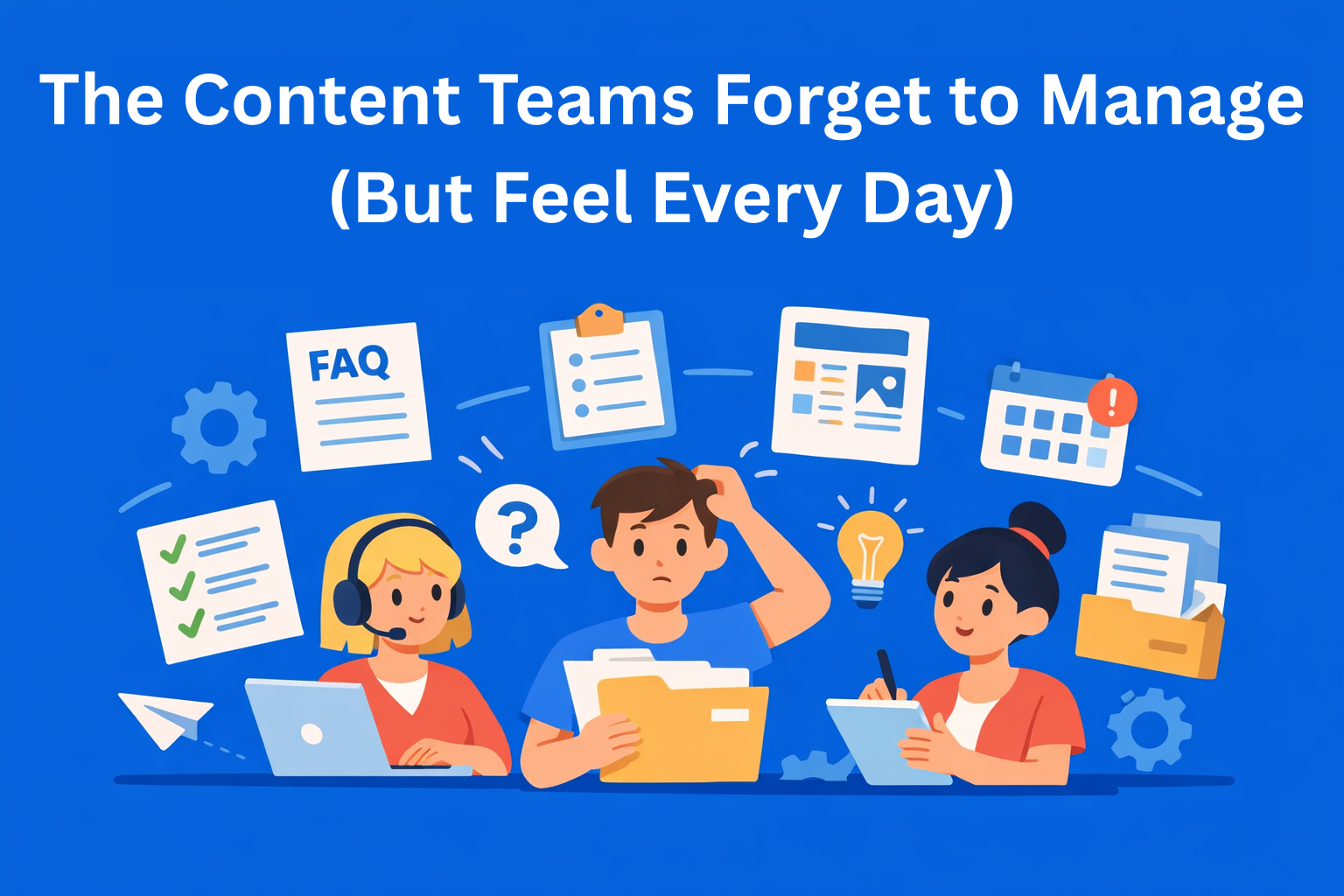
When content is mentioned inside a company, most people immediately think of blog posts, social media, campaigns, or landing pages. That is the content that gets planned, measured, and discussed in meetings. However, there is another layer of content that is almost never in focus, even though users interact with it every single day.
These are help centers, FAQ sections, onboarding guides, product videos, and knowledge bases. This customer-facing content quietly shapes the user experience, often more than any marketing campaign. And precisely because it is quiet, it is the content that gets forgotten most often.
In this blog, we talk about the content that content teams often do not manage consciously, but whose consequences they feel every day.
Key Takeaways
- User education content is used daily - help centers, FAQs, onboarding guides, and tutorials shape the user experience more than most campaigns.
- This content often has no clear owner - marketing, product, and support all touch it, but no one actively maintains it.
- Outdated content creates confusion and distrust - mismatched explanations make products feel unreliable, even when they work well.
- Support feels the pain first - unclear or stale content turns support teams into living FAQs instead of problem solvers.
- Treat education content as a living system - content must be reviewed, updated, and owned just like the product itself.
Content That Is Not on the Calendar, but Is Used Every Day
Most content teams work with clear plans. There is a content calendar, there are deadlines, campaigns, and goals. Marketing content has its own rhythm and structure. But educational content for users rarely has the same place in the system.
A help center is often created when the product goes to market. An FAQ is written when support receives too many of the same questions. An onboarding guide appears as quick help for new users. At that moment, everything seems good enough.
The problem is that the story often ends there.
Customer education content often stays the same for months or even years, while the product itself keeps changing. Buttons move, options disappear, new features appear, but the explanations do not follow those changes and quickly become outdated.
What Actually Belongs to the “Forgotten” Content
When we talk about content that gets forgotten, we are not talking about something secondary. We are talking about content that users rely on when they need it the most.
This includes:
- Help centers and knowledge bases
- FAQ sections
- Onboarding guides and checklists
- Product videos and tutorials
- In-app explanations and short educational messages
This content is not meant to attract attention. Its role is to help users understand the product, solve a problem, or make the right decision. That is why it has a strong impact on the user experience, even though it is rarely treated as part of a broader content strategy.
Why This Content Almost Always Gets Neglected
One of the main reasons customer-facing content gets neglected is that it has no clear owner. The marketing team thinks it belongs to support. Support thinks it belongs to the product team. The product team assumes it has already been handled.
When no one is truly responsible for managing this content, it quickly ends up without maintenance.
Another issue is that this content is rarely measured. Marketing has metrics, performance data, and reports. Educational content for users often has none of that. If it is not measured, it can feel like it is not important.
The third reason is the speed of change. Products evolve quickly today. Features constantly change, the UI changes, and flows are optimized. Content does not keep up with that pace because it is not part of the same process.
The result is content that was once accurate, but is no longer reliable.
How Neglected Content Creates Confusion for Users
Users do not know how content is organized inside a company. They only see the information they are trying to understand.
When they see one version of the product in the help center, another in onboarding emails, and a third inside the product itself, confusion follows.
Customer education content that is not updated can leave the impression that the product is unreliable or that the team does not pay attention to details. Even when that is not true, the impression remains.
And impressions are often stronger than reality.
Why Support Feels the Impact First
When educational content does not do its job, the support team feels the impact first. The same questions arrive day after day.
Support then spends time explaining basic things that could have been clearly documented, instead of solving more complex problems. This increases workload, slows down responses, and creates frustration for both the team and the users.
In many companies, support becomes a living FAQ instead of a strategic part of the user experience.
How Neglected Content Affects Trust
Trust is built through consistency. When content does not match what users see in the product, that trust is easily damaged.
Users start to wonder whether they can rely on the information they are reading. If they cannot, every next step becomes harder. They need to double-check, ask questions, and seek additional help.
Outdated customer-facing content does not look like just a technical issue. It looks like neglect.
The Problem Is Not the Amount of Content, but How It Is Managed
Most teams do not struggle with writing content. The problem appears after publishing.
Content is treated as a one-time deliverable. It gets written, published, and then the team moves on to the next task. But educational content for users must evolve together with the product. If the product changes, the content must change as well. If processes change, the explanations must change too.
Without a system, content starts to age the moment it is published.
Customer Education Content as a Living System
When educational content is treated as a living system, the mindset changes.
This means content has its own lifecycle. It is created, used, reviewed, updated, and sometimes removed, just like any other part of the product.
This approach means it is clear who is responsible, that the content is reviewed regularly, and that it is visible to everyone. The content team does not wait for problems to appear, but actively maintains the content.
Customer-facing content becomes a reliable source of truth, not a collection of outdated documents.
Why This Matters for Growth and Retention
When users understand the product, they see its value faster. Onboarding becomes easier, and there is less frustration. Clear and up-to-date educational content helps users feel more confident in their decisions.
This helps users stay longer. When things are clearer, they give up less often. When they rely less on support, growth becomes easier to sustain.
Customer education content is not just supporting material. It is a core part of the user experience and long-term growth.
How Content Teams Can Take the First Step
The first step is not writing new content. The first step is acknowledging that this content exists and that it matters.
Content teams can start by gathering help centers, FAQs, and onboarding materials in one place. When everything is in one place, it becomes much easier to manage.
The second step is collaboration. This content does not belong to a single team. It sits at the intersection of product, support, and content.
The third step is continuity. Instead of large, infrequent updates, it is better to have small, regular checks that ensure the content remains accurate and useful.
Conclusion
Users do not differentiate between marketing content and educational content. For them, it is all part of one experience.
Content that is not immediately visible often has the biggest impact. It influences understanding, trust, and the decisions users make every day.
Content teams that ignore this layer feel the consequences constantly. Teams that treat it as a living system build a stable, consistent, and trustworthy user experience.
And that is where the difference users remember is created.