The Hidden Cost of “Just One More Revision”
Endless revisions often seem harmless, but they quietly slow teams down, drain energy, and blur ownership. This article explains the hidden cost of “just one more revision” and why knowing when to stop editing matters as much as quality.

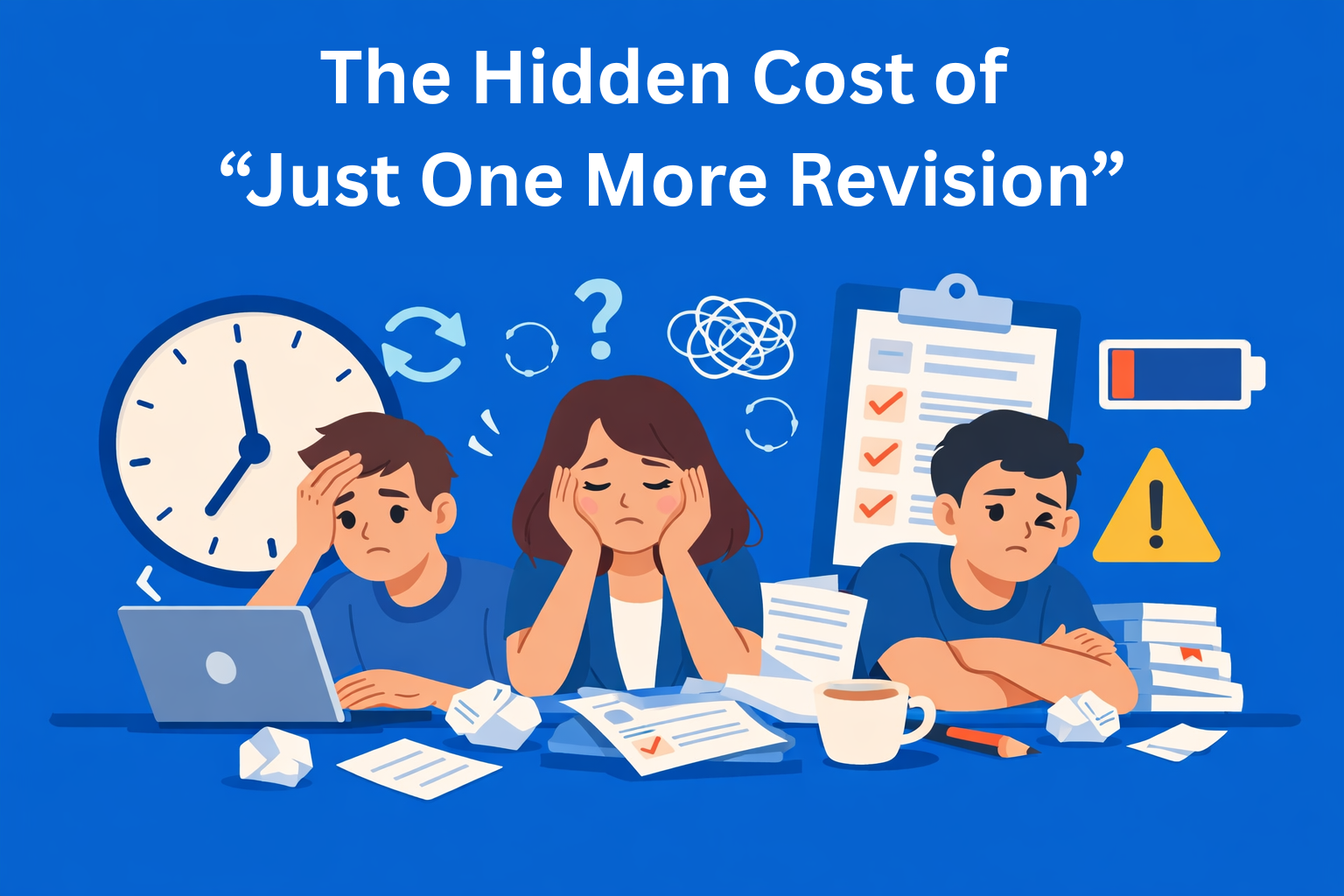
“Let’s just make one small change.” This is a sentence that sounds harmless and can be heard in almost every content team. The change is small, the intention is good, and the goal is to make the content better. Yet this is often exactly where problems in the content process begin.
In practice, one more revision rarely stays just one. It often triggers a chain of additional comments, new opinions, and small tweaks that keep piling up. Instead of moving closer to publication, the content gets stuck in a constant loop of editing.
In this blog, we’ll talk about why endless changes in the content workflow slow teams down, drain energy, and erase a sense of ownership. Even more importantly, we’ll explain why knowing when to stop editing is just as important as creating good content in the first place.
Key Takeaways
- “One more revision” rarely stays one - small changes often trigger endless edit loops that block progress.
- Unclear goals create unnecessary revisions - when “good enough” isn’t defined, everyone feels free to change something.
- Endless edits kill momentum - constant interruptions slow delivery and remove the sense of progress.
- Too many revisions cause decision fatigue - teams stop improving content and start editing just to avoid mistakes.
- Clear ownership and limits protect quality - defined stages and final responsibility prevent content from stalling.
Why Revisions Multiply (Even When Everyone Has Good Intentions)
Most revisions don’t happen because the content is bad. On the contrary, they often appear when the text is already quite good. The real issue is that content goals are not always clearly defined from the start.
When a team doesn’t have a clear definition of what “good content” actually means, every new person who reviews the text sees an opportunity to change something. Each additional comment leads to another, and content revisions quickly start to pile up.
Another common reason is doubt about decisions that were already made. Instead of fixing real problems, revisions are used to reassure people that they made the right choice. At that point, feedback stops being helpful and starts slowing the entire process down.
The Momentum Problem: How Endless Edits Slow Everything Down
Every content process has its own rhythm. When a team works without constant interruptions, ideas flow more easily and deadlines are easier to meet. However, endless revisions keep breaking that rhythm.
Each new change means going back to the same content and reading it again. These pauses may seem small, but they quickly add up and create serious delays in the content workflow.
Content that is always waiting for “just one more review” never feels finished. The team loses a sense of progress, and projects start to overlap.
Decision Fatigue: The Invisible Drain on Content Teams
Every revision requires a new decision. Should the headline be changed? Is this paragraph better or worse? Do we need another example? When these decisions repeat too many times, decision fatigue sets in.
Decision fatigue means that the more decisions we make, the worse those decisions become. In a content process, this means the team slows down, becomes uncertain, and avoids making clear choices. Instead, compromises are made that don’t actually improve the content.
Ironically, too much editing doesn’t lead to better writing. When a team gets tired, people stop improving the text to make it better and start editing just to avoid mistakes. As a result, the content becomes weaker and is published more slowly.
Blurred Ownership: When Everyone Can Edit, No One Is Accountable
One of the most common problems in content teams is unclear ownership of content. When everyone has the right to change the text, it often happens that no one has the final say.
This leads to a content by committee approach, where the content tries to please everyone but doesn’t fully serve anyone. The content approval process gets longer because no one wants to take responsibility for the final version.
Without a clearly defined owner, revisions continue out of habit rather than necessity. Each new change further blurs the direction the content is supposed to take. To avoid this situation, there are tools like EasyContent, where you can define your own workflow and assign roles to each team member. That way, it’s always clear who is responsible for each phase. If any issues arise, they can be discussed in real time directly on the platform, and all changes can be tracked, which makes the entire content process much easier and faster.
When Revisions Stop Adding Value (And Start Doing Damage)
At some point, revisions stop being helpful. After that, every new change just keeps the same text going in circles, without any real improvement.
One clear sign that revisions have gone too far is when the same parts of the text keep being changed or old versions are brought back. Today a paragraph looks one way, tomorrow it’s different, and then it goes back to the original version. If the text is constantly being rewritten and no one knows exactly why, it’s usually a sign that the content is already good enough to be published.
At that point, additional editing only wastes more time and pushes deadlines back. This often results in content having less value than it would have had if it had been published earlier, even if it wasn’t “perfect” at the time.
How to Set Healthy Limits on Editing Without Sacrificing Quality
The solution isn’t to remove revisions entirely, but to set healthy limits.
The first step is to clearly define the stages of the process:
- Draft
- Review
- Final
At each stage, it should be clear what kind of changes are allowed. Important changes should always take priority over small details. This makes the entire process clearer and easier to manage.
Agreed editing rules save time and reduce frustration, because when everyone knows where the process ends, there’s less need for extra checks.
Knowing When to Stop: A Skill, Not a Compromise
Knowing when to stop editing is a skill that’s built through experience. The best content teams understand that perfection is often neither necessary nor realistic.
In real-world conditions, good enough at the right time is more valuable than perfectly polished content that arrives late. The process should be clear and fast, not something that constantly goes in circles.
When a team learns to recognize the right moment to finish, content quality becomes more consistent and energy is saved for new projects.
Conclusion
The best content isn’t the one that’s been edited the most. It’s the content that has a clear goal, clear ownership, and a healthy process behind it.
Endless revisions don’t just slow work down, they also exhaust the people doing it. A healthy content workflow protects both quality and the team.
When you know when to edit, and when to stop, content actually starts delivering results.