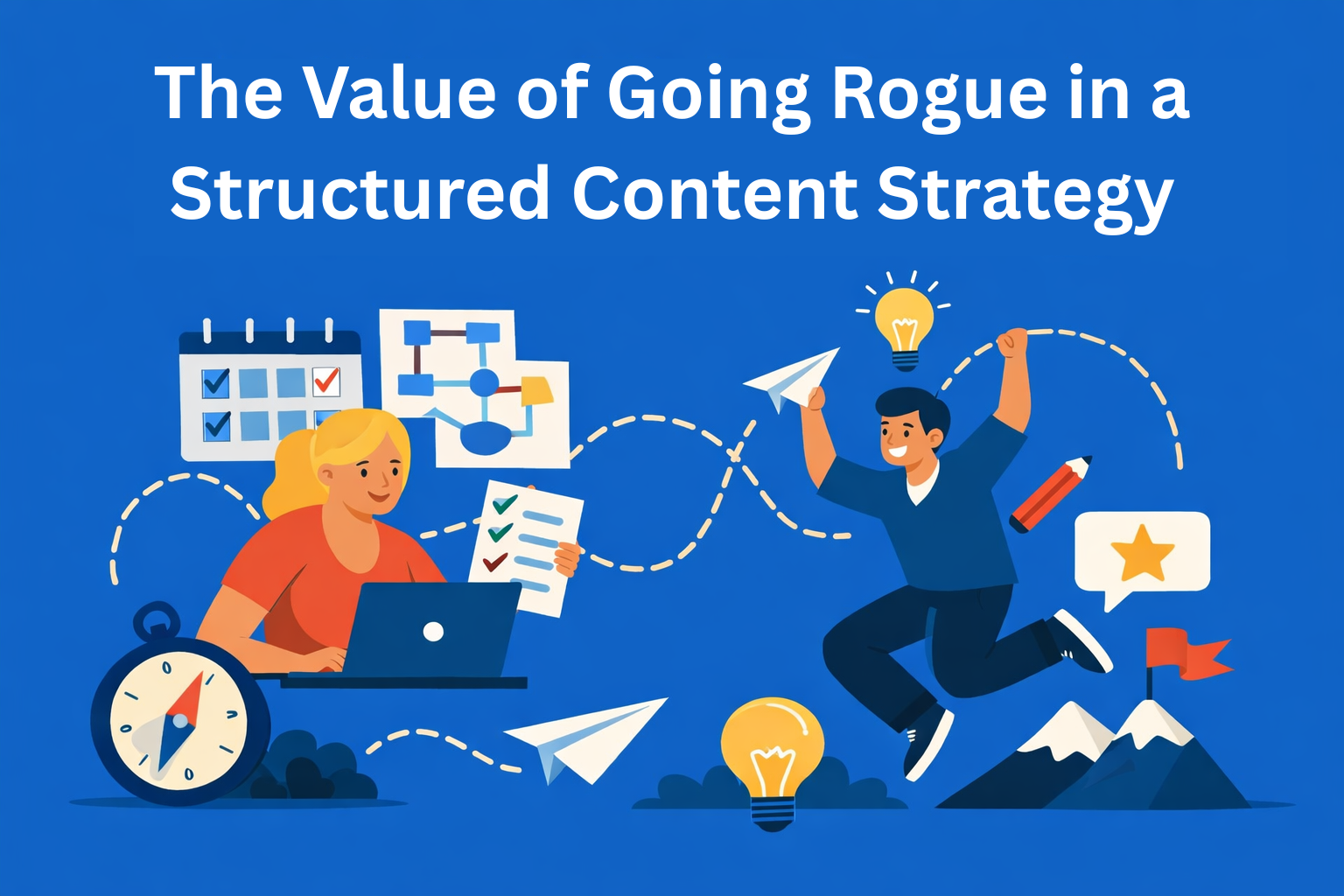
The Value of Going Rogue in a Structured Content Strategy
A structured content strategy brings clarity and consistency, but when followed too rigidly, it can limit creativity. This article explores why leaving room to go off-plan helps content teams create more relevant, authentic, and effective content.

Most teams that work with content marketing start the same way. First, they create a content strategy, then fill in a content plan, define topics, formats, and publishing dates. Everything looks neat, predictable, and under control.
The problem starts when a content strategy is taken too literally. When the plan becomes something that must not be changed, even when a better idea appears. At that point, the structure that was supposed to help starts to limit creativity.
In this blog, we’ll talk about why it’s important to leave room for flexibility within a structured content strategy, how occasionally going off-plan can improve content marketing, and why the best content systems always balance order and freedom.
Key Takeaways
- Structure enables consistency - a clear content strategy creates focus, alignment, and momentum, especially for growing teams.
- Rigid plans quietly limit creativity - when every idea must fit the calendar, content may stay “correct” but lose relevance and emotional impact.
- Going rogue means responding with purpose - off-plan content works when it reacts to real situations, not when it abandons goals or audience needs.
- Spontaneous content reveals what matters - strong reactions to unplanned posts often signal topics worth expanding and formalizing later.
- The best systems allow controlled freedom - healthy content strategies balance clear boundaries with room to move when good ideas appear.
What a structured content strategy gets right
Structure is not the problem. On the contrary, a good content strategy is the foundation of any serious content marketing effort.
A structured content strategy helps a team understand:
- who they are speaking to
- which topics they are writing about
- what the goals of the content are
- how success is measured
Thanks to a plan, publishing doesn’t happen randomly, but follows a clear and meaningful order. Messages are aligned, and content is built as a whole, not as a collection of disconnected pieces.
For teams that are just getting started, a content plan is often the only way to begin writing at all. Without it, it’s easy to fall into creative blocks or constant postponing. That’s why structure is necessary, but it should be a help, not a barrier.
When structure starts to hurt creativity
The problem appears when the plan is followed without thinking about the situation, the audience, or new ideas.
In those cases, content often looks “correct” but has no real impact. The texts are grammatically correct, SEO-optimized, and published on time, but there are no comments, no shares, and no sense that anyone truly connected with the message.
One clear sign that structure has gone too far is when every new idea is rejected simply because it’s “not in the plan.” Instead of the strategy serving the team, the team starts serving the strategy.
At that point, content marketing loses its authenticity, its speed of reaction, and the feeling that content comes from real experience rather than just a document.
What “going rogue” really means (and what it doesn’t)
The phrase “going rogue” often sounds dramatic, but in the context of content strategy, it doesn’t mean chaos or abandoning the plan.
Going rogue does not mean:
- publishing without a goal
- ignoring the audience
- completely abandoning the content plan
Going rogue means allowing yourself to react when a good idea appears, even if it wasn’t planned. It can be a piece of content that comes from a conversation, personal experience, or something that just happened.
This kind of content often feels more natural because it isn’t overly polished. It shows the human side of a brand and adds depth to content marketing.
The key is not to see spontaneous ideas as a threat to the strategy, but as something that complements it.
How spontaneous ideas can strengthen your strategy
Spontaneous content often brings better results than carefully planned pieces because it appears at the right moment.
When a team reacts to what’s happening right now or to a real problem, the content feels more meaningful. People get the sense that the text was written for them, not just for an algorithm.
On top of that, this kind of content can show which direction is worth exploring next. If a spontaneous post performs well, it clearly shows that people care about that topic. Later, that idea can be developed further and added to the plan.
The balance: systems that allow flexibility
The best content systems are designed to leave room for adjustment.
One simple way to do this is to leave empty slots in the content plan. These “open slots” are meant for spontaneous ideas that appear during the month.
Another important element is process. If every new idea requires ten approvals, flexibility doesn’t really exist. A content strategy should have clear rules, but it should also allow good ideas to be published quickly.
Balance is achieved when a team knows the boundaries but has freedom within them. A topic can be outside the plan and still make sense for the audience and the goals of content marketing.
Why the healthiest content teams allow controlled chaos
Good content teams know that the best ideas often come on their own, when you least expect them.
Instead of trying to keep everything under strict control, good teams know when to loosen up. Strategy serves as a guide, but they don’t expect every piece of content to fit the plan down to the last detail.
This approach builds trust within the team. People feel more comfortable suggesting ideas, and the content becomes more diverse and more authentic.
Content marketing then stops being just an operational task and becomes a tool for real communication with the audience.
Conclusion
The purpose of a content strategy is to help a team create better content, not to limit how they think.
When structure and freedom are combined the right way, content marketing gets the best of both worlds. There is order, but also room for spontaneity. There is a plan, but also permission to step away from it when it makes sense.
In the end, the most valuable content often appears exactly where strategy and instinct meet.What a structured content strategy gets right
Structure is not the problem. On the contrary, a good content strategy is the foundation of any serious content marketing effort.
A structured content strategy helps a team understand:
- who they are speaking to
- which topics they are writing about
- what the goals of the content are
- how success is measured
Thanks to a plan, publishing doesn’t happen randomly, but follows a clear and meaningful order. Messages are aligned, and content is built as a whole, not as a collection of disconnected pieces.
For teams that are just getting started, a content plan is often the only way to begin writing at all. Without it, it’s easy to fall into creative blocks or constant postponing. That’s why structure is necessary, but it should be a help, not a barrier.
When structure starts to hurt creativity
The problem appears when the plan is followed without thinking about the situation, the audience, or new ideas.
In those cases, content often looks “correct” but has no real impact. The texts are grammatically correct, SEO-optimized, and published on time, but there are no comments, no shares, and no sense that anyone truly connected with the message.
One clear sign that structure has gone too far is when every new idea is rejected simply because it’s “not in the plan.” Instead of the strategy serving the team, the team starts serving the strategy.
At that point, content marketing loses its authenticity, its speed of reaction, and the feeling that content comes from real experience rather than just a document.
What “going rogue” really means (and what it doesn’t)
The phrase “going rogue” often sounds dramatic, but in the context of content strategy, it doesn’t mean chaos or abandoning the plan.
Going rogue does not mean:
- publishing without a goal
- ignoring the audience
- completely abandoning the content plan
Going rogue means allowing yourself to react when a good idea appears, even if it wasn’t planned. It can be a piece of content that comes from a conversation, personal experience, or something that just happened.
This kind of content often feels more natural because it isn’t overly polished. It shows the human side of a brand and adds depth to content marketing.
The key is not to see spontaneous ideas as a threat to the strategy, but as something that complements it.
How spontaneous ideas can strengthen your strategy
Spontaneous content often brings better results than carefully planned pieces because it appears at the right moment.
When a team reacts to what’s happening right now or to a real problem, the content feels more meaningful. People get the sense that the text was written for them, not just for an algorithm.
On top of that, this kind of content can show which direction is worth exploring next. If a spontaneous post performs well, it clearly shows that people care about that topic. Later, that idea can be developed further and added to the plan.
The balance: systems that allow flexibility
The best content systems are designed to leave room for adjustment.
One simple way to do this is to leave empty slots in the content plan. These “open slots” are meant for spontaneous ideas that appear during the month.
Another important element is process. If every new idea requires ten approvals, flexibility doesn’t really exist. A content strategy should have clear rules, but it should also allow good ideas to be published quickly.
Balance is achieved when a team knows the boundaries but has freedom within them. A topic can be outside the plan and still make sense for the audience and the goals of content marketing.
Why the healthiest content teams allow controlled chaos
Good content teams know that the best ideas often come on their own, when you least expect them.
Instead of trying to keep everything under strict control, good teams know when to loosen up. Strategy serves as a guide, but they don’t expect every piece of content to fit the plan down to the last detail.
This approach builds trust within the team. People feel more comfortable suggesting ideas, and the content becomes more diverse and more authentic.
Content marketing then stops being just an operational task and becomes a tool for real communication with the audience.
Conclusion
The purpose of a content strategy is to help a team create better content, not to limit how they think.
When structure and freedom are combined the right way, content marketing gets the best of both worlds. There is order, but also room for spontaneity. There is a plan, but also permission to step away from it when it makes sense.
In the end, the most valuable content often appears exactly where strategy and instinct meet.