What AI Agents Mean for Content Operations
AI agents are no longer just tools. They act like team members, taking over tasks, coordinating workflows, and keeping content work on track. This post explains what that means for content operations and how teams can work smarter, not harder.

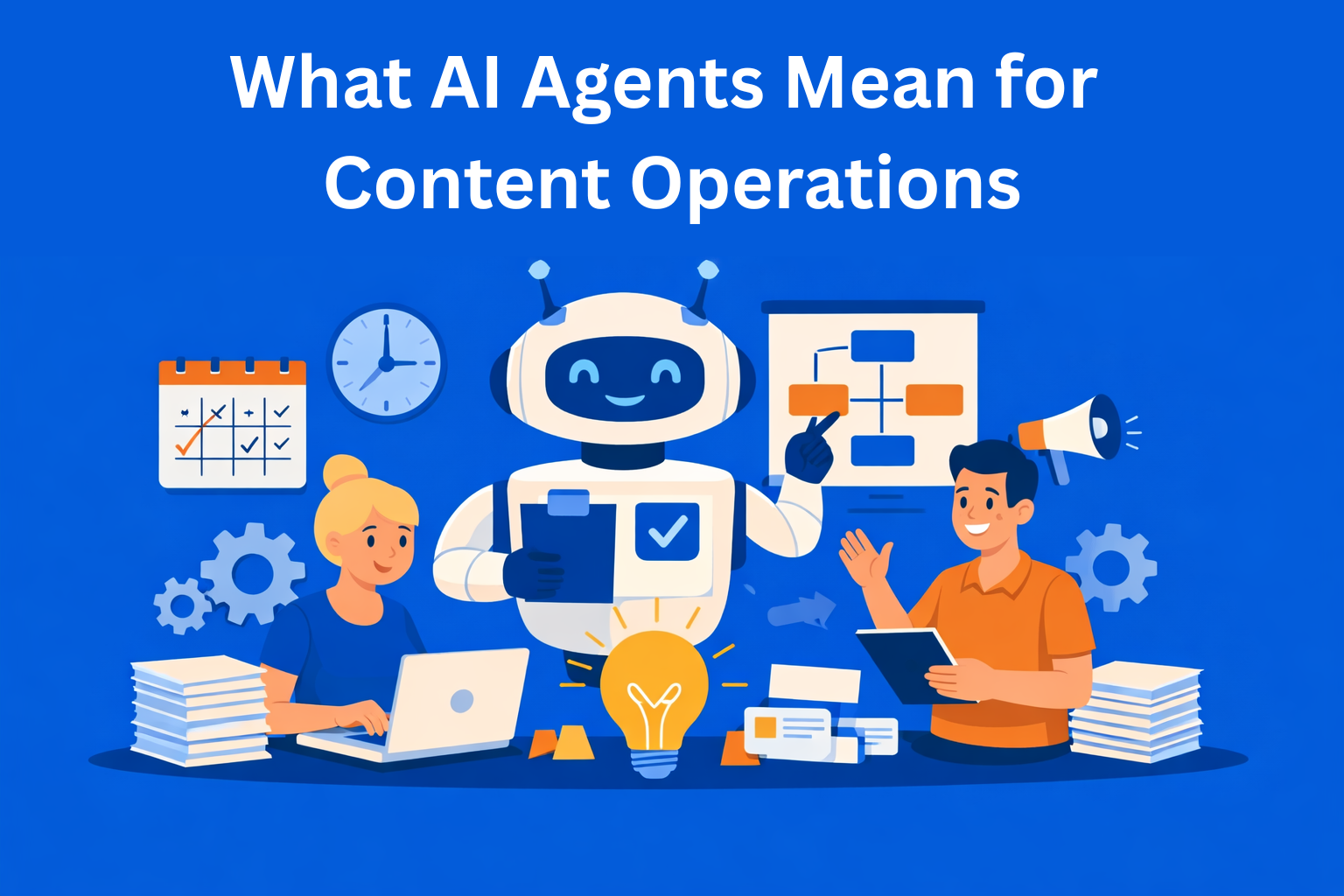
Until recently, AI was mostly seen as just another tool. Something you use when you need a quick piece of text or an idea. You type in a prompt and get a result. But today, things are different because AI agents have entered the picture.
They are no longer just tools we use from time to time. They behave much more like actual team members. They can take over tasks, track workflows, make simple decisions, and connect different parts of content operations. Instead of waiting for commands, AI agents know what they need to achieve and work toward that goal on their own.
For content teams, this can completely change how work is organized, who is responsible for what, and how the work can grow more easily.
In this blog, I’ll explain what AI agents are, how they affect content operations, and why understanding their role is essential for building efficient and reliable content systems.
Key Takeaways
- AI agents work toward goals, not prompts - they plan, execute, and move content through workflows without constant human input.
- Agents take over operational responsibility - tracking status, triggering next steps, and preventing work from getting stuck.
- Content roles shift from coordination to oversight - people focus on strategy and quality while agents handle execution flow.
- Scale requires systems, not more people - AI agents make content operations more reliable as volume and complexity grow.
- The real skill is system design - clear rules, workflows, and definitions enable agents to work effectively.
What Are AI Agents (and Why They’re Different From Traditional AI Tools)
The easiest way to understand the difference is this:
A traditional AI tool waits for you to tell it what to do. You write a prompt, it generates an output, and it stops there. If you want the next step, you have to repeat the process.
An AI agent, on the other hand, is given a goal. Based on that goal, it plans the steps, executes them, checks the result, and decides what to do next. That means an AI agent doesn’t just do one task, it runs a small process.
In practice, this means the agent doesn’t only write content. It knows when the content should be written, who it should go to for review, and what to do if something gets stuck.
That’s why AI agents matter. They don’t just speed up one part of the work, they connect the entire workflow into something that actually makes sense.
How AI Agents Take Responsibility in Content Workflows
One of the biggest changes AI agents bring is responsibility. That doesn’t mean they replace people, but that they take over the operational work that used to require constant human attention.
An AI agent can:
- assign a task to a writer when a new idea appears
- track the status of a piece of content
- notify an editor when a draft is ready
- trigger the next step in the workflow
What matters most is that the agent doesn’t wait for someone to say, “do this now.” It knows the rules of the process and follows them.
For content teams, this means less manual chasing and fewer things slipping through the cracks. Work flows more calmly because the system itself makes sure everything moves forward as it should.
How AI Agents Change the Way Content Teams Work
When AI agents take over part of the work, people spend less time on small details and more time on things that actually require humans.
Instead of a content manager constantly checking who’s late, what’s waiting for approval, or where things are stuck, the AI agent handles that automatically. The content manager can then focus on priorities, strategy, and quality.
In other words, people no longer hover over every single task. They agree on the rules and let the system do its job.
This is how AI agents change roles inside a content operations team. There’s less hands-on coordination and more oversight of the entire process.
AI Agents as Workflow Coordinators, Not Just Executors
AI agents can connect people, tools, and processes into a single flow of work, even though many people still think of them as just faster workers. They know when something is finished and when it’s time to move on. If something gets stuck, the agent notices and reacts immediately.
For example, an agent can wait for approval before a piece of content goes live. If that approval takes too long, the agent sends a reminder or flags that something is delayed.
This kind of coordination is critical for content operations because it prevents the chaos that often appears as teams grow. The bigger the team, the more important it is to have a system that keeps order on its own.
What This Means for Scale and Reliability
Many content teams can produce content at a small scale without major issues. But when there’s a need to grow, problems quickly become visible.
Without AI agents, scaling often means:
- more manual work
- more mistakes
- slower delivery
Instead of everything depending on one or two people who remember everything, the work relies on the system. That’s the difference between simply doing more work and having work that actually functions properly.
The New Skill: Designing Agent-Friendly Content Systems
As AI agents become part of everyday work, a new skill becomes increasingly important: system design.
The future of content operations isn’t about writing perfect prompts. It’s about defining clear rules, statuses, and workflows. AI agents work best when it’s clear what “done,” “waiting,” or “blocked” actually mean.
If a content team understands this, the work can run on its own, without constant вмешanje and firefighting. That’s a major shift in how teams think about their work.
Risks, Limits, and Where Humans Still Matter Most
Even though AI agents bring many benefits, it’s important to understand their limits. They are not a replacement for human judgment, they are support.
AI agents shouldn’t make strategic decisions on their own or define a brand’s voice. Their strength lies in execution and coordination, not creative leadership.
Humans are still essential for:
- strategy
- narrative
- final responsibility
The best results come when AI agents and people work together, each in their own role. This works especially well when combined with content management tools like EasyContent, where you can define your own workflows, assign team roles, customize templates for different content types, collaborate in real time, track content changes, and much more. When systems are set up this way, success is far more likely.
Conclusion
AI agents are not a passing trend. They are changing how content teams work and how work is organized.
Instead of being tools that are turned on and off, AI agents operate in the background and make sure work keeps moving the way it should.
Content teams that understand this shift and adapt their processes will be in a much better position to build efficient, scalable, and reliable content systems in the years ahead.