When Content Becomes a Liability Instead of an Asset
Content is meant to create long-term value, but without ownership, maintenance, and alignment, it can quietly turn into a liability. This blog explores how outdated and unmanaged content hurts teams and what it takes to make content work for the business again.

When we write blog posts, create pages, guides, and documents, we believe that content will bring value over time. The idea is simple: good content attracts people, builds trust, and supports the business. When done right, content can continue to deliver value long after it is published.
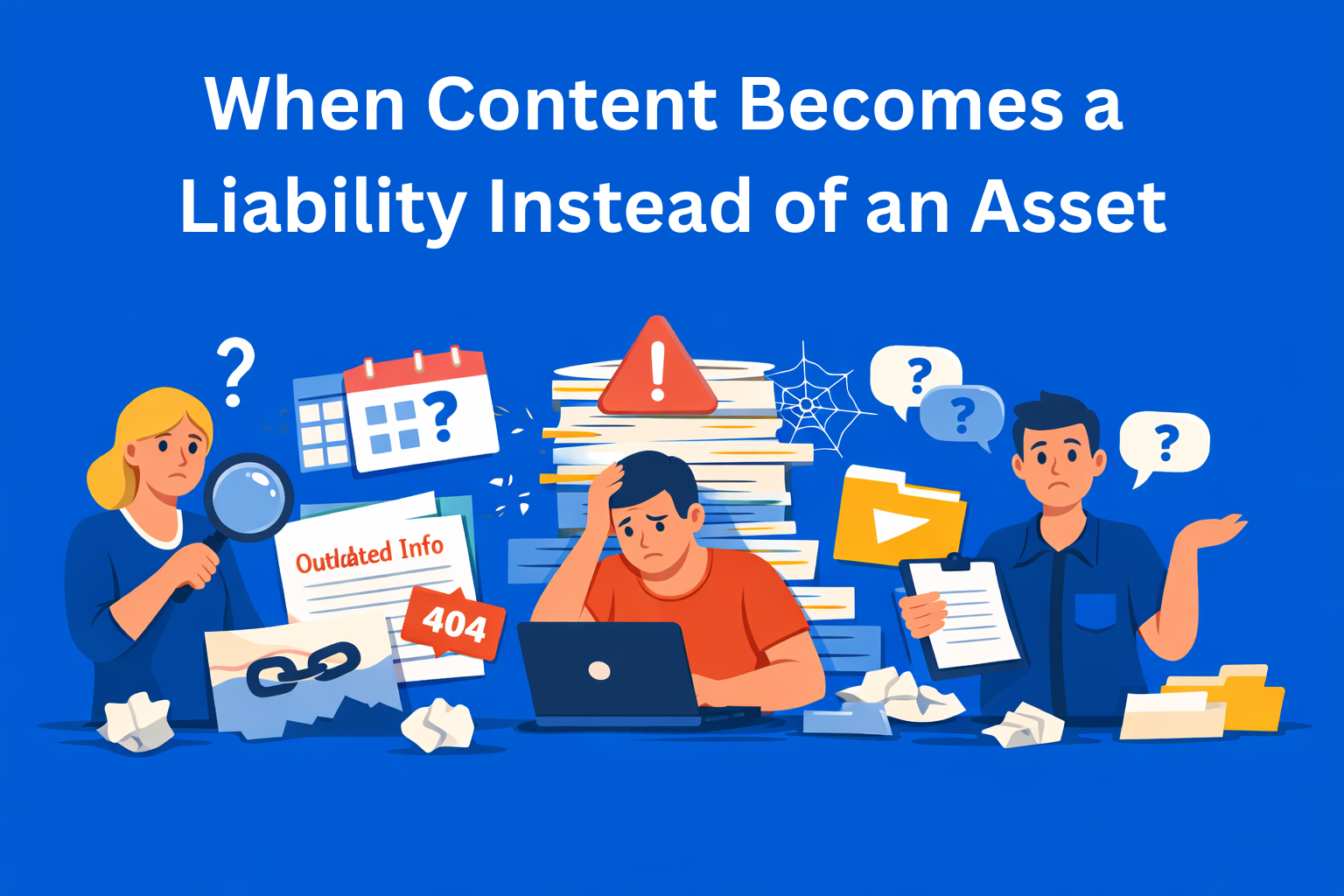
But in reality, the opposite often happens. Content stays on the website or in internal tools, but over time it stops being useful. Information becomes outdated, messages are no longer aligned, and some content is no longer used by anyone. Instead of helping, content slowly turns into a problem.
In this blog, we will explain how and why this happens. We will explain how content can become a problem instead of a help, why teams often don’t notice it in time, and what it takes for content to start supporting the business again.
Key Takeaways
- Content can lose value over time - without ownership, updates, and clear purpose, even good content becomes outdated.
- Outdated content actively harms trust - incorrect information and inconsistent messages confuse users and teams.
- Creation is prioritized over maintenance - teams focus on new content while existing content quietly decays.
- Content without ownership becomes a risk - when no one is responsible, content stays live even when it no longer makes sense.
- Content must be treated as a system - regular review, clear responsibility, and alignment turn content back into an asset.
Content Is Supposed to Create Value Over Time
Companies invest in content because they expect it to be useful in the long run.
- Because a good blog can bring people to the website for years.
- Clear documentation helps new employees find their way more easily.
- A good guide can reduce the number of questions the support team receives.
In other words, content is supposed to pay off over time. The longer it exists, the more value it should create. But this only works if content is maintained, updated, and used in the right context.
When content is published and then forgotten, it can very easily stop being useful. If it has no clear purpose and no one takes care of it, even the best text will slowly lose its value. That is where the problem really begins, and many teams don’t notice it until it is already too late.
What Content Looks Like When It Becomes a Liability
Content that has become a liability often does not look bad at first glance. The problem is that it no longer does what it was created to do.
The most common signs that content has become a liability include:
- Information that is no longer accurate
- Different versions of the same message in different places
- Blog posts that no one reads
- Internal documents that teams no longer open
- Pages that confuse users instead of helping them
This kind of content does not just fail to help, it can cause serious problems. People stop trusting what they see, teams get confused, and reaching business goals becomes much harder.
How Content Slowly Turns Into a Problem
Content almost never becomes a problem overnight. It usually happens slowly, step by step.
For example, a new blog post is published and no one thinks about who will update it a year later. A new landing page is created for a campaign, but it is never removed or adjusted when the campaign ends. A document is written for one team, and later other teams start using it, without any changes.
Over time, these small issues pile up. Content keeps growing, but there is no system to keep it under control. If no one knows who is responsible for content, if it is never reviewed, and if it has no clear purpose, content eventually starts causing problems for the very people who created it.
Why Teams Often Don’t Notice the Problem
One of the biggest challenges is that content problems are not immediately visible. Unlike technical issues, content can be “bad” while the system still technically works.
There are several reasons why teams don’t notice that content has become a liability. Most of them come down to the way people work and think:
- The focus is on creating new content, not maintaining existing content. People are constantly creating something new: a new blog post, a new page, a new PDF. What already exists is rarely reviewed or cleaned up.
- The job is considered done as soon as content is published. A post is published, a page goes live, and the team moves on. But content is like a shop window, if you don’t take care of it, over time it starts to look bad and push people away.
- There is no clear owner of the content. It is not clear who is responsible for which text or page. Everyone assumes it is someone else’s job, so no one touches it. Content stays as it is, even when it no longer makes sense.
- No one has a clear overview of everything that exists. Content is spread across the website, documents, tools, and folders. Over time, people don’t even know what all exists anymore, what is new, and what is outdated and useless.
As teams and businesses grow, this problem only gets bigger. There is more content, more people involved, and responsibility becomes less clear. Without a clear system and structure, control is very easy to lose.
The Hidden Costs of Poor Content
When people talk about the cost of content, they usually think about the time and money needed to create it. But poorly managed content has hidden costs as well.
When information is old or incorrect, people get confused and often give up on buying. When messages are inconsistent across different places, trust in the company drops. And when internal documentation is unclear, teams work more slowly and make more mistakes.
Instead of helping, content starts slowing processes down, creating extra questions, and increasing frustration. At that point, content is no longer neutral. It actively hurts the business.
The Difference Between Content That Exists and Content That Works
Not all content that exists is automatically useful. The key difference is purpose and maintenance.
Content that “works” has a clear goal. It is clear why it exists, who it is for, and how it is used. There is a person or a team responsible for it. This kind of content is reviewed from time to time, updated, and adjusted to new needs.
On the other hand, content that just sits there has no real purpose. It was created a long time ago because it was needed back then, but today it no longer serves a clear function. When it is unclear what it is for and where it is used, this kind of content easily becomes an obstacle instead of a help.
How to Turn Content Back Into an Asset
The good news is that most content problems can be fixed. The first step is changing the way people think about content.
Content should not be treated as a one-time project. It is an ongoing responsibility. This means that every piece of content should have an owner, a clear purpose, and a maintenance plan.
Some practical steps include:
- Knowing exactly who is responsible for which content
- From time to time, reviewing what exists and whether it still makes sense
- Fixing or removing outdated and incorrect information
- Making sure every piece of content has a purpose and supports something concrete in the business
These steps do not require a perfect system, but they do require consistency and awareness of how important content really is. To make this work properly, there are tools like EasyContent, where you can assign roles to each team member and clearly see who is responsible for what. You can create your own workflows and include the right people in them. One useful option is version tracking, which allows you to follow changes in content over time, for example when you want to update existing content.
Content as Part of a System, Not a Collection of Files
One of the most common problems is viewing content as a pile of separate files and pages. In reality, all of this content is connected and works as one system.
A blog post affects SEO. A landing page affects sales. An internal document affects how a team works. When content is viewed in isolation, it is easy to lose the bigger picture.
When content is viewed as a system, it becomes clearer where it helps and where it hurts. This approach makes decisions easier and reduces chaos.
Conclusion
Content can help a business a lot, but only if it is properly taken care of. If it is not clear who is responsible for it, if it is not maintained and aligned, it can very easily become a burden instead of a benefit.
The first step is admitting that the problem exists. The next step is changing the mindset. Content is not something you do once and forget about. It is something that needs ongoing attention.
In the end, the goal is not to have more texts, pages, and documents. The goal is to have content that actually works and helps the business.