When Content Decisions Are Made Too Late
Content problems rarely start with bad ideas. They start with late decisions. Delayed approvals, unclear ownership, and last-minute changes slow down your content workflow and hurt content performance. Here’s why making decisions earlier improves content strategy and results.

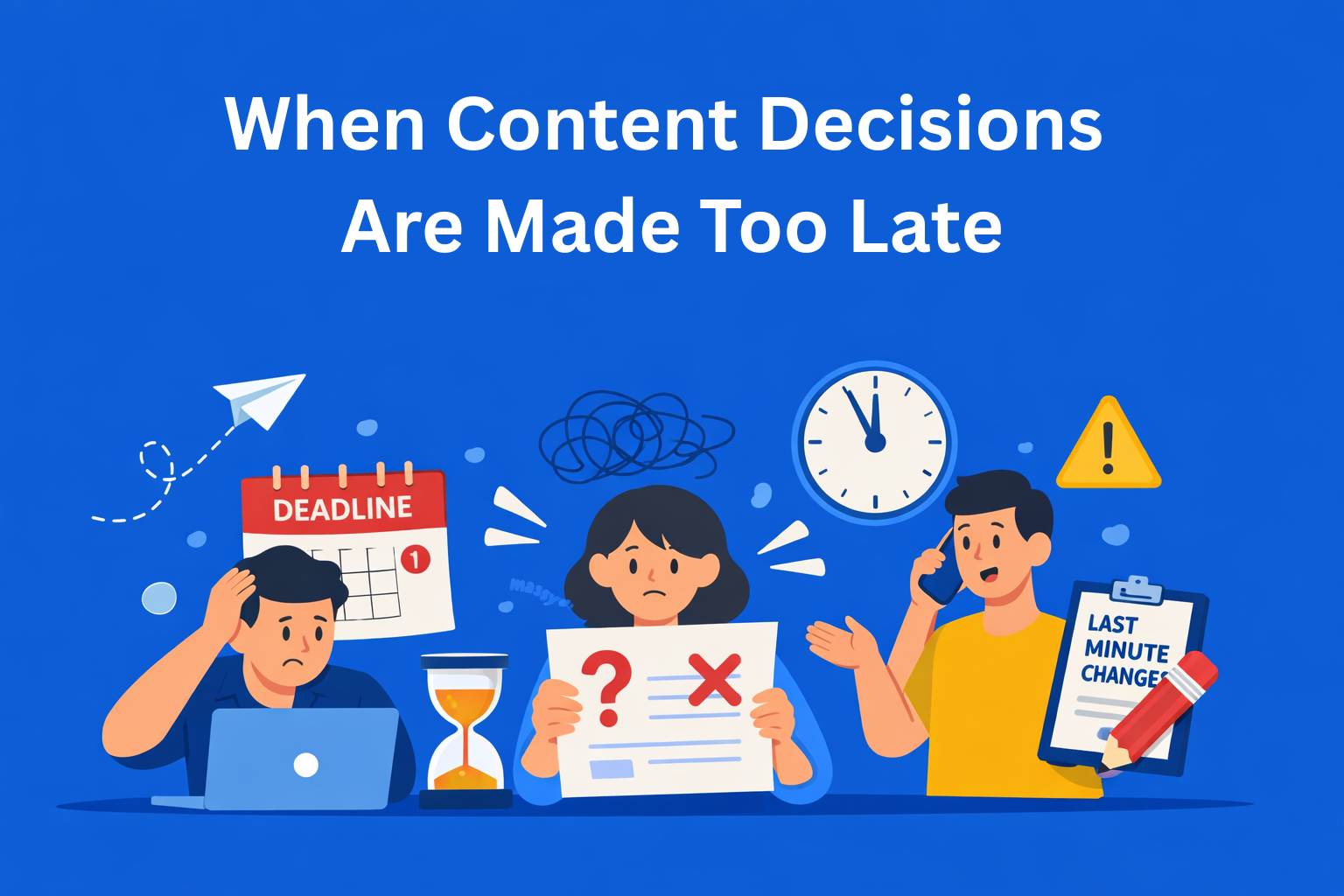
Content problems most often do not happen because the ideas are bad.
In most cases, teams have good ideas. The problem starts when important decisions are made too late, meaning when the work has already begun.
At the beginning, everything seems fine.
- There is a topic
- There is an outline
- Someone starts writing
- Designers prepare visuals
- Deadlines are set
And then, when almost everything is finished, someone says: “This is not what we had in mind.”
And then the team has to redo almost everything from the beginning. This is one of the biggest hidden problems in content strategy and content execution.
In this blog, we will talk about why delayed approvals, unclear decision ownership, and last-minute changes hurt content results, and why it is much better to make important decisions earlier.
Key Takeaways
- The problem is rarely the idea - it’s delayed decisions. When audience, goal, and direction are unclear at the start, content loses focus later.
- Late approvals damage momentum and quality. Waiting too long for feedback slows production, shortens deadlines, and increases rushed changes.
- Unclear ownership creates confusion. If no one has the final word, content gets pulled in different directions and loses its strength.
- Last-minute direction changes weaken performance. Rewriting content late in the process leads to mixed messages and lower engagement.
- Early clarity creates stronger results. Defining goals, audience, angle, and decision ownership upfront saves time, reduces frustration, and improves outcomes.
The Real Problem Is Not Ideas, It Is Timing
When content does not perform well, teams often assume that the problem is the idea.
“Maybe the topic was not strong enough.”
“Maybe we should have chosen something trendier.”
But in many cases, the idea was good. The real problem was that some important decisions came too late or were completely postponed.
If at the beginning we do not know who we are speaking to, the text will be unclear. If we do not know what we want to achieve, the message will be weak. If it is not clear who makes the decision, confusion appears.
By the time the team realizes something is wrong, the content is already written.
And fixing it at that stage is expensive, not only in terms of time, but also in energy and motivation.
How Delayed Approvals Slow Down the Entire Process
One of the most common places where things get stuck in a content workflow is delayed approval.
The blog is written. It is sent for review. And then… nothing.
It sits in someone’s inbox. Or it waits for “one more person” to review it. Or it gets moved to next week because other priorities feel more urgent.
While waiting for approval, the team does not know what to do next. So they move to another task, lose focus and lose momentum. And even when approval finally arrives, changes are made in a rush, deadlines get shorter and quality drops.
Late approvals do not just slow down the work. They damage the entire process of creating content.
The Hidden Cost of Unclear Ownership
Another big problem in content operations is that the team does not know who makes the final decision.
- Is it the marketing manager?
- The product team?
- The founder?
- The sales team?
If this is not clearly defined at the beginning, everyone gives their opinion, but no one takes responsibility.
Everyone starts sharing their opinion. One person says one thing, another says something else. The writer tries to satisfy everyone, and in the end the message loses its point.
Good content requires clear decisions. If it is not clear who decides, the text gets pulled in all directions.
And when you try to please everyone, in the end you please no one.
What Happens When Direction Changes at the Last Minute
Last-minute changes are very common in content production. For example, at the beginning the blog was supposed to educate beginners, and in the end it turns out that it should target decision-makers instead.
The text was originally planned to build awareness. Now it needs to drive conversions, and the tone was relaxed. Now it needs to sound more “corporate.”
Each change seems small. But when you add them all together, the team has to rewrite half of the text from scratch, and in the end everything looks messy and unfinished. Because you are trying to speak to both groups at the same time. And in the end, a good idea turns into average content.
When you change direction too late, the message completely gets lost.
Why Late Decisions Weaken Content Performance
It is easy to think that these are just organizational problems. But they directly affect content performance.
Clear decisions create a message with more focus, and that kind of message creates higher engagement, and higher engagement improves conversion.
When you change the strategy too late, the message becomes weaker and loses its strength. Readers feel that something is not right, they cannot fully connect, and they will not take the next step (sign up for a newsletter, buy a product or service, book a demo, and so on).
When you create content without order and clarity, results will constantly vary. And over time, people stop taking you seriously and lose trust in your brand.
Why Teams Delay Important Content Decisions
If late decisions create such big problems, why do we keep making them?
Here is why this most often happens.
1. Fear of Making the Wrong Decision
Some leaders delay decisions because they want more information. They want certainty. They want to avoid risk.
They think it is better to wait a little longer, to check one more thing and to be completely sure before they make the final call. But while they wait, time passes, the team stands still and the work drags on.
In the end, waiting too long often creates a bigger problem than if they had made the decision earlier, because then everything has to be done quickly and under pressure.
2. Too Many Stakeholders
In many companies, multiple teams are involved in content. Marketing, sales, product and management.
This means many people want to share their opinion and influence the direction of the text. But if it is not clear from the beginning who has the final word, chaos appears.
Without a clear decision structure, everyone wants to give input. And no one wants to take full responsibility.
In the end, everything drags on. The text keeps going back for revisions and time is lost. If it is not clear who is in charge, everything moves slowly and confusion grows.
3. Lack of Clear Priorities
If business goals are not clearly defined, content goals will not be clear either.
That means the team does not know exactly what they are trying to achieve. One day one thing is important, the next day something else.
When priorities constantly change, the direction of the text changes too. And in the end nothing has a clear direction. The audience notices that.
4. Avoiding Responsibility
Sometimes decisions are intentionally delayed because no one wants to take responsibility.
If the decision is not made on time, later it is easy to say that “it was not the right moment” or that “there was not enough information.”
In this way, no one is directly to blame, but the work stands still and everyone waits. The team goes in circles, energy drops and everything takes longer than it should.
In the end, this creates a slow and inefficient process that exhausts people and slows down results.
What Changes When Decisions Are Made Earlier
Now imagine a different scenario.
Before writing begins, the team clearly defines:
- Who exactly we are speaking to
- What exactly we want to achieve
- From which angle we are telling this story
- What we want people to do after reading
- Who has the final word
Once you agree on these things, the work begins.
To make this easier, there are tools like EasyContent, where you can define your own workflow, assign roles and permissions to each team member, and in that way everyone knows exactly what their task is. One option is also creating your own templates for every type of content you produce, communicating in real time with team members, and many other features.
All of this creates momentum, and that momentum improves production and the final content result.
Conclusion
Many teams think they need something big and complicated. They buy new AI tools. They hire more people. They change their entire way of working.
But often they just need to make important decisions earlier.
When it is clear from the beginning who decides and what the goal is, everything becomes easier. There is less going back for revisions. There is less frustration. Results are better.
The problem is not the ideas. The problem is when decisions are made too late.
Sometimes you do not need to create more content. You just need to decide earlier what exactly you are doing.