Where AI Fits (and Where It Doesn’t) in the Content Creation Process
AI can support ideation, research, drafting, and optimization, but only when used intentionally. This guide breaks down the content creation process step by step, showing where AI adds real value and where human judgment, context, and decisions still matter most.

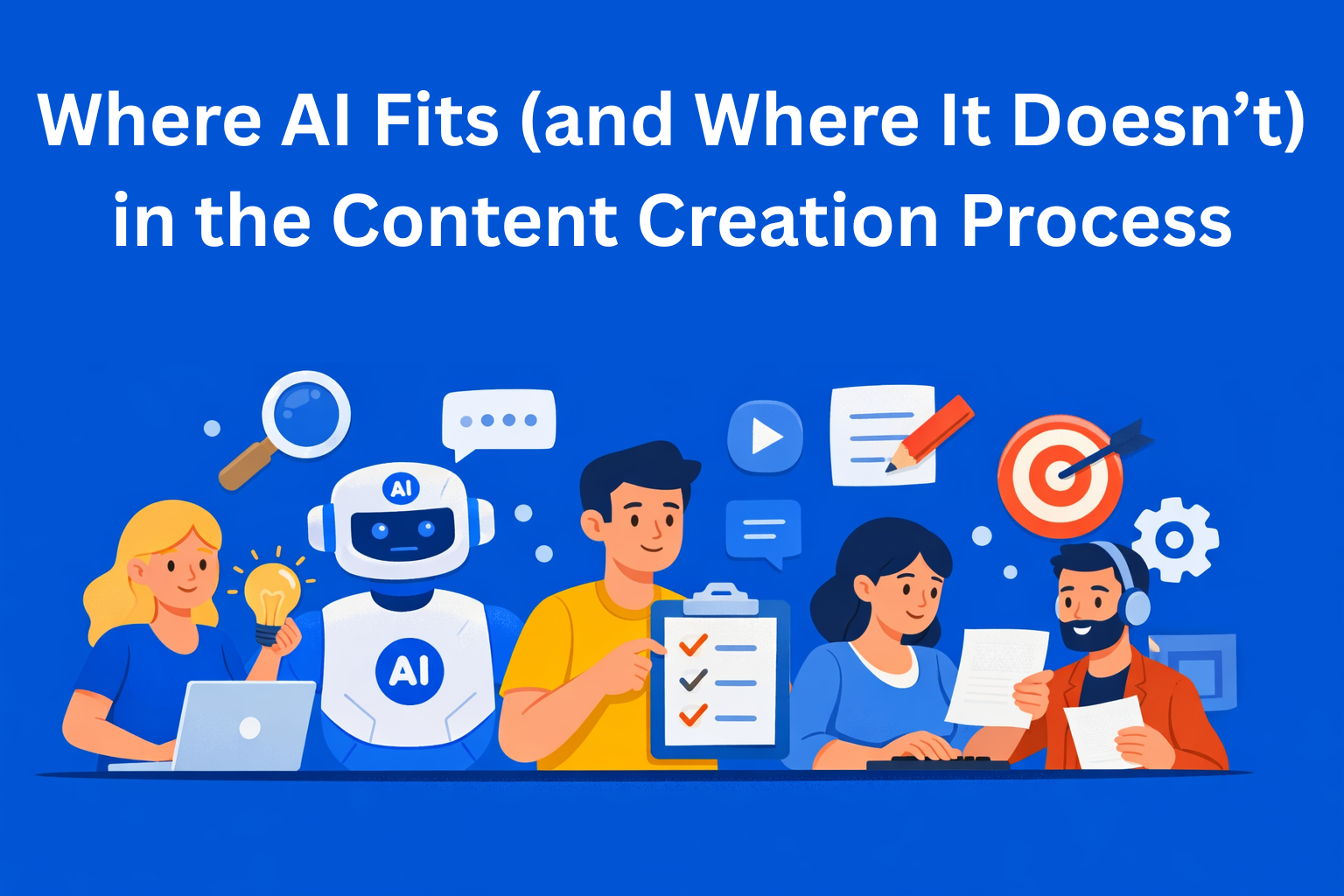
Today, AI is present in almost every conversation about the content creation process. Blogs are written with AI, social media posts are generated, email campaigns are drafted, and even content strategies are shaped with its help. Because of this, many teams feel that they have to use AI, and use it as much as possible. The problem begins when AI is used without a clear understanding of where it truly adds value and where it can cause more harm than good.
Key Takeaways
- AI supports execution, not strategy - AI helps with ideas, drafts, research, and optimization, but people define goals, priorities, and direction.
- Ideation and research need human context - AI can generate ideas and summaries fast, but humans decide what matters and verify accuracy.
- First drafts are scaffolding - AI speeds up drafting, but without human thinking, content stays generic and forgettable.
- Editing is where value is created - Decisions about tone, emphasis, and meaning must always stay with human editors.
- Strong systems make AI useful - When AI works inside clear workflows with ownership and guidelines, teams gain speed without losing control.
Why “More AI” Doesn’t Automatically Mean Better Content
One of the most common mistakes in the content creation process is assuming that AI will automatically improve content quality. In practice, the opposite often happens. When the process is unclear, AI only speeds up confusion. Instead of better content, teams end up producing more material that sounds the same, lacks a clear point of view, and serves no specific goal.
AI does not understand business goals, audiences, or broader context in the same way people do. It reacts to the input it receives. If that input is unclear, the output will not be high quality either. That’s why it’s important to understand that AI is not a strategist. It is a tool that can help with execution, but not with decision-making.
Step 1: Ideation, Where AI Helps, and Where You Need to Stop
Ideation is the stage where content ideas are created. At this stage, AI is most useful when it works within clearly defined briefs, goals, and structures, because that keeps ideas connected to real business and team needs. In this context, AI can be very helpful. For example, it can suggest blog topics, content angles, or questions that an audience often asks. This is especially useful when a team hits a creative block or is entering a new topic for the first time.
In the content creation process, AI can quickly list and expand ideas, which works well as a starting point. The problem arises when AI is used as the only source of ideas. It does not understand what truly matters for your business, which topics have long-term value, or what should be prioritized at a given moment.
That’s why people need to decide which ideas actually make sense, while AI helps shape them. An idea without context is just text. Strategy is what gives an idea real value.
Step 2: Research, AI as an Assistant, Not a Source of Truth
Research is another stage where AI can be extremely helpful. It can quickly summarize complex topics, explain basic concepts, or provide an overview of a subject area. For someone with no prior knowledge, this can be a great starting point.
However, in content marketing, accuracy and relevance are critical. AI can make mistakes or surface information that is no longer up to date. It also doesn’t always know the difference between a surface-level fact and a meaningful insight. That’s why human judgment is still essential.
In a well-structured content creation process, AI helps teams get to information faster, while people verify sources, add context, and decide what truly matters to the audience.
Step 3: Drafting, Speed Without Thinking Is a Trap
Writing the first draft is the stage where AI most often enters the process today. When AI is part of a system that uses templates and predefined fields, it can help create a draft that follows an agreed structure and standards from the start. And for good reason. AI can very quickly turn ideas into structured text. It can suggest an introduction, section flow, and a basic narrative.
In the content creation process, this can significantly speed up work. But this is also where the biggest trap appears. If an AI-generated draft is treated as finished content, it often sounds generic, lacks a clear voice, and has no real point of view.
People are the ones who give meaning to the text. They decide what needs to be emphasized, where to pause, and where to go deeper. AI can write text, but it cannot understand why that text is being written.
Step 4: Editing and Decision-Making, The Part AI Can’t Replace
Editing is often an underestimated stage in the content creation process. In practice, AI can assist at this stage by suggesting improvements, but final changes always go through human review, comments, and a clear approval process. Many people think editing is just fixing mistakes. In reality, editing is about making decisions. What stays in the text, what gets removed, and what needs to change.
This is the moment when content gains a clear message and purpose. A human editor adds nuance, adjusts tone, and ensures the text makes sense for a specific audience. AI can suggest edits, but it cannot take responsibility for decisions.
Without this stage, AI-generated content remains just a collection of sentences, without clear value.
Step 5: Optimization, AI as a Tool, Not a Strategist
Optimization is another area where AI plays a role. When AI is integrated into an existing workflow, its SEO and structural suggestions remain visible and controlled, with a clear understanding of who makes the final decisions and when. AI can help with SEO recommendations, headlines, subheadings, and text structure. In content marketing, this can improve visibility and performance.
But optimization without strategy leads to empty content written only for algorithms. People decide what should be optimized and why. AI can help with the technical side, but it cannot define goals.
In a strong content creation process, optimization comes after a clear message, not instead of it.
Where AI Most Often Becomes a Roadblock
AI becomes a problem when it is used without rules. When there is no clearly defined process, when no one takes ownership, and when AI output is treated as the final version. In those cases, content quality drops and teams lose control.
Another common issue is misalignment. When different team members use AI in different ways, without shared guidelines, the result is inconsistent content.
What a Healthy Relationship Between AI and a Content Team Looks Like
In practice, this kind of relationship is easiest to achieve when AI is not treated as a separate tool, but as part of the same system in which a team plans, writes, edits, and approves content. For example, in EasyContent, AI is built directly into the content workflow, helping teams use it where it makes the most sense, without skipping human decisions. A healthy content creation process clearly defines where AI enters the workflow and where people take control. AI is used to speed things up, support research, and assist execution, while people make decisions, set strategy, and protect quality.
This approach allows teams to use AI intentionally, without losing control over their content. The focus is not on the tool, but on the system.
Conclusion
AI can significantly improve the content creation process, but only when it is set up correctly. It amplifies what already exists. If the process is strong, AI makes it faster and more efficient. If the process is weak, AI simply accelerates the problems.
The best teams use AI as support, not as a shortcut. Thinking, context, and strategy still come from people. AI is there to help, not to replace what makes good content truly good.