Who Benefits More From AI: Lean Content Teams or Large Editorial Departments?
AI boosts every content team, but in different ways. Lean teams gain speed and capacity; large teams gain coordination and consistency. This blog breaks down who benefits most - and why.

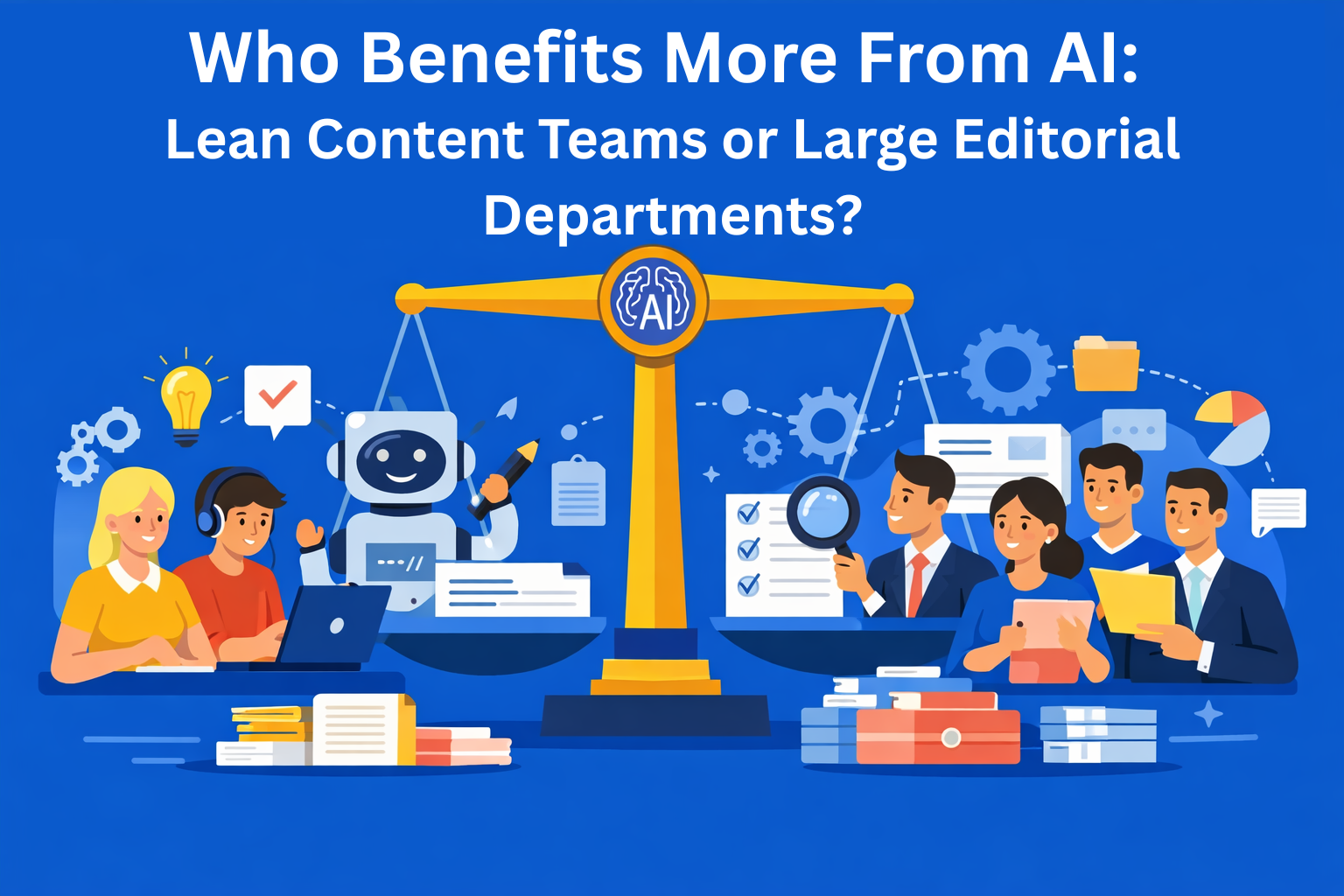
AI helps every content team, but in different ways. Smaller teams gain speed and capacity, while larger teams gain better coordination and consistency. This blog explains who benefits the most, and why.
AI didn’t arrive quietly. It came with a promise of faster writing, fewer bottlenecks, more ideas, and less repetitive work. But how those benefits actually show up depends largely on the size of the team.
Lean content teams often see AI as extra hands, support they never had before. Large editorial departments see it as a way to finally bring order to operations that have grown too complex. Both groups “win,” but not in the same way and not for the same reasons.
Let’s break down where AI truly makes a difference for each.
Key Takeaways
- Lean teams gain capacity, not just speed - AI helps smaller teams draft, ideate, and repurpose faster, giving them room to focus on strategy instead of nonstop execution.
- Large teams gain alignment, not just efficiency - AI supports bigger editorial groups by reducing tone drift, shortening review cycles, and simplifying coordination across many contributors.
- AI cuts repetitive workload for everyone - tasks like product descriptions, metadata, headline variants, and cleanup become lighter and more manageable for all team sizes.
- AI never replaces judgment or expertise - strategy, accuracy, context, and brand nuance still require human oversight regardless of how advanced the tools get.
- Workflow is the real competitive edge - AI delivers real value only when teams have strong processes and systems that turn raw drafts into consistent, high-quality content.
How Lean Content Teams Benefit From AI
Small teams feel the impact of AI immediately, because every saved hour matters. One person is often balancing strategy, writing, editing, publishing, and reporting so automation removes friction across multiple pain points at once.
Lean teams benefit the most from:
Speed and momentum
In practice, this works best when AI is used inside a structured workflow, rather than as a standalone tool. Platforms like EasyContent combine AI writing with clear templates and briefs, allowing teams to move faster without losing clarity or structure.
AI enables solo creators and small teams to draft, outline, and generate ideas more quickly. Not perfectly, but fast enough to break the “blank page” paralysis.
More space for strategic work
When AI reduces the time spent rewriting paragraphs or generating alternatives, teams finally gain room to think bigger: themes, user needs, and long‑term quality.
Support for repetitive tasks
When these tasks live in one place drafts, metadata, comments, and approvals teams avoid the usual copy‑paste chaos across tools. A centralized workspace, such as EasyContent, helps ensure fast AI outputs don’t become fragmented or lost.
Product descriptions, headline variations, content repurposing, metadata the tasks no one enjoys become easier, faster, and far less mentally draining.
Consistency across channels
If you’re a team of one or two publishing across multiple channels, AI helps keep tone and structure consistent even on days when your energy is low.
Lean teams don’t get “more people.” But they get something surprisingly close: more capacity.
How Large Editorial Teams Benefit From AI
For larger organizations, AI delivers the most value when it’s embedded into the same systems teams already use to plan, review, and approve content, not when it’s added as yet another disconnected tool.
For large departments, the benefits aren’t about speed, they’re about alignment.
When dozens of writers, editors, and reviewers touch the same content, the challenge usually isn’t creativity. It’s consistency, coordination, and staying aligned as volume grows.
AI helps large teams through:
Unified tone and framing
Instead of tone varying across writers or formats, AI helps everyone start from a shared baseline, smoothing out inconsistencies that previously required extra editing rounds.
Faster review cycles
When AI‑assisted editing is paired with visible workflows, change tracking, and shared context, editors can focus on decisions instead of detective work. This is where workflow‑first platforms quietly shine, keeping AI suggestions reviewable, traceable, and reversible.
Editors can use AI to tighten sections, improve clarity, highlight weak spots, or surface missing context, without spending half the day line‑editing.
Reducing operational complexity
High‑volume teams often deal with multiple approval layers, subject‑matter reviews, and distribution steps. AI helps reduce friction at every stage.
Better reuse of institutional knowledge
Systems that store templates, past content, and structured guidelines make reuse far more reliable. Instead of relying on memory or scattered documents, teams can consistently feed proven structures and language back into new content.
AI helps large teams preserve past work frameworks, structures, examples, brand language and reuse it in new content without constant manual oversight.
Large teams don’t need AI to write more. They need AI to make the entire machine run smoother.
Limitations (Shared by Both Types of Teams)
This is where tooling choices really matter. Without guardrails - version history, approvals, and clear ownership, AI can just as easily amplify confusion as reduce effort.
AI does not eliminate:
- strategic judgment
- subject‑matter nuance
- brand voice precision
- final editorial decisions
- legal or compliance requirements
It’s an amplifier, not a replacement.
And if used carelessly, it can create even more mess, scattered drafts, duplicated ideas, version confusion, and content that feels coherent but isn’t actually correct.
The tool helps. The workflow matters even more.
Conclusion
So, who benefits more from AI, lean teams or large editorial departments? The honest answer is: both, just in different ways. Small teams gain speed and breathing room; large teams gain alignment and operational clarity. What they share is the need for a system that turns raw AI output into consistent, strategic, polished content, something prompts alone can’t deliver.