Why Your CEO’s LinkedIn Matters More Than Your Company Page
A CEO’s LinkedIn profile often drives more reach, trust, and engagement than a company page. This blog explains why executive profiles matter, how they build authority, and how content teams can use them as a powerful, authentic content channel.

If we look at how most companies behave on LinkedIn, a familiar pattern appears. Posts are published regularly from the company page, new blogs, case studies, or press releases are shared, and then everyone waits for engagement. In reality, the reactions are often modest, comments are rare, and reach is limited.
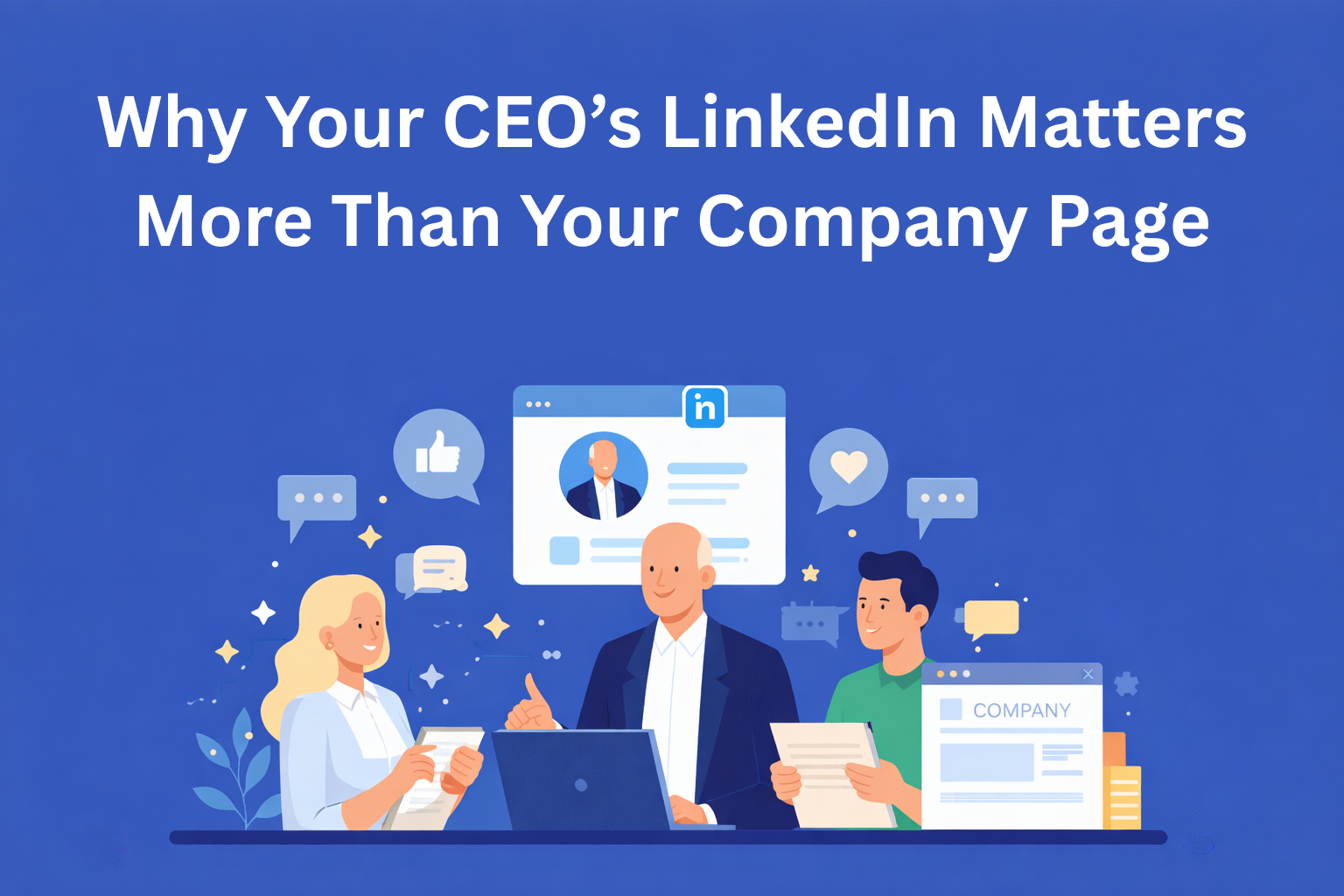
At the same time, a single personal post from a CEO, written in a simple and honest way, often gets significantly higher reach and more reactions. This is not a matter of luck. It comes from the way people actually use LinkedIn. It is a network built around people, their experiences, and their opinions. It is not built around logos.
In this blog, we explain why a CEO LinkedIn profile often has more impact than a company page, why it carries more authenticity and authority, and how content teams can use it as a strong and sustainable content channel, even when the CEO has limited time or no writing experience.
Key Takeaways
- People trust people, not logos - CEO posts feel more human and naturally attract more engagement than company page updates.
- CEO profiles have stronger organic reach - LinkedIn prioritizes personal profiles, especially executive ones, over brand pages.
- Authenticity beats promotion - simple, honest CEO perspectives build more trust than polished corporate messaging.
- The CEO profile is a strategic content channel - it supports sales, employer branding, partnerships, and brand visibility at once.
- Content teams amplify the CEO’s voice - by structuring ideas and refining tone without losing authenticity.
Company Page vs. CEO Profile: Where the Real Difference Is
At first glance, a company page seems like the logical place to publish content. It is the official channel of the company, where all links, products, and updates live. The problem is that LinkedIn’s algorithm and its users do not react to pages and personal profiles in the same way.
Personal profiles, especially executive profiles, have a natural advantage. People find it easier to start a conversation with a person than with a brand. They are more willing to comment, share, and react when a real person publishes a post. That is why a CEO LinkedIn presence often has higher organic reach than a company page, even when the company has far more followers.
A company page usually communicates in a formal, corporate tone. A CEO profile, on the other hand, can be more personal, open, and direct. That difference in tone creates a significant difference in perception and trust.
Authenticity as the Currency of Attention
One of the main reasons CEO profiles perform better is authenticity. People do not come to LinkedIn to read ads. They come to understand how others think, how they make decisions, and how they deal with challenges.
When a CEO shares a personal experience, even a simple thought about a business problem, it feels more real than a perfectly polished company page post. This does not mean the CEO needs to share private details. It is enough for the tone to feel human and honest.
Content teams often make the mistake of trying to make CEO posts sound like PR statements. At that moment, the biggest advantage of a CEO LinkedIn strategy is lost, the feeling that the person behind the profile truly stands behind the words being shared.
Authority Built Through Thinking, Not Promotion
A CEO already has authority because of their role, but LinkedIn makes it possible to strengthen that authority through content. The key is not to use the profile as a sales channel, but as a space for thinking.
When a CEO talks about industry trends, mistakes they have made, or lessons they have learned, they are not directly selling a product. They are building trust. Over time, the audience starts to see the CEO as a relevant and reliable source, and that authority naturally extends to the company itself.
Unlike paid ads, this kind of LinkedIn thought leadership cannot be bought. It is built gradually, through consistent and meaningful content.
Why a CEO Profile Can Be the Strongest Content Channel
In many companies, the CEO LinkedIn profile is actually the strongest, and most underused, channel. This is because it combines organic reach, personal trust, and strategic messaging in one place.
A single strong CEO post can:
- start an industry conversation, because people are more likely to react and join in when an opinion or question comes from a real person rather than a brand
- bring new followers to the company page, as part of the audience first connects with the CEO and then naturally wants to learn more about the company behind them
- attract potential clients or partners, who gain a clearer picture of the company’s thinking, values, and direction through the CEO’s posts
- strengthen employer branding, since candidates often judge company culture through the tone and messages a CEO shares publicly
For content teams, this means the CEO profile should not be treated as extra work, but as an extension of the existing content strategy. Blogs, research, and internal insights can easily be turned into shorter, simpler posts on the CEO’s profile, where the CEO shares their perspective, experience, or point of view.
The Role of the Content Team in a CEO LinkedIn Strategy
A common misconception is that the CEO must write every post alone. In practice, this rarely works. CEOs have limited time, while content teams bring structure, clarity, and writing skills.
The real role of the content team is to help the CEO turn their thoughts into clear, readable content, without losing their personal voice. This can include:
- short conversations with the CEO (or notes from meetings) that surface ideas and opinions the CEO already has
- editing and structuring the text so the message is clearer and easier to read, while still sounding like something the CEO would write
- adjusting the tone for a LinkedIn audience, so posts do not sound overly formal, corporate, or promotional
It is important not to cross the line and turn CEO posts into generic ghostwritten content. If the audience feels the content is not authentic, the impact disappears.
How to Use a CEO LinkedIn Profile Without Overloading Them
The good news is that a CEO does not need to post every day. Consistency matters more than frequency. One or two high-quality posts per week are often more than enough.
The posts that perform best are usually:
- short and clear, meaning they are easy to read and the main point is immediately understood
- focused on one idea, so the reader does not have to guess what the post is trying to say
- written in simple language, without jargon or complicated sentences that push people away
CEO LinkedIn content can support the company page, but it should not copy it. The company page can share formal updates, while the CEO profile adds context and a personal angle.
The Most Common Mistakes Teams Make
One of the biggest mistakes is turning the CEO profile into another version of the company page. When every post feels like an advertisement, the audience quickly loses interest.
Another common mistake is posting inconsistently without a clear purpose. Without a basic LinkedIn content strategy, posts feel random and fail to build long-term impact.
The third mistake is being afraid of simplicity. Many teams believe a CEO must sound “smart” in every post. In reality, clarity and simplicity are far more effective.
Conclusion
Attention is limited today, and people choose to follow people, not brands. That is why a CEO LinkedIn presence often has more impact than a company page, even when a company has a strong marketing team.
For content teams, this is an opportunity to expand the existing strategy and include the CEO profile as an important part of the overall content mix. Not to replace the company page, but to add a personal voice, trust, and the sense that real people stand behind the brand.
When used the right way, a CEO LinkedIn profile becomes a place where strategy turns into conversation, and the brand becomes a real story people want to follow.