The Death of the Single Prompt: Why 2026 Content Runs on Prompt Chains
One good prompt is no longer enough. In 2026, content teams are moving to prompt chains, a clear way of working where AI moves step by step. This blog explains why this shift is happening and how it improves content quality.

For a long time, it seemed like working with AI required just one thing: a good prompt. You write a sentence, hit enter, and get a text. For many content teams, this was their first contact with AI tools, and at that moment, it felt like enough. One prompt, one result, job done.
But as the work grew and content became more and more important, it quickly became clear that this approach did not really work that well. One text would turn out good, the next one weaker, and the third with a completely different tone. Everything depended on whether you happened to “hit” the right prompt at that moment or not.
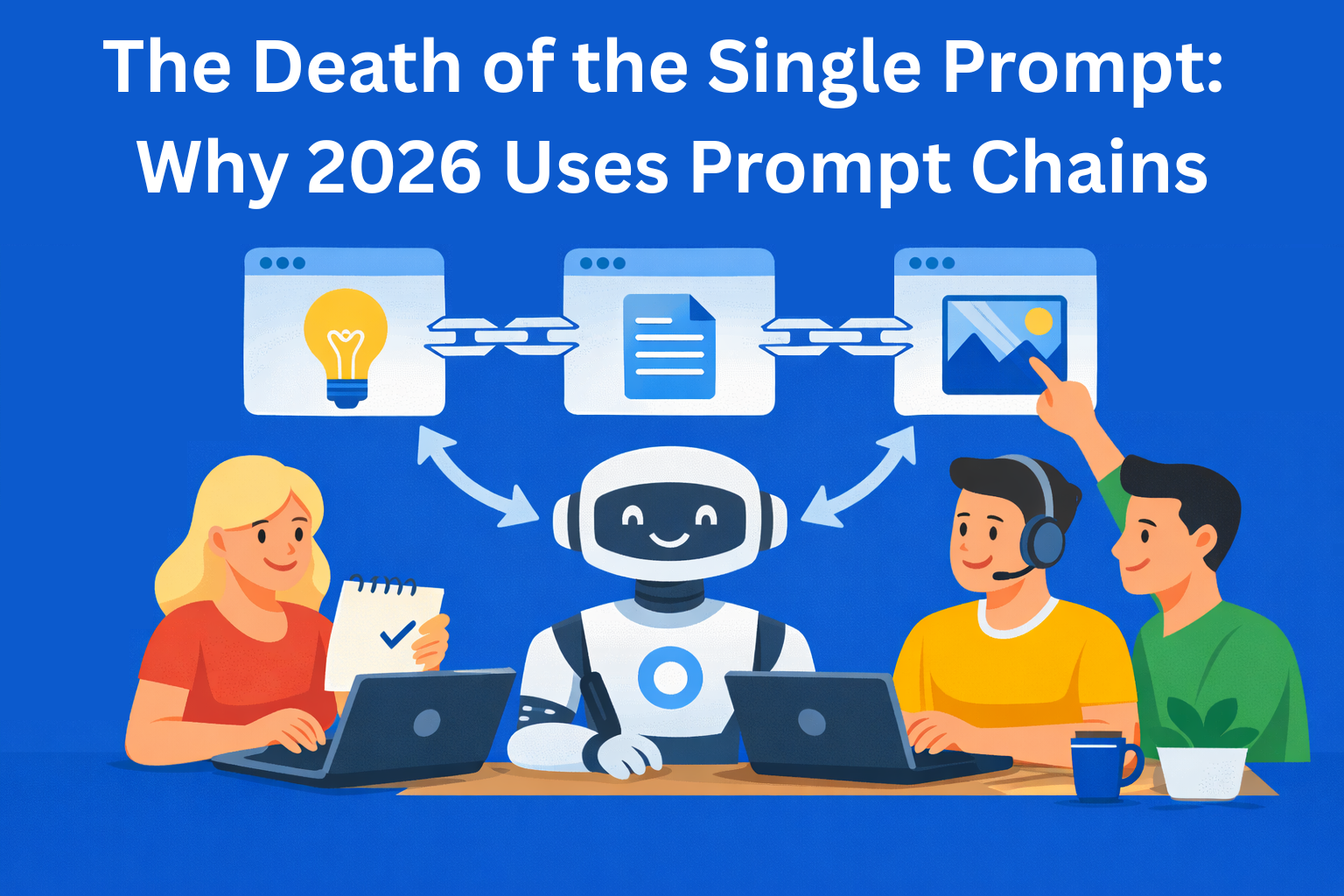
In 2026, content teams can no longer rely on a single prompt. Instead, more and more teams are working with prompt chains, meaning chains of prompts that together form a process, not just a single step.
In this blog, we will talk about why the single prompt approach is slowly disappearing, how prompt chains help content become better and more consistent, and what that means in practice for how teams use AI in their everyday work.
Key Takeaways
- Single prompts don’t scale - they create inconsistent tone, structure, and quality when content production becomes continuous.
- Prompt chains turn AI into a process - step-by-step prompts guide AI instead of forcing it to do everything at once.
- Consistency comes from upfront decisions - audience, tone, and structure are defined early and reused across every piece of content.
- Breaking work into steps improves quality - clearer structure, better flow, and fewer generic sentences are a natural result.
- 2026 is about systems, not clever prompts - the real advantage comes from repeatable workflows, not one-off AI instructions.
What “single prompt” actually means (and why it held us back)
A single prompt is the simplest way of using AI. It is one request, one instruction, and one output. For example:
“Write a blog post about AI trends.”
Or:
“Translate this text and make it more formal.”
This approach was useful at the beginning because it is fast and simple. It does not require planning, structure, or thinking about the process. However, that is exactly where the problem lies.
With a single prompt, every text is created as if it exists on its own. AI does not know what you did before, it does not remember previous decisions, and it has no idea how that text fits into the bigger picture. Tomorrow, for a similar topic, you will get a completely different style, a different tone, and a different way of writing.
For small, one‑off tasks, this might not be a big problem. But for content teams that work continuously, the single prompt quickly becomes a problem in the AI content workflow.
Why content teams are turning to prompt chains
As AI started being used more and more in everyday work, expectations also grew. It is no longer enough for a text to simply exist. What matters is that the text makes sense, sounds similar every time, fits the people who read it, and can easily be created again in the same way.
At that point, a single prompt is no longer enough. Content teams realized that the problem is not that AI “writes badly,” but that it is being asked to do too many things at once.
That is why, in 2026, people are talking more and more about the prompt chains approach. Instead of asking AI for everything at once, the work is broken down into smaller, clearer steps. You move step by step, and each next step builds on the previous one.
What prompt chains are (simple explanation)
A prompt chain is a series of connected prompts that together form one process. Instead of telling AI everything at once, you guide it step by step.
For example:
- Explain the topic in a simple way, as if to a beginner
- Define the main points of the text
- Develop each point in a separate paragraph
- Adjust the tone to be relaxed but professional
- Edit the text so it is easy to read
Each of these steps is a separate prompt, but together they form a whole. This gives you more control, better structure, and higher‑quality content.
How prompt chains improve content consistency
One of the biggest problems with single prompts is inconsistency. Today you get a good text, tomorrow an average one, and the day after something with a completely different tone.
Prompt chains solve this problem because the key decisions are made upfront. For example, tone, style, and audience are defined in the first step and then used throughout the entire chain.
This means that every new text starts from the same agreed‑upon basics. AI does not have to guess how the text should sound, because that is already clear from the beginning.
For content teams, this means fewer corrections, less back‑and‑forth, and more trust in AI as something they can rely on, rather than something that works well today and poorly tomorrow.
The impact of prompt chains on content quality
When work is broken down into smaller steps, quality naturally improves. AI has space to focus on one thing at a time.
Instead of thinking about structure, tone, audience, and message all at once, each prompt has a clear purpose. This leads to:
- text that is clearer and easier to follow
- ideas that flow in order and make sense
- fewer empty and generic sentences
- content that feels like someone actually thought it through before writing it
In 2026, the quality of AI‑generated content depends less and less on a “smart prompt,” and more and more on a good working system.
Prompt chains and modern content workflows
Prompt chains fit perfectly into modern content workflows. They make it possible to document the entire process, repeat it, and improve it over time.
Instead of every writer working in their own way, a team can have standardized prompt chains for blog posts, landing pages, newsletters, or social media content. Another thing that can make this much easier is using tools like EasyContent. For example, you can create a template for every type of content you produce and place your prompts inside those templates, so they are always stored in one place. On top of that, you can define your own workflow, assign roles to team members, set permissions, and include everything in a single workflow. This way, you can always be sure that content stays consistent, because everyone knows exactly what their role is and can always use the same prompts from one central place.
This means that AI is no longer just occasional help, but a normal part of everyday work.
Why 2026 is a turning point
By 2026, most content teams have already gone through the phase of experimenting with AI. The focus is now shifting from the question “should we use AI?” to “how do we use AI in a smart way?”
People are tired of AI hype, too many tools, and unclear processes where nobody really knows who is responsible for what. That is why teams started looking for something simpler and more meaningful. Prompt chains are one of the answers to that problem.
They bring order into the work, reduce improvisation, and help teams consistently get similar, reliable results without constant changes and fixes.
How content teams can start thinking in prompt chains
The first step is a change in mindset. Instead of looking for the perfect prompt, the focus should be on the process.
That means:
- breaking content down into logical steps
- documenting prompts
- testing and improving chains
- thinking about how the same way of working can be easily repeated every time
Once this way of working is adopted, AI becomes a reliable part of the content team.
Conclusion
A single prompt was fine as a starting point, but it is no longer enough for serious work. In 2026, content is not created from one question or request, but through a clear and well‑structured way of working.
Prompt chains are the next logical step. They help content stay consistent in quality, make sense, and ensure that the team knows what is happening at every step.
In the future, what matters most will not be who can write the “best prompt,” but who can build a simple, solid process that consistently delivers good results.