Why “More Content” Still Isn’t the Answer in 2026
Creating more content used to feel like the fastest path to growth. In 2026, it often leads to more noise, wasted effort, and internal chaos. This post explains why volume no longer works and what content teams should focus on instead.

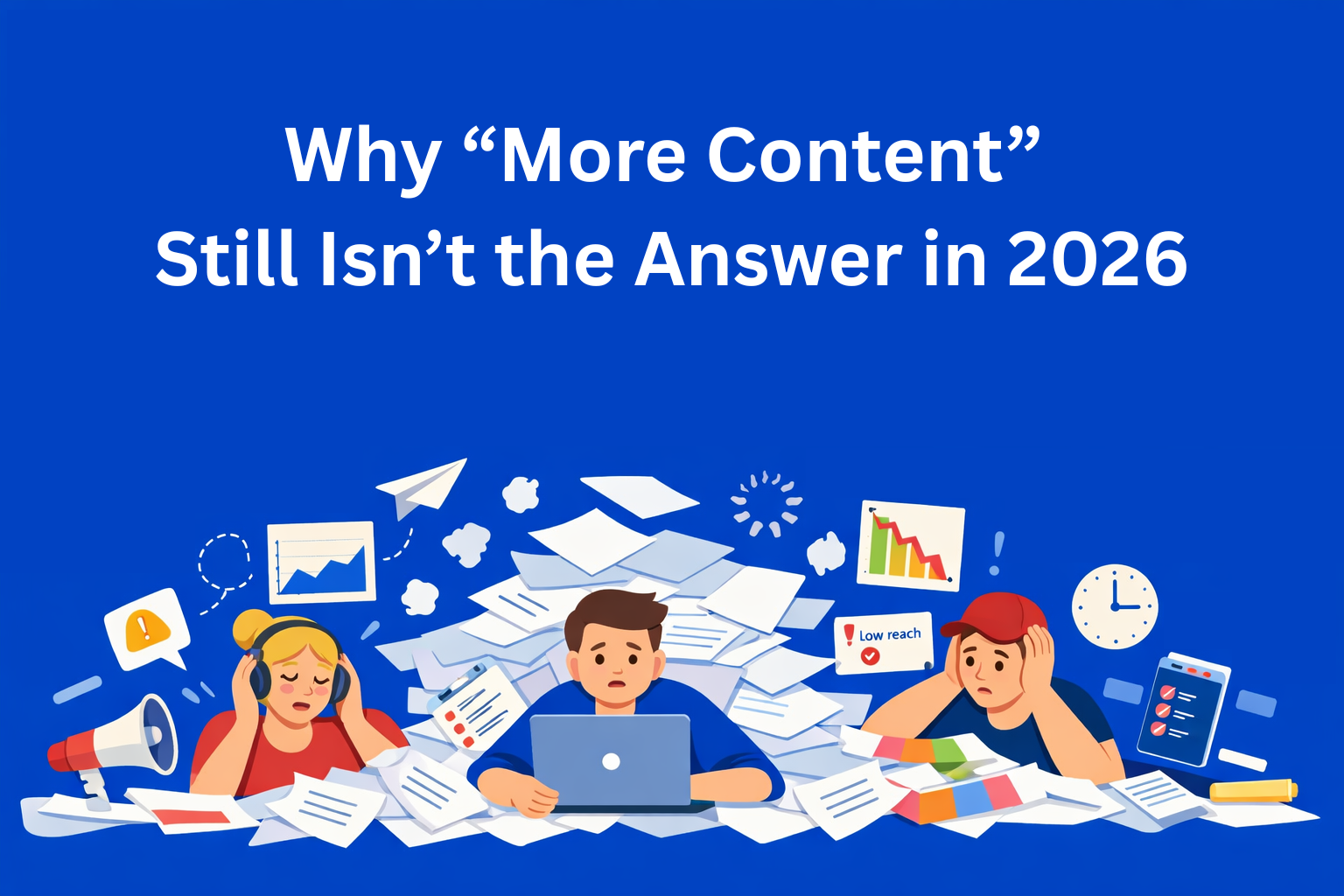
For years, when a marketing or content team noticed slow growth, weak performance, or declining results, the "solution" was always the same: create more content. More blog posts. More social posts. More campaigns. More of everything.
At first glance, this feels logical. If something isn’t delivering results, the natural reaction is to do more of it. The problem is that in 2026, this way of thinking no longer produces the results it once did. Instead of growth, teams end up with more noise, more confusion, and a lot of work that ultimately never gets used.
In this blog, we’ll explain why more content is no longer the answer, what the real problem content teams are facing today, and why shifting from “more” to better-managed content leads to better results with less stress.
Key Takeaways
- More content no longer equals more results - in 2026, volume increases noise, not impact.
- The real issue is content management, not production - teams struggle because content lacks purpose, ownership, and structure.
- Publishing more often creates internal chaos - without a clear system, coordination and decision fatigue grow fast.
- Growth comes from clarity and reuse - fewer, well-managed pieces outperform large amounts of one-off content.
- AI amplifies systems, not strategy - it helps only when content decisions and context are already clear.
Why “more content” still sounds like the right answer
The idea that creating more content is the solution is deeply rooted in how marketing teams have worked for years. SEO strategies relied heavily on publishing frequency. Social media demanded constant activity. Algorithms, at least for a while, rewarded volume.
Because of this, the reflex reaction to declining results became the belief that we simply weren’t publishing enough. In practice, that meant adding more tasks, more ideas, and more content to an already overloaded system, often without much thought.
The problem is that the environment content teams operate in has completely changed. Audiences are saturated. There are more channels than ever. AI has accelerated production. And user attention spans are shorter than before. Because of this, more content does not automatically mean more value.
How we became obsessed with volume in the first place
There was a time when higher content volume truly provided an advantage. Ten or so years ago, a blog that published more frequently had an easier time ranking. Brands that were more active on social media reached their audiences faster.
That model worked because competition was lower and the total amount of content online was much smaller. However, many teams held on to this approach even after the conditions changed dramatically.
Today, almost every company produces content. Nearly all of them have a blog, a newsletter, social media channels, and some form of video. In this environment, an extra article or post no longer makes a difference on its own.
Still, the idea that the problem is “not enough content” keeps coming back, even though the symptoms clearly point to something else.
What actually happens when teams produce more content
When the focus shifts entirely to volume, problems start to appear, problems that aren’t immediately obvious.
More noise, less attention
The first issue is saturation. Audiences see an enormous number of messages every single day. When too much content is created without a clear purpose, it starts competing not only with competitors, but with itself.
The result is that each individual piece of content gets less attention and is forgotten very quickly.
More coordination, more chaos
The second issue is internal. More content means more people involved in every step, from ideation to approval. Without a clear system, the same discussions repeat, context gets lost, and decisions become unclear.
In the end, teams spend more time aligning and coordinating than actually making the content better.
More work that never gets used
The third issue is often the most expensive one. A large portion of content gets published once and then simply disappears. There’s no continuation and no real long-term value.
In practice, this means time, energy, and budget are spent on work that quickly stops having any real impact.
Why content volume no longer drives growth in 2026
In 2026, growth is increasingly less about producing more output. Algorithms are smarter. Audiences are more selective. AI can generate volume, but it can’t solve the relevance problem on its own.
A content strategy that relies only on volume actually ignores the core issue: the lack of clear content management, which is the real problem.
Growth doesn’t stall because teams aren’t producing enough, it stalls because teams don’t clearly know:
- why a piece of content exists
- who it’s for
- how it should be used over time
Without clear answers to these questions, adding more content only increases chaos.
The real problem: content isn’t treated as a system
Most teams still view content as a series of individual tasks. One blog post. One campaign. One social post. Once it’s done, they move on.
The issue with this approach is that the bigger picture disappears. Teams can’t see how content connects, how decisions repeat, or where effort is being wasted.
When there’s no system, there’s no control. And without control, adding more content only makes things worse.
In 2026, more mature content teams are starting to treat content as a long-term asset, not a one-time output.
What content teams should focus on instead of volume
If more content isn’t the answer, what is? The solution is simpler than it seems.
A clear purpose for every piece of content
Every article, video, or post should have a clear reason for existing. Who it’s for. What problem it solves. Where it fits in the user journey.
When the purpose is clear, it’s much easier to decide whether the content is actually needed.
Management, not just production
Production is only one part of the job. It’s also important to know where content lives, which version is current, and how it’s used later on.
When content is well organized, there’s less confusion and work moves faster, even with a smaller volume.
Longevity and reuse
One strong piece of content can last much longer if it’s used thoughtfully across multiple channels. This requires some planning, but it delivers far more value.
What a more mature content model looks like in 2026
A mature content model doesn’t measure success by how many pieces are published. It measures clarity, continuity, and real content usage.
In this kind of model:
- Content has an owner - someone who is responsible for keeping it up to date, deciding if it should be reused, and determining its next step. When there’s an owner, content doesn’t “disappear” after publishing or get forgotten in a folder.
- Decisions have context (it’s clear why something was decided)
- For example: why a headline was changed, why a message was softened, or why a section was removed.
- When context is preserved, teams don’t repeat the same discussions over and over.
- New team members onboard faster because they can see the reasoning behind decisions instead of guessing.
- AI is used as support, not as a replacement for thinking
- AI can speed up work (drafts, ideas, headline variations, summaries, structure suggestions).
- But humans still make the decisions: what the message is, what matters most, what’s accurate, and what makes sense for the audience.
- Used this way, AI gives teams speed without sacrificing quality or control.
This approach allows teams to work more calmly, stay focused, and maintain greater control.
Conclusion
The idea that “more content” is the solution has lasted far too long. In 2026, it’s clear that growth comes from managing what already exists better, not from constantly adding more.
Less chaos, more structure, and clearer processes deliver better results than any attempt to force volume. For content teams that want sustainable growth, changing this mindset is no longer optional, it’s necessary.