Why Some Content Spreads Without Being Pushed
Some content spreads without ads, boosts, or heavy distribution. This blog explains why clarity, emotion, and relevance matter more than tactics, and how content that truly helps people often starts spreading on its own.

Many people believe that good content cannot succeed without ads, boosts, and serious distribution. Without a budget and a promotion plan, many assume content has no real chance. And sometimes they are right - but not always.
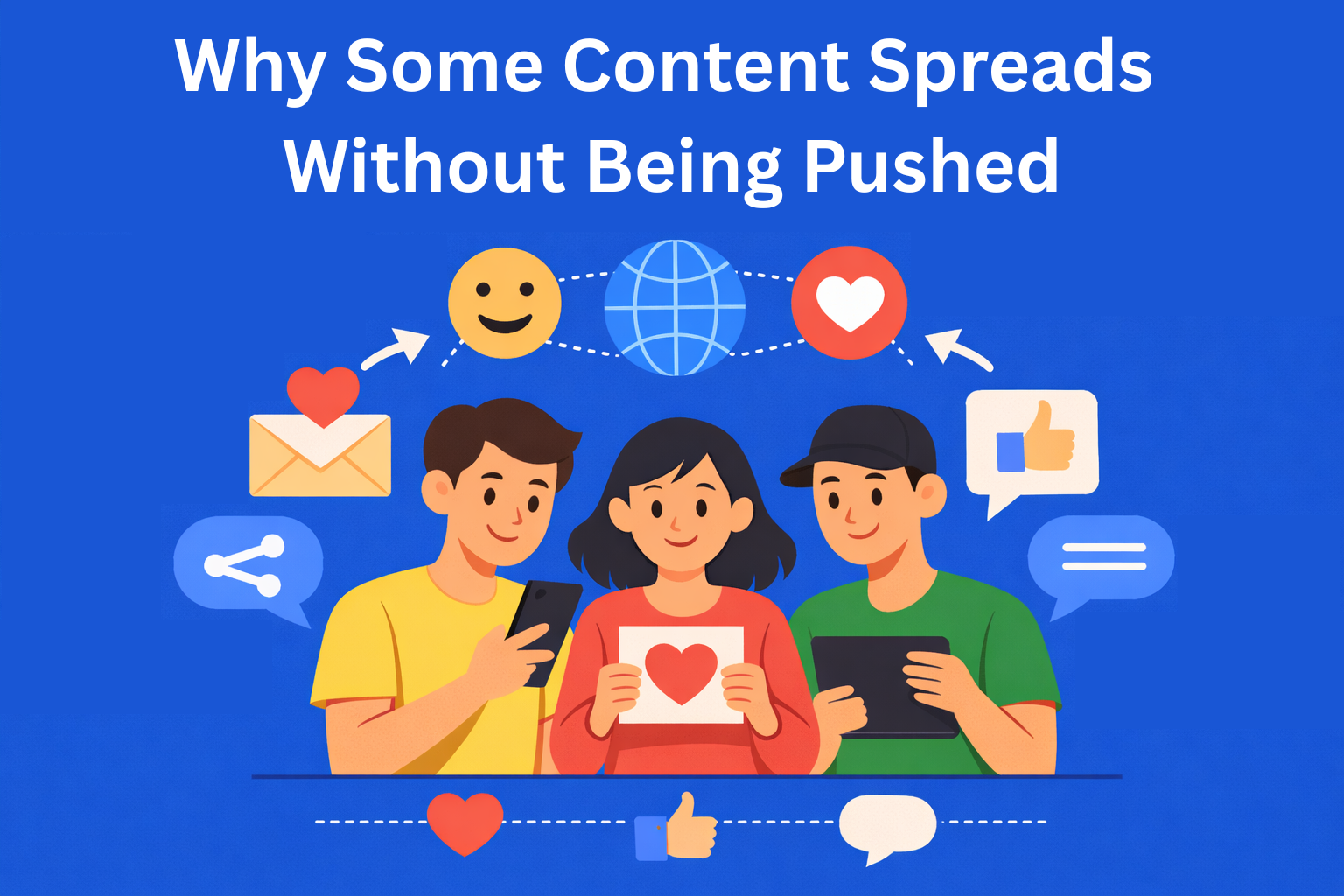
There are texts and ideas that people share on their own, without being asked. They pass them on to colleagues and friends because they matter to them. This kind of content spreads naturally, without ads or forcing it.
In this blog, we will explain why that happens. If you have ever seen content spread on its own, here you will understand why.
Key Takeaways
- Content spreads when the idea is strong, not when it’s pushed harder - distribution only amplifies interest, it can’t create it.
- Clarity makes sharing easy - if people can’t explain your idea in one sentence, they won’t pass it on.
- Simple language increases reach - content spreads faster when it’s easy to understand, not when it sounds smart.
- Emotional recognition drives organic sharing - people share content that reflects what they already feel but couldn’t articulate.
- Relevance beats reach - content spreads naturally when it speaks directly to a real, current problem for a specific group.
The myth of “just distribute it harder”
When content does not get results, the first reaction is almost always the same:
- “We need to push it more”
- “We need a bigger budget”
- “We didn’t publish enough”
Distribution is important, but it cannot create interest where there is none. It only amplifies what already exists. If the idea is bad or unclear, distribution will only expose that faster.
Many teams rely on different tactics because it is easier than admitting that the content simply is not good or clear enough. But content that spreads organically almost always has something that cannot be forced.
That is why it matters to understand why some content spreads on its own, instead of constantly relying only on channels and budgets.
What does it actually mean when content spreads
Content spreading does not just mean a high number of views. Views can come from ads, algorithms, or pure chance. Real spreading looks different.
When content truly spreads:
- people share it in private messages
- someone sends it with the line “you have to read this”
- it is used to explain a problem many people have
This is the moment when content stops being just a post and starts being useful to people. That is when it spreads on its own, not because you planned it.
This is where the difference between popular content and content that spreads by itself becomes clear.
Clarity always comes first
People do not share what they do not understand. This sounds obvious, but it is often ignored.
If a reader cannot explain the core idea to someone else, they will not share it. When an idea is clear, people can pass it on more easily.
How to know if your message is really clear:
- Can you explain the point in one sentence?
- Is the message the same at the beginning and at the end of the text?
Content that spreads without being pushed almost always has one main idea. It does not try to explain everything. It does not overwhelm the reader with terms and theories.
When everything is clear, content spreads more easily on its own.
Simple language beats smart language
One of the biggest reasons content does not get shared is overly complicated language. People often write to sound smart, not to be understood.
Content that spreads uses short sentences, familiar words, and concrete examples.
That does not mean it is shallow. It means it is accessible. When someone with no background in the topic can understand the text, the chances of sharing it are much higher.
Simplicity is not a weakness. It is a requirement for organic content spreading.
Emotion is what makes people hit “share”
People do not share content only because it is useful. They share it because something in it hits them.
That can be:
- a feeling of recognition (“this is me”)
- relief (“finally someone explained this clearly”)
- frustration that everyone feels but rarely says out loud
This is not about manipulating emotions. It is about clearly describing what people already feel but could not put into words.
When a reader emotionally connects with an idea, the chances that content spreads without being pushed increase.
Relevance matters more than reach
A large audience does not automatically mean a big impact. Content often spreads better in smaller but highly relevant circles.
Relevant content:
- solves a current problem - it deals with something people are struggling with right now, not a theory for later.
- appears at the right moment - it shows up when people are already looking for an answer or solution.
- speaks directly to a specific group - it addresses exactly who it is meant for, not everyone at once.
When people feel that content was “written exactly for them,” they are much more likely to share it.
That is why relevance is often more important than algorithms, trends, or massive reach.
Why tactics come second
Format, headline, timing, and CTA are useful. But they cannot save a bad idea.
If content has no clear point, a better headline or a better channel will not make a real difference.
If an idea is good, it can survive even when it is poorly packaged. If an idea is bad, nothing can save it.
That is why content that spreads on its own relies more on the idea itself than on tricks and tactics.
People share content to help others
People do not share content to help the author. They share it to help someone else.
That can be:
- a colleague with the same problem
- a friend struggling with the same question
- a team that needs a clear explanation
When content genuinely helps someone, people naturally pass it along. It spreads on its own because it has meaning and purpose.
How to increase the chances without forcing it
There is no formula for virality. But there are things that increase the chances of organic content spreading:
- focus on one idea - do not try to say everything at once. When you stick to one clear point, it is easier for people to understand and remember what you wanted to say.
- write for real problems - write about what people are actually struggling with in everyday work or life. When they recognize the problem, they are more likely to share the content.
- use simple language - write as if you are talking to a friend, not giving a lecture. The easier the text is to read, the more people will understand it and pass it on.
- respect your audience’s emotions - pay attention to how people feel about the problem. When you show that you understand them, it is easier for them to connect with the content.
Conclusion
Content that spreads on its own does not need explaining. It is clear, emotional, and relevant.
If you constantly have to push content, it is probably not good enough yet. When it hits the right idea at the right moment, people start sharing it themselves.
That is why understanding why some content spreads on its own matters more than learning new tricks. Most of the time, the reason is much simpler than we think.