Why Your AI Content Sounds Fine, but Still Doesn’t Convert
AI content can sound clear and well written, but still fail to convert. This article explains why AI-generated content often misses real engagement, where the gap starts, and how better structure, context, and strategy lead to higher conversions.

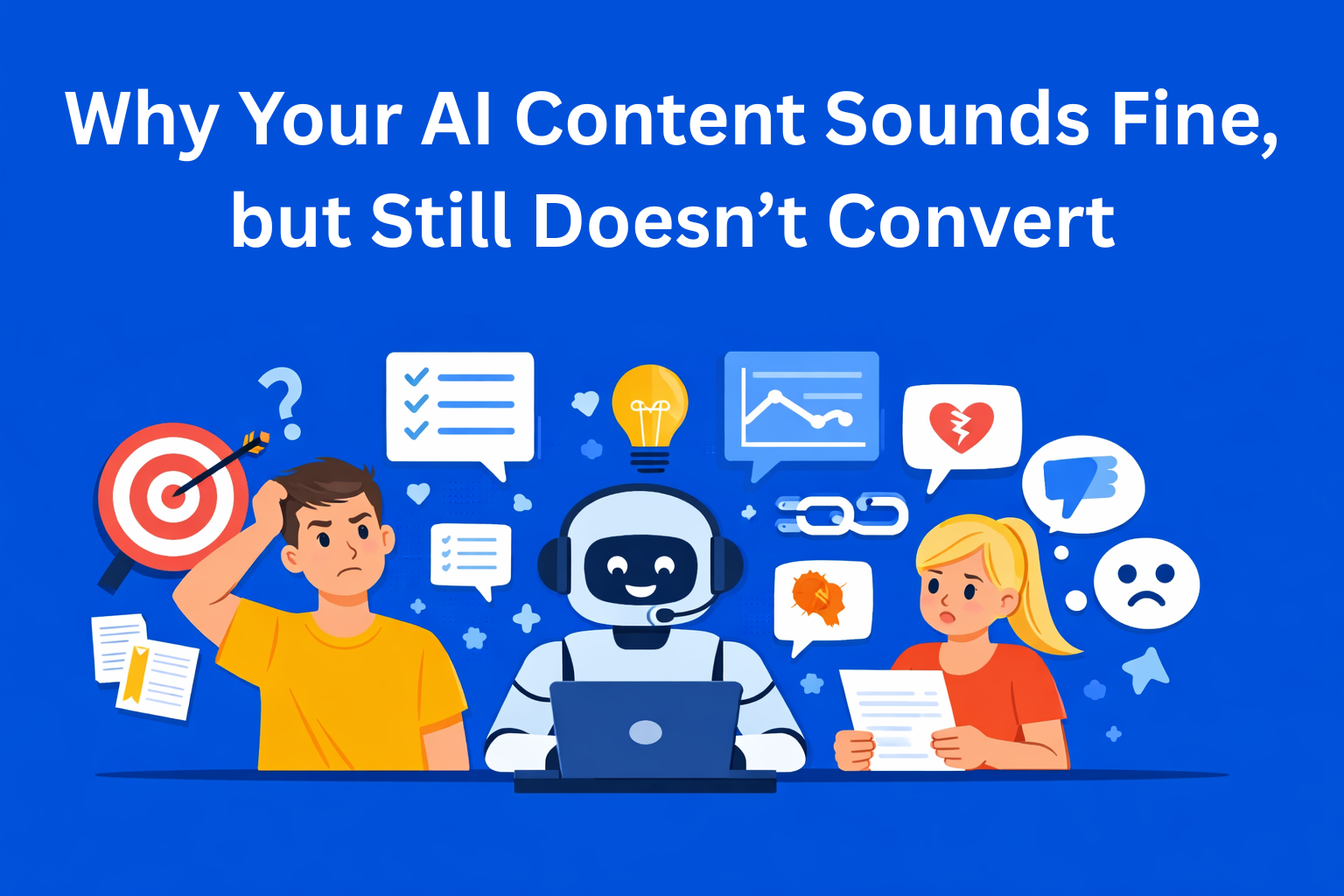
Today, AI tools can write text that looks completely fine. Sentences are clear, grammar is correct, the tone is polite, and everything feels like it’s “in place.” But people often notice the same thing: AI content sounds good, yet there are no clicks, no sign-ups, no reactions. The text is there, but after reading it, the reader does nothing.
In this blog, I’ll explain why this happens, how to understand why AI content often doesn’t convert, where this problem really starts, and how you can fix it with better structure, clearer context, and a simpler strategy.
Key Takeaways
- Good writing doesn’t equal conversion - AI content can be clear and polished while still giving readers no reason to act.
- Lack of context kills results - when AI doesn’t know who the reader is or why they’re reading, the message feels generic and forgettable.
- Neutral content doesn’t persuade - conversion requires perspective, priorities, and clear opinions, not just balanced explanations.
- Structure must guide the reader - content should lead from problem to insight to next step, not just explain and stop.
- Humans define direction, AI supports execution - strategy, angle, and decisions must come before AI starts writing.
What does it actually mean for content to “convert”
When people hear that content should convert, they usually think of a button, a form, or a sale. But conversion is a much broader idea. Conversion means that the reader takes the next step.
That step can be:
- continuing to read
- clicking on another article
- signing up for a newsletter
- sending a message
- remembering a brand or an idea
If AI content only explains things but doesn’t tell the reader what to do next, then it’s not really doing its job. Many AI texts are correct and easy to read, but they have no direction. You read them and that’s it, they sound nice, but nothing happens afterward.
Why AI content sounds good at first glance
AI is very good at writing text that sounds clean and well put together. Sentences flow nicely, everything makes sense, and it feels like the text is well written. It knows how to explain a topic and make the text feel smooth.
That’s why AI content often looks high-quality at first glance. When you read it quickly, everything seems fine. But very often, the text sounds good while missing a real point.
AI knows how something should sound, but it doesn’t know why that text is being written.
Where the conversion problem starts
The main issue is that AI content is usually created without clear context. The text gets written because “we need a blog,” “we need to publish content,” or “we should use AI.”
But readers don’t arrive by accident. They come because something is bothering them or something caught their interest. If an AI text doesn’t hit exactly what the reader is looking for at that moment, the text means nothing to them.
That’s where the gap appears between content that sounds good and content that actually works.
Lack of context: the biggest problem with AI content
AI doesn’t know who the reader is. It doesn’t know whether they’re a beginner or someone with experience. It doesn’t know why that person came to this specific article. It doesn’t know what they’ve already read before.
Because of this, AI content often explains things too broadly or too generally. Everything is technically correct, but nothing is precise. The reader doesn’t see themselves in the text.
And when there’s no recognition, there’s no trust. Without trust, there’s no conversion.
AI writes about the topic, but not from a perspective
Another reason why AI content doesn’t convert is the lack of perspective. People don’t react to neutral descriptions. People react to opinions, experience, and clear points of view.
AI usually writes:
- without a personal angle - the text has no experience, no real-life examples, and no clear stance. It sounds like a general explanation that could apply to anyone.
- without a decision - AI doesn’t clearly say what’s good and what’s bad. It doesn’t say what should be done and what should be avoided. Everything is left to the reader to decide, so the text leads nowhere.
- without priorities - everything is presented as equally important. Nothing truly stands out, so the reader doesn’t know what to focus on or what to do first.
Everything is presented evenly. Everything sounds “fair.” But content that converts needs to say: this matters, this doesn’t, this is where you’re going wrong, this is where you’re wasting time.
Without that, AI content stays just information.
Structure that doesn’t guide the reader
Many AI texts have good grammar but poor structure. Everything feels equally important. There’s no clear flow. No sense of progress.
The reader doesn’t know:
- where they are in the text and how much is left
- what the main message is
- what they should remember or do after reading
If a text has no clear order or direction, the reader gets confused. And when people get confused, they usually just close the page and move on.
Good content doesn’t just explain, it guides. It has a beginning, a middle, and an end that all make sense.
Why a better prompt isn’t the solution
Many people think the problem is a bad prompt. They believe that if they just write a longer and more detailed prompt, the AI text will suddenly start converting.
But that rarely happens. A better prompt can help the text sound nicer, clearer, and more polished. But that’s usually where it ends.
A prompt can’t think for you. It doesn’t know what truly matters to you, what your real goal is, or what exactly is bothering the reader. Those are things you need to decide before AI starts writing at all.
AI is a tool. Strategy has to come before it.
How to bridge the gap between AI text and conversion
For AI content to start delivering results, you first need to clarify a few things.
A clear purpose for the text
Every piece of content needs one main purpose. Not three. Not five. One.
For example:
- to explain a problem - so the reader clearly sees what the issue is and why they should even care about it. Without this, the text feels pointless.
- to change the way someone thinks - so something “clicks” in their head and they realize they were looking at things the wrong way. That’s when a text starts to have real value.
- to prepare the reader for the next step - so it’s clear what to do next, even if it’s just thinking about the topic or reading something else. Without this step, the reading ends with no effect.
When you know the purpose, AI can help. Without a purpose, AI just fills space.
Structure that builds understanding
Good AI content needs a clear structure:
- recognizing the problem - so the reader immediately feels the text is talking about them and their situation. When people recognize themselves in the first few lines, they’re more likely to keep reading.
- explaining why it happens - so it’s clear what caused the problem in the first place. People accept advice more easily when they understand the cause, not just the result.
- a simple solution or insight - so the reader walks away with a clear thought, tip, or new way of looking at things. It doesn’t have to be a big solution, it’s enough for them to say, “okay, this makes more sense now.”
Each part should lead naturally to the next. When the reader feels progress, they’re more likely to stay until the end.
Human decisions, AI support
The best results come when:
- a human defines the message - deciding what the text should really say and what the main point is. Without this, AI can write a lot of words that don’t mean much.
- a human chooses the angle - deciding how the topic is approached and from which point of view. This gives the text personality and keeps it from sounding like just another generic article online.
- a human makes the decisions - deciding what matters and what can be skipped. AI can’t do this on its own; someone has to tell it what’s most important and where to focus.
AI then helps turn those ideas into text. It speeds things up, but it doesn’t run the show.
When these roles get mixed up, problems appear. The AI content looks finished, but it has no real strength.
AI content as part of a system
AI text shouldn’t exist on its own. It should be part of a bigger content system.
That means it’s connected to:
- other articles - so the text continues what you’ve already written instead of standing alone. When everything connects, people take you more seriously and trust you more.
- a clear topic - so you stay within the same area instead of jumping from one subject to another. This helps people understand why they should come back.
- a consistent tone - so all texts sound like they’re written by the same person, using the same style and language. This creates a sense of continuity and professionalism.
- a long-term strategy - so you know why you’re writing and what you want to achieve over time. Without this, content gets published randomly and is quickly forgotten.
When AI content becomes part of a system, conversion happens more naturally. Readers don’t decide based on one article, but on the overall impression.
Conclusion
AI can write good text. But good text is not the same as text that converts.
For AI content to truly work, it needs clear context, simple structure, and human decisions behind it.
The real question isn’t how to make AI write better. The real question is what you want your content to achieve.
When you know that, AI becomes a powerful ally. Without it, AI is just another tool that produces texts that sound fine, but change nothing.