How to Build a Content Production SOP for Your Agency
A content production SOP helps agencies create consistent workflows and scale content without delays. Learn how to build a clear content workflow that improves team efficiency and delivers faster, high-quality results.

Imagine you have five clients, three writers, and no one really knows who is responsible for what. One person is writing a blog post without a brief, another has been waiting for approval for ten days, and a third is publishing content that no one reviewed before it went live. Chaos.
Most agencies operate exactly like this. And while they are small, they somehow manage. But as soon as they start growing, everything falls apart. That is where a content production SOP comes in - a document that puts everything in its place.
Key Takeaways
- A content production SOP removes agency chaos - every deliverable follows the same documented workflow from brief to publishing, no matter who is involved.
- Each content type needs its own mini-workflow - blog posts, newsletters, social posts, and video scripts should each have role-specific steps and deadlines.
- Clear ownership is what makes the system work - define who strategizes, writes, edits, designs, publishes, approves, and who gets informed at every step.
- Templates and style guides reduce onboarding time - standardized briefs, formatting rules, and brand voice docs make quality repeatable across writers and clients.
- A living SOP scales with the agency - document it, train the team on it, review it regularly, and improve bottlenecks as client volume grows.
What is an SOP and why your agency needs one
SOP stands for Standard Operating Procedure.
Think of it as a set of clear instructions. When you do something for the first time without clear steps, you improvise and make mistakes. When you have clear instructions, the result is consistent every time, no matter who is doing the work.
In content production, an SOP means that every piece of content - from the first brief to publication - goes through the same steps. No improvisation, no forgotten steps, no "who was supposed to do this?" moments.
Agencies that have a strong content workflow can onboard new people more easily, deliver work faster, and make fewer mistakes. Those that do not - lose time and money every single day.
First - list all the types of content you produce
Before you start building an SOP, you need to understand what you are working with. Create a list of everything your agency produces:
- Blog posts
- Social media posts
- Email newsletters
- Video scripts
- Case studies
- Infographics
Each of these content types works differently. A blog post goes through research, writing, and SEO optimization. An Instagram post may only need copy and a visual. An email has its own structure and A/B testing.
That is why each content type needs its own mini-workflow. You cannot have one single process for everything - that would be like using the same approach for completely different tasks.
Once you list everything you create, you can group it by channels and clients. This gives you a clear picture of how much work you actually have and where your content production process most often breaks down.
Who does what - define roles clearly
This is the step most agencies skip, and it costs them. When no one is responsible for something, everyone assumes someone else will handle it. And then no one does.
A typical content agency team includes these roles:
Content strategist - defines what is being created, for whom, and why. They write briefs and make decisions about topics.
Writer - writes the content based on the brief. They do not guess or wait for inspiration - they follow clear instructions.
Editor - reviews the content, fixes mistakes, and ensures quality and tone. They are not there to rewrite everything, but to improve and refine it.
Designer - prepares visuals, thumbnails, and infographics. Works according to brand guidelines.
Publisher - uploads content into the CMS, adds metadata, and publishes or schedules it.
Each of these roles must be clearly defined in your content SOP. For every step in the process, it should be clear - who is responsible, who approves, and who needs to be informed.
Build a step-by-step workflow
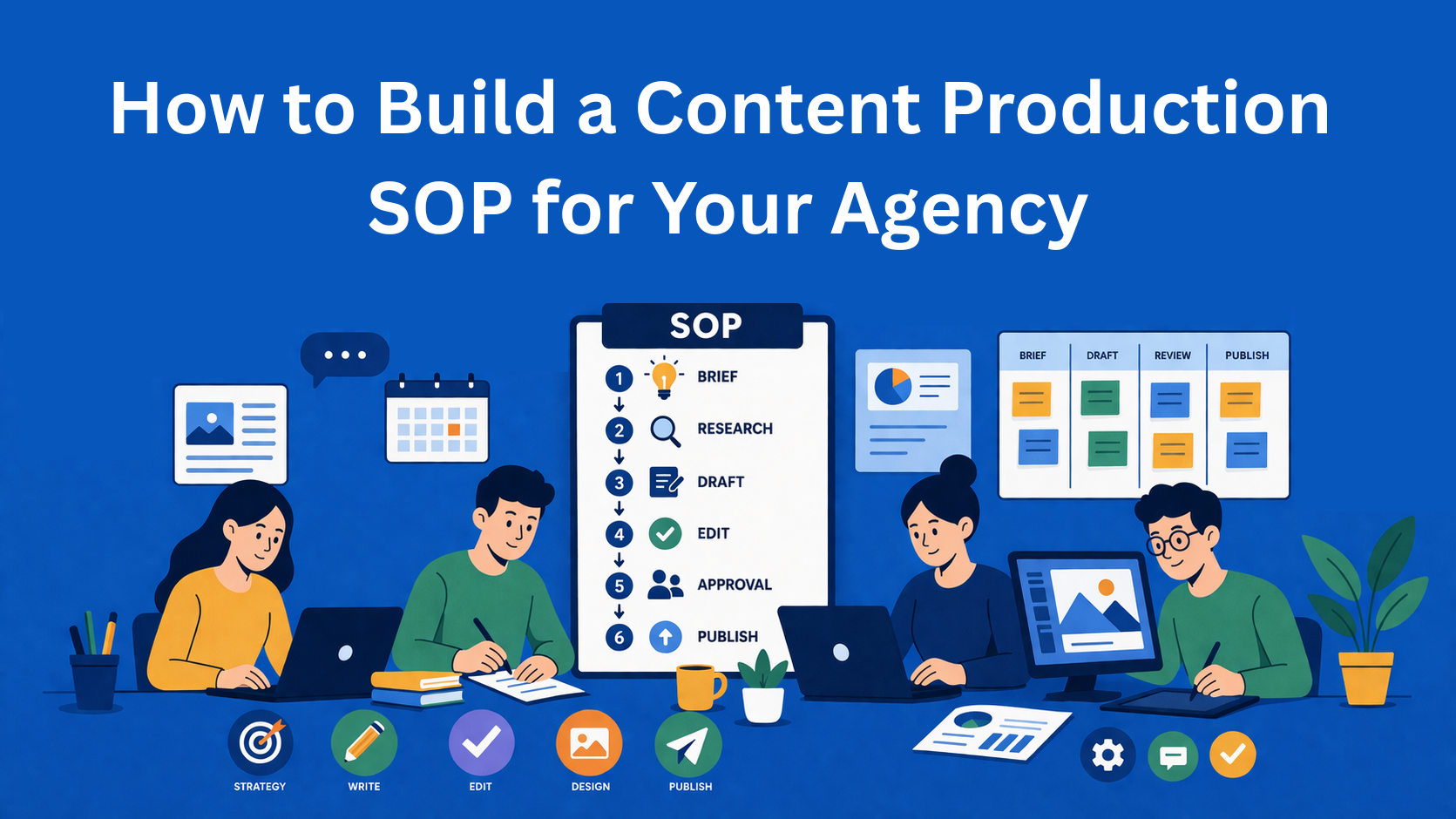
This is the core of your SOP. The content production workflow is the sequence of steps every piece of content must go through, from idea to publication.
Here is what a typical blog post workflow looks like:
Step 1 - Brief. The strategist writes the brief: topic, target audience, keywords, content length, tone, and deadline.
Step 2 - Research. The writer researches the topic, reviews competitor content, and finds relevant sources.
Step 3 - Draft. The writer creates the first draft and submits it for review.
Step 4 - Editing. The editor reviews it, leaves comments, and sends it back for revisions or edits it directly.
Step 5 - Client approval (if needed). The client receives the content and has a clearly defined deadline for feedback - for example, 48 hours.
Step 6 - Finalization. The content is refined, visuals are added, and formatting is prepared for publication.
Step 7 - Publishing and distribution. The publisher publishes the content, sends it to newsletters, and shares it across channels.
Each step must have an owner and a deadline. Without that, content production turns into endless waiting and confusion about who is next.
Create templates and a style guide
When your writers start from scratch every time, they waste time. When every blog post looks different, clients get confused. The solution is templates and a content style guide.
A brief template is a document where the strategist simply fills in fields: topic, audience, tone, keywords, length, deadline, and internal notes. No improvisation, everything in one place.
A style guide explains how your agency - or your client’s brand - writes and communicates. It answers questions like: Do we write formally or casually? Do we use "you" or "we"? How long should headlines be? What do subheadings look like?
In addition, create a formatting standard - what every blog post should look like: H1, H2, H3 headings, paragraph length, use of bullet points, and CTA at the end.
With all of this in place, a new team member can start producing quality content within a couple of days - without needing a month of onboarding.
Content calendar and approval process
A content calendar is not just a spreadsheet with dates. It is a central place where everyone can see what is being created, who is responsible, and when it needs to be completed.
A good content calendar shows:
- What content is being created and for which client
- Who is responsible for each step
- Where the content is in the process (brief, draft, review, publish)
- The publication date
For the approval process, set clear rules. The client has 48 hours to provide feedback. If they do not respond, the content is considered approved. The number of revision rounds is limited - for example, two rounds are standard, anything beyond that is charged additionally.
Without these rules, every piece of content becomes an endless back-and-forth between the agency and the client. Your agency SOP needs to solve this before it becomes a problem.
Tools that support your SOP
An SOP is not just a document - you also need tools that allow the process to actually be followed in practice.
Here is what most agencies use:
Project management tools - Asana, Trello, Monday, or EasyContent. These tools allow you to manage everything we described above, from defining roles to managing your content calendar, all in one place.
CMS (Content Management System) - WordPress, Webflow, or whatever your client uses. It is important that the publisher knows exactly where and how to upload content.
File sharing - Google Drive, Notion, or Dropbox. All templates, briefs, and final content in one place.
Communication - EasyContent can also help here, as it allows real-time communication within the platform, ensuring that everyone sees messages and stays aligned.
The tool itself is not what matters. What matters is that the entire team uses the same tool in the same way. If half the team uses Trello and the other half sends emails, your content workflow will not work.
Document your SOP, train your team, and improve it
You created an SOP. Great. But if only you understand it, it is useless.
Your SOP must be written, accessible, and easy to understand for everyone on the team. You can store it in Notion, Google Docs, or any tool your team uses. What matters is that everyone knows where to find it - within seconds.
When you onboard a new team member, the SOP should be the first document they receive. Go through it together, explain each step, and answer their questions. That is your onboarding process.
But an SOP is not set in stone. Every few months, sit down with your team and ask: what is not working? Where do we get stuck most often? What could be improved?
A content production SOP that never changes is a SOP that no one uses. It needs to evolve as your agency grows.
Common mistakes agencies make
Finally, here is what to avoid:
Too complex. If your SOP has 40 pages and 15 steps for every content type, no one will follow it. Start simple and add details as needed.
No team buy-in. If you create an SOP alone and impose it on the team, resistance is guaranteed. Involve your team in the process - ask them what frustrates them and what could be clearer.
No version control. If you have five versions of your SOP in Drive and no one knows which one is current, you have a problem. Always clearly mark the active version and archive the old ones.
Set and forget. You create an SOP and never revisit it. Six months later, the team is back to old habits, and the document is collecting dust. Schedule regular reviews and keep it alive.
Conclusion
A content production SOP is not bureaucracy. It is a tool that gives your agency freedom - freedom to grow, take on more clients, onboard people faster, and deliver consistent quality without constant firefighting.
Start small. Create a workflow for just one content type - for example, blog posts. Test it for a month. Fix what does not work. Then expand it to everything else.
There is no perfect SOP from day one. But every step toward structure is a step toward an agency that actually works.