Editing Long-Form Content: Techniques to Keep It Tight
Long-form content doesn’t fail because it’s long, but because it’s poorly edited. This article breaks down practical editing techniques to remove excess, improve clarity, and keep readers engaged from the first paragraph to the last.

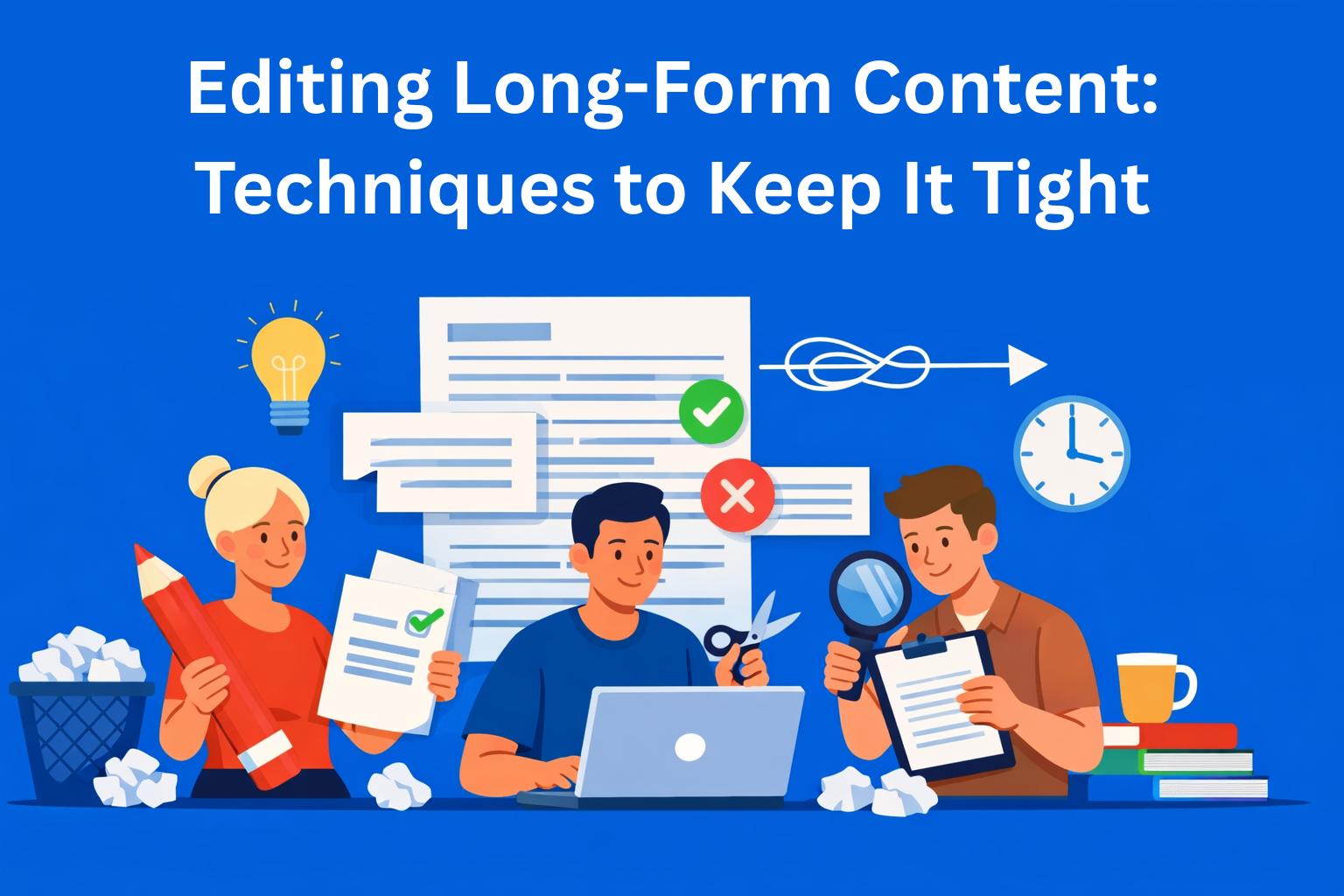
Long content is not a problem by itself. The problem appears when a text feels stretched, hard to follow, and tiring to read. Many authors think long-form content is good simply because it is long, but without proper editing, even the best ideas can get lost in a sea of unnecessary words.
In practice, readers are not looking for more text, but for clearer text. If they have to fight through long paragraphs, repetition, and complicated sentences, there is a high chance they will give up before reaching the end. That is why editing long-form content is a crucial step that determines whether a text will keep the reader’s attention or not.
In this blog, we will talk about simple and practical editing techniques that help tighten content, remove unnecessary parts, and make it easy to read.
Key Takeaways
- Start with one clear point - if you can’t summarize what the reader should remember, the draft will feel long no matter what you cut.
- Cut anything that doesn’t add new value - repetition, overexplaining, and “smart-sounding” sentences are usually the first things to remove.
- Keep one idea per paragraph - shorter paragraphs and tighter sections make long-form feel lighter and easier to follow.
- Use structure to reduce reader fatigue - clear subheadings, spacing, and lists help people scan and still understand the flow.
- Edit in rounds, not all at once - first fix structure, then cut excess, then polish clarity and tone for the cleanest result.
First rule of editing: A clear point above all
Before you start shortening sentences or deleting paragraphs, you need to know exactly what you want to say. Every good long-form content piece has one main message. If that message is not clear to the author, it will not be clear to the reader either.
A simple question that helps at this stage is: What do I want the reader to remember after reading this text? If a part of the text does not support the main message, there is no need for it to stay.
Editing here does not mean fixing grammar mistakes, but making decisions. When you have a clear point, editing long-form content becomes easier because you know what is extra and what is essential.
Cutting without guilt: Removing the excess
One of the hardest parts of editing is deleting your own sentences. We often get attached to parts of the text that sound nice, but in reality do not add much meaning.
With long-form content, this is especially important because problems usually appear in the form of:
- repeating the same idea in different ways
- overexplaining simple things
- sentences that “sound smart” but do not say anything specific
A good technique is to look at each paragraph separately and ask yourself: Does this part add new value? If it does not, it is time to cut.
One idea per paragraph
Readers understand a text more easily when they know what each paragraph is about. The problem starts when one paragraph tries to explain too many things at once.
That means one main idea per paragraph. If you notice several different thoughts inside one paragraph, it is probably time to split it.
Shorter and clearer paragraphs:
- are easier to read
- make the text flow more naturally
- help readers navigate the text more easily
This is especially important for people who scan the text before deciding whether to read it until the end.
Active voice and simpler sentences
One of the easiest ways to make a text clearer is to switch to active voice. Active sentences are more direct and easier to understand.
For example, look at the difference:
Before: Within the content editing process, it is very important to take into account the fact that overly complex sentence structures can negatively affect readers’ understanding of the text.
After: During editing, use simple sentences because they are easier to understand.
The point is not to make the text shallow, but to make it clear and easy to read.
Simple sentences help keep attention and reduce the reader’s mental effort. If a reader has to read the same sentence twice to understand it, something is wrong.
Structure as an editing tool
Good structure is often half the job done. Even high-quality content can feel chaotic if it is not well organized.
Headings, spacing, and lists are not just visual elements. They help readers move more easily through long-form content.
When editing, pay attention to:
- Clear and descriptive subheadings - A subheading should immediately tell the reader what the next section is about. If someone reads only the subheadings, they should still understand the overall story.
- Breaking up long sections of text - Large blocks of text quickly become tiring. When you split text into smaller parts, reading becomes easier and more readable, and the reader feels they are progressing faster.
- Logical order of ideas - Ideas should follow one another in a clear and logical way. Each new part should naturally build on the previous one, without jumping from topic to topic.
Good editing long-form content allows readers to understand the text even if they only read the subheadings.
Editing in multiple rounds
One common mistake is trying to fix everything at once. In practice, editing is much more effective when done in several rounds.
For example:
- First round: structure and flow of the text
At this stage, you look at the big picture. You do not focus on words or style, but on whether the text makes sense as a whole. Does the introduction explain what the text is about? Do the ideas flow naturally from one to another? Is there a section that feels out of place? The goal is for the text to have a clear beginning, middle, and end. - Second round: removing excess and shortening
Only after the structure is clear do you start cutting. Here you remove repetition, overly long paragraphs, and sentences that do not add new value. If an idea has already appeared earlier, there is no need to repeat it. The goal of this round is to make the text shorter, cleaner, and easier to read. - Third round: style, tone, and clarity
Finally, you focus on the details that make a big difference. You check whether sentences sound natural, whether the tone is consistent, and whether the text is easy to understand for everyone. This is where you simplify sentences and remove anything that sounds complicated or unnecessarily formal.
This approach makes editing long-form content less exhausting and helps you focus on one thing at a time.
How to know when the text is tight enough
Many authors struggle to decide when to stop editing. There is always something that could be improved, but that does not mean it should be.
A good sign that long-form content is ready is when:
- the text reads smoothly without interruptions
- there are no obvious repetitions
- every section has a clear purpose
If a reader can understand the main point without additional explanations, editing has done its job.
Conclusion
The best-edited texts are the ones where readers do not even feel like they're reading. Everything feels natural, clear, and logically connected.
The goal of editing long-form content is not to make the text as short as possible, but as clear as possible. When you remove the excess, the message stands out, and the reader stays engaged from beginning to end.
If you remember only one thing, let it be this: long content can work extremely well, but only if it is well edited.