Keeping Team Morale High During Crunch Times
Crunch periods are unavoidable, but low morale doesn’t have to be. This article explains how leaders and content managers can keep teams motivated, focused, and supported during high-pressure periods without burnout or loss of quality.

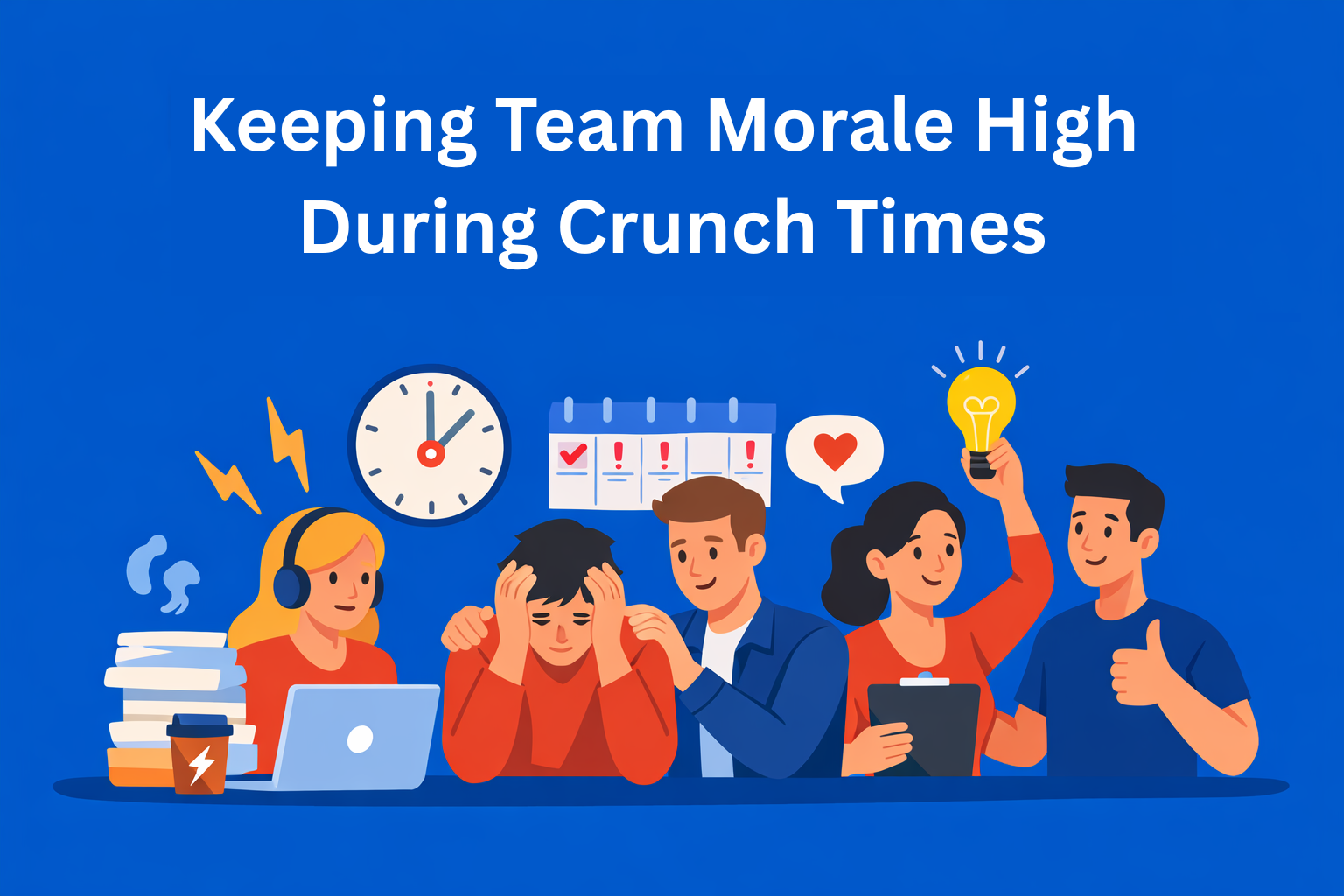
Crunch periods are part of almost every content or marketing team. Sometimes they happen because of a campaign launch, sometimes because of the end of a quarter, and often simply because too many requests pile up at the same time. And while crunch periods are often unavoidable, a drop in morale does not have to be. In this blog, we will talk about how leaders and content managers can maintain team motivation, trust, and energy even when deadlines are short and pressure is high.
It is important to understand that the goal is not to make people work more, but to prevent them from burning out while working under pressure. This is where the real difference shows between teams that function well in the long run and those that constantly fall apart and replace people.
Key Takeaways
- Crunch periods hurt morale through chaos, not workload - stress grows when priorities are unclear, not just when work is intense.
- Clarity restores a sense of control - defining what truly matters, what can wait, and how long the crunch lasts lowers anxiety.
- Communication should calm, not escalate pressure - transparency, context, and short check-ins build trust during high-stress periods.
- Sustainable pace beats short-term heroics - constant overtime and urgency damage motivation more than tight deadlines.
- Morale depends on recognition and recovery - acknowledging effort and reflecting after a crunch helps teams stay resilient long-term.
Why crunch periods have the biggest impact on team morale
During crunch periods, the problem is often not how much work there is, but the feeling that everything is disorganized. People quickly lose their sense of control when tasks pile up, priorities keep changing, and no one is sure what actually matters. All of this immediately affects team morale.
In these situations, even the most motivated people can become exhausted very quickly. Pressure, stress, and uncertainty drain energy faster than the work itself. That is why caring about morale is not something optional or secondary, but something leaders need to think about all the time.
If crunch periods happen too often and without clear structure, people start to associate work with constant stress. That is when motivation drops, communication weakens, and burnout eventually appears.
The most common reasons morale drops during crunch periods
- One of the main reasons morale drops is lack of clarity. When the team does not know what truly matters, everyone tries to do everything. This leads to overload and frustration.
- Another common problem is unfair workload distribution. In many teams, the same people carry the crunch every time, while others stay on the sidelines. This creates a sense of unfairness and quiet dissatisfaction.
- There is also a lack of context. When people do not understand why something is urgent or what the bigger goal is, the work loses meaning. Motivation does not come only from tasks, but from understanding why those tasks exist.
- Finally, morale often drops because effort is not recognized. When effort is taken for granted and no one says that something was done well, the team slowly starts working without energy or enthusiasm.
How to recognize when team morale is starting to break
A drop in morale rarely happens overnight. It usually shows up through small signals that are easy to ignore. People become quieter, participate less in discussions, and do only what is strictly assigned to them.
From an operational point of view, you may notice delays, more mistakes, and a drop in content quality. This is not a sign of incompetence, but a sign of exhaustion.
There are also emotional signals:
- cynicism,
- nervousness,
- comments like “just let this end” or “here we go again.”
When these kinds of phrases keep repeating, it is clear that team morale is suffering.
The earlier these signs are noticed, the easier it is to react and prevent bigger problems.
Clear expectations are the first line of defense
During crunch periods, clarity matters more than ever. The team needs to know exactly what the priority is and what can wait. If everything is urgent, then nothing really is.
At the beginning of every crunch period, it is important to define:
- which tasks absolutely must be completed
- how long the crunch period will last
- which activities are temporarily paused
This clarity reduces stress because it gives people back a sense of control. When they know what is expected of them, it is easier to focus and worry less.
Maintaining team morale during crunch periods often starts right here, with setting clear boundaries.
Communication that reduces pressure instead of increasing it
The way communication works during crunch periods can either calm the team or increase stress even more. Last-minute messages, unclear requests, and constant changes have a very negative effect on the team.
Instead, it is better to introduce short and regular check-in messages or meetings. These can be quick updates like “where are we now” or “what’s next.” The point is not to control people, but to make sure everyone is on the same page. When the team knows what is done, what is in progress, and what comes next, people feel calmer and more secure.
Transparency is also crucial. When the reasons behind decisions are shared, the team has more understanding and patience. Even bad news is easier to accept when it is clearly explained.
Good communication directly affects team morale because it builds trust.
This is an example of how things can work if you are not using tools for content tracking and creation. But if you use a tool like EasyContent, the communication process can be much easier and faster. With a
- Customizable workflow, you can define each step of the content creation process,
- Assign roles to every team member, and add them into the workflow.
- To make sure the context and goals are clear, you can use briefs where all content guidelines are written down.
- And with customizable templates, you can define a clear structure for every type of content you create.
All of these features help simplify and speed up both communication and content creation.
A sustainable pace matters more than short-term heroics
In many teams, “heroics” are still celebrated, overtime, weekend work, and constant availability. While this may help in the short term, it destroys motivation in the long run.
Maintaining team morale means taking care of energy, not just results. If people are constantly giving their maximum just to get work done, there is no time left to recover.
That is why it is often better to reduce the scope of work than to expect the team to constantly give more. Sometimes it is more realistic to move a deadline than to risk burning out key people.
Crunch periods should be the exception, not the rule.
Small things that have a big impact on motivation
Not every form of support has to be big or formal. Very often, small things have the biggest impact on team morale.
When someone’s effort is noticed and someone says “good job,” people gain more energy. The same goes for clearly finishing tasks, that sense of completion gives the team extra motivation.
Flexibility also makes a big difference. Sometimes it is enough to give people a bit more time or a short break for their energy to come back.
The most important thing is to create a space where people can openly say when things feel like too much.
The role of leaders during crunch periods
During crisis periods, people pay close attention to how the leader behaves. If the leader is stressed, that stress quickly spreads to the entire team.
It is far more helpful for a leader to stay calm, consistent, and realistic than to give motivational speeches. When a leader shows that they respect boundaries and do not push the impossible, the team feels safer and more relaxed.
Leading by example means showing what normal work looks like:
- taking breaks,
- setting realistic deadlines, and
- clearly saying what matters.
When the team sees this, morale stays more stable and strong.
Leaders do not need to remove all pressure, but they do need to make it manageable.
What to do after a crunch period
One of the most common mistakes is ignoring the period after a crunch. When everything is finished, teams often immediately move on without a pause or any reflection on how things went.
A short retrospective can make a big difference:
- What worked?
- What didn’t?
- What could be better next time?
It is important to thank the team and show that their effort is seen. People then feel valued and enter the next challenge more confidently.
If this step is skipped, every next crunch period will feel harder.
Conclusion
Crunch periods are not a problem on their own. The problem appears when they are managed poorly and when the burden is constantly pushed onto people.
Maintaining team morale during crunch periods requires clear priorities, good communication, and realistic expectations. When a team feels supported and valued, it can handle pressure without losing quality.
In the end, strong results come from healthy systems, not from exhausted people.