Why Content Teams Work Faster When Everything Lives in One Place
Content teams work faster when everything is in one place. Centralizing briefs, feedback, assets, workflows, and approvals cuts chaos, removes bottlenecks, and gives teams the clarity they need to stay aligned and create better content, faster.

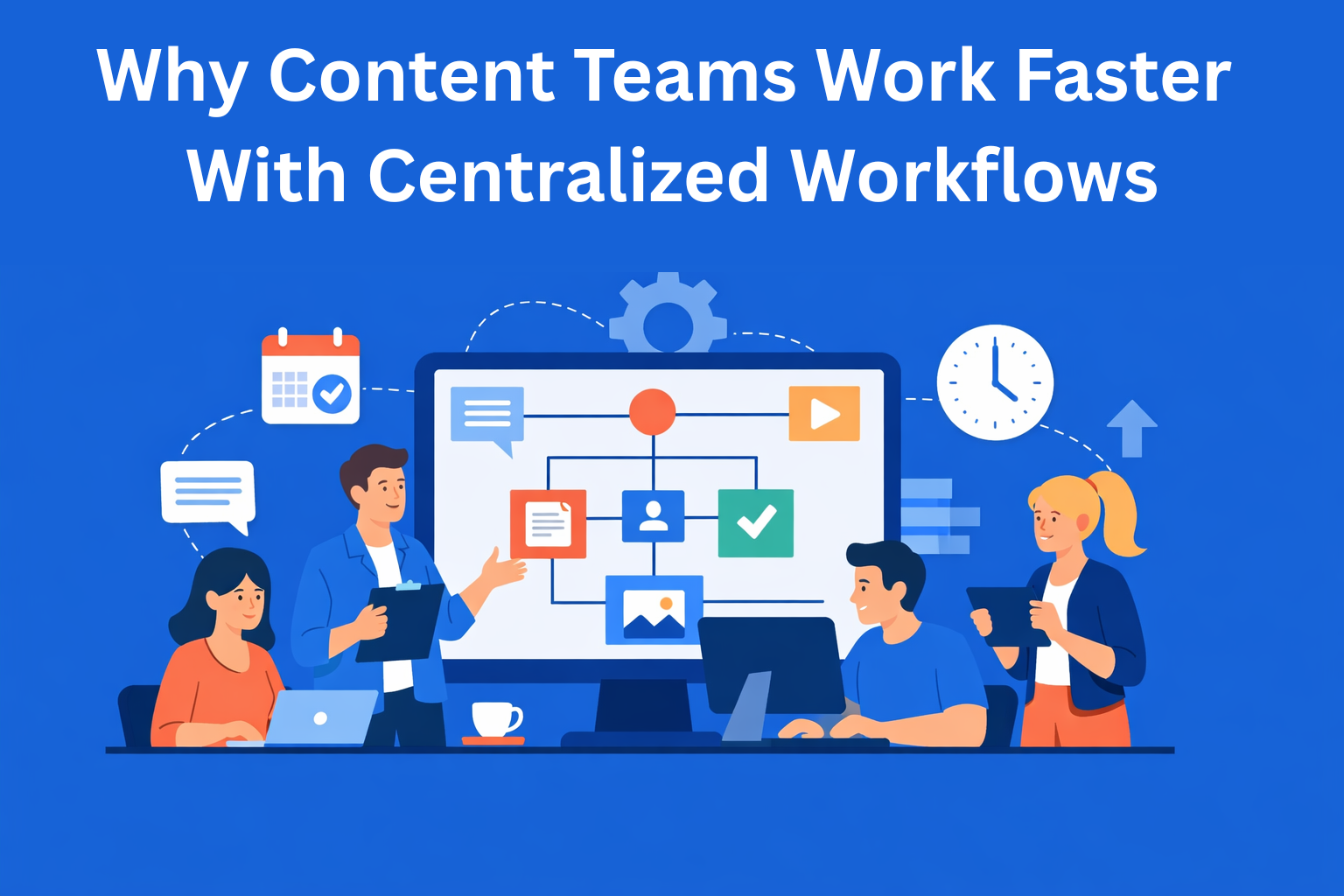
If you’ve ever worked in a content team, you know exactly how it feels. Everyone is moving, everyone is doing something, but somehow, nothing moves fast enough. And it’s not because the team lacks talent. On the contrary, most content teams are full of great people. The problem is that the work is scattered across too many places.
Documents in one folder, briefs in another, assets who‑knows‑where, comments in Slack, emails in the inbox, versions in spreadsheets… and five different tools that don’t "talk" to each other. This slows everything down and forces people to work reactively instead of proactively. That’s where centralization becomes crucial, when everything lives in one place, the team works faster, smarter, and with far less stress. That’s the core idea behind a good content operations platform.
In this blog, we’ll explain why centralization creates speed, how it gives teams the focus they need, and how platforms like EasyContent remove the biggest everyday obstacles.
Key Takeaways
- Centralization removes digital chaos - when all briefs, files, comments, and versions live in one place, the team instantly stops losing time on searching and context switching.
- Unified feedback reduces revisions - one place for comments means no overlap, no confusion, and far fewer back-and-forth edits.
- A shared asset library speeds up production - organized visuals, documents, and attachments cut hours of “Can you send me that?” delays.
- Automated workflows keep work moving - clear steps, ownership, statuses, and notifications prevent bottlenecks and lost tasks.
- EasyContent centralizes everything - creation, collaboration, approvals, assets, and publishing all happen in a single, streamlined platform.
The Problem Everyone Underestimates: Digital Chaos
Content teams rarely lose speed because of big, dramatic issues. Speed disappears in the small things: searching for the right document, checking if the brief is updated, trying to track who left which comment, or whether someone already sent the latest version. It’s the perfect example of poorly organized content collaboration.
The biggest problem isn’t effort, it’s scattered work. Here’s what that looks like in practice:
- a brief in an email,
- an outline in Google Docs,
- design files in a Figma folder,
- comments in Slack threads,
- assets in Drive,
- deadlines and statuses in a Google Sheet,
- approvals lost in random messages.
Before anyone even starts writing, half of the time is spent on "Where is this?" moments. It kills focus and drains creativity. That’s how content teams end up constantly putting out fires.
The same applies to software: when you use multiple disconnected tools, you lose time on manual work, duplicate steps, moving files around, and constantly switching context. Even the best content management system can’t help if your team works across five different places.
What Happens When Everything Lives in One Place?
When all work moves into a single system that covers briefs, creation, comments, assets, workflows, and approvals, three big changes happen:
• Less searching, more doing
People stop hunting for information and can immediately start working. That’s the core of a centralized workflows approach, everything is available with one click.
• Fewer revisions, clearer decisions
When feedback isn’t scattered, the team makes faster decisions. Fewer steps, fewer duplicate versions, cleaner communication.
• Less reactive work, more planning
When you always know the status of each task, you instantly see where the blockers are. This reduces chaos and makes the process predictable, the foundation of any serious content team productivity strategy.
Why Centralized Briefs Speed Up Production
Many teams underestimate the importance of a brief. Yet a brief is often the biggest source of confusion. When it’s in Slack, in an email, or in an outdated document, it becomes a guaranteed time‑waster.
Centralized briefs bring:
- a clear single source of information,
- everything in one place,
- easier understanding of the task,
- fewer misunderstandings across the team.
This is the foundation of content workflow automation. When the brief lives inside one platform and is directly connected to the content, everyone starts from the same information, and that naturally speeds up the work.
Feedback in One Place = Fewer Revisions
Nothing slows a project down like feedback arriving in pieces.
Some is in Slack. Some is in an email. Some is in file comments. Some is in a separate document.
When everything is gathered into one centralized commenting system:
- you see all notes,
- you know what’s resolved,
- feedback doesn’t overlap,
- the team works in sync,
- revisions drop dramatically.
A good content collaboration system acts like the team’s central nervous system, everything you need is there.
When Assets Are Organized, Speed Becomes Normal
How many times have you heard: "Send me that visual" or "Where’s that image?" Those are minutes that quickly turn into hours and days. Once assets live in one library, you finally see how much time was being lost.
A unified asset library gives you:
- instant access to images, documents, and resources,
- easy reuse without downloading files again,
- better organization without external tools,
- simple insertion of visuals into content.
A strong asset library within a content operations platform means zero wandering around, and much faster production.
Workflows That Speed Up Instead of Slow Down
Most teams already have workflows, they just track them manually. That kills speed. When workflows are automated and live inside one system, you get:
- clear steps,
- clear ownership,
- automatic deadlines,
- automatic notifications,
- a clear status overview.
This eliminates 80% of messages like: “Is this done?” “Is this with the client?” “Who’s up next?”
Automation is the backbone of any healthy centralized workflows system.
Approvals in One Place
Approvals are one of the biggest bottlenecks in any content process. When they happen through email, Slack, or messy documents, the process slows down instantly.
In a centralized system:
- everyone sees the same content,
- decisions are clearly recorded,
- there’s a clean feedback trail,
- no delays caused by lost messages.
This is the heart of a streamlined approvals approach, it removes friction and keeps the team moving.
How EasyContent Solves All of This
Everything described above is exactly what EasyContent solves, because you work from one platform.
EasyContent offers:
- real‑time collaboration,
- centralized briefs and templates,
- automated workflows,
- a unified asset library,
- change tracking and content versions,
- built‑in calendars, deadlines, and statuses,
- shareable client links,
- WordPress and Figma integrations,
- complete visibility across the entire process.
Conclusion
Content teams don’t slow down because they’re “bad”, they slow down because the system they work in constantly holds them back. When everything moves into one organized, intuitive, centralized platform, the team starts working faster, more focused, more aligned, without chaos or wasted time, and with much more room for creativity.
That’s why modern content teams choose centralization as the key to working faster, and EasyContent as the platform that makes it simple.