Audit-Ready Content: How Healthcare Teams Can Track Approvals and Changes
Learn how healthcare teams can create audit-ready content by tracking approvals, changes, and reviews in one place. Build a clearer process, reduce mistakes, and make every audit easier with better content workflows.

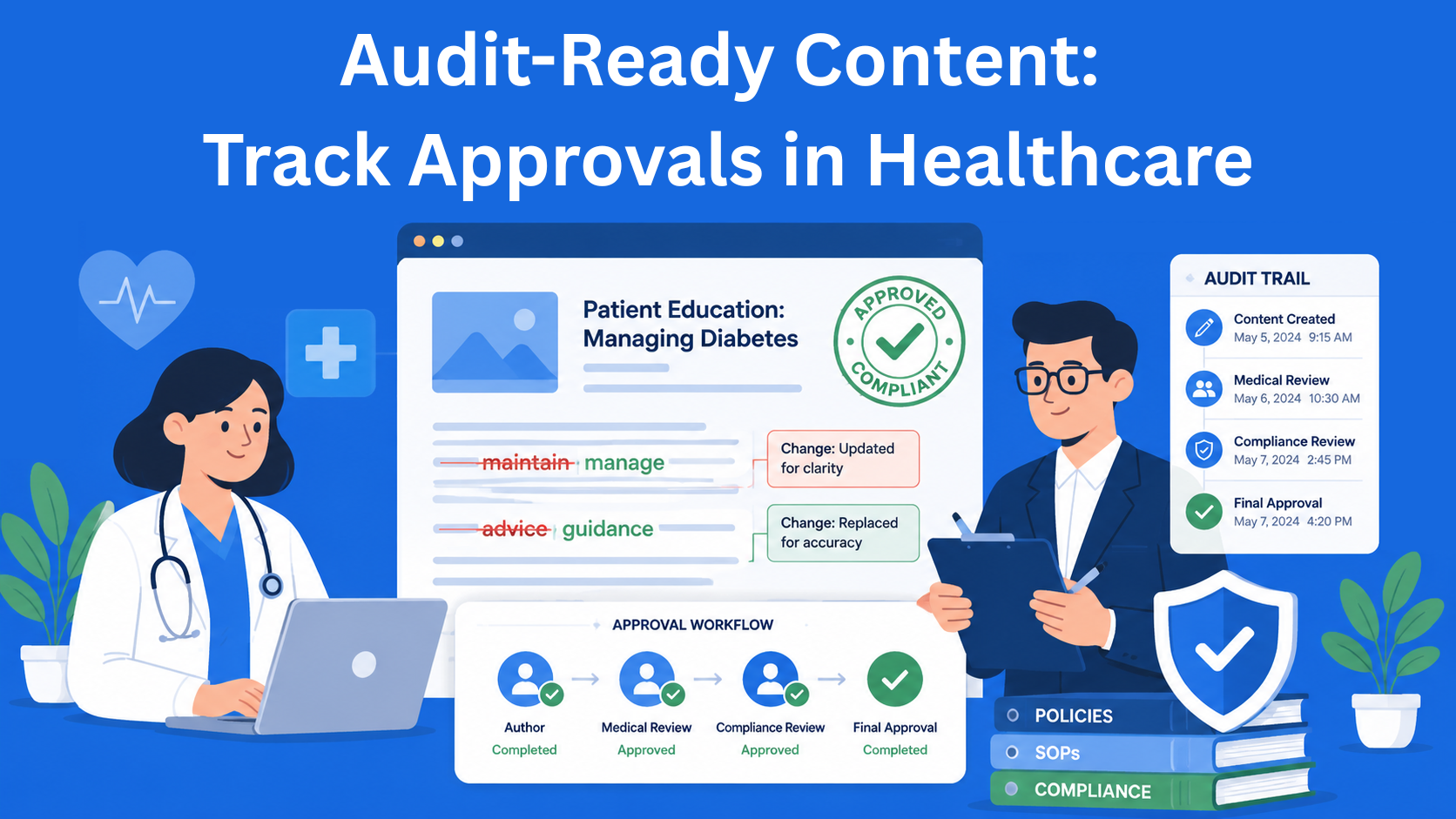
In healthcare, it is very important that every text, image, or video is accurate and safe for people. Everything that gets published must be checked and in line with the rules. When it is time for a review or audit, the team must quickly show who changed the content, who approved it, and when it happened. That is why more and more healthcare teams want to have audit-ready content, meaning content that is always ready for review.
In this blog, I will explain how teams in hospitals, clinics, and pharmaceutical companies can track approvals and changes.
Key Takeaways
- Audit-ready content ensures full visibility and accountability - tracking who made changes, when, and why is essential for compliance and trust.
- Manual processes create risk and confusion - using emails and multiple file versions makes it difficult to track approvals and increases the chance of errors.
- Structured workflows simplify complex approvals - clear steps for medical, legal, and final reviews keep content accurate and organized.
- Access control and change tracking prevent mistakes - defining roles and recording every action ensures only the right people can approve and publish content.
- A gradual implementation makes adoption easier - introducing processes and tools step by step helps teams transition without disruption.
Why is this so difficult in practice?
In healthcare, one person almost never does everything alone. A doctor may write the text, a lawyer may review it, the compliance team may add its comments, marketing may adapt it for patients, and someone from leadership may give the final approval at the end. By the time all these people finish their part of the work, a lot of time can pass. Then it can easily become difficult to track who changed what, when they did it, and why.
It becomes an even bigger problem when people from the team do not work in the same place. Someone is in the hospital, someone works from home, and someone is in another city. In those situations, teams often use emails, Word documents, and WhatsApp messages. Because of that, it can easily happen that the wrong version of a text ends up on the website or in a brochure. If an inspection comes after that, the team may not be able to clearly show what happened. This can lead to fines, delays, and loss of trust.
That is why healthcare teams are increasingly looking for a better way to track approvals and changes.
What is audit-ready content, actually?
Audit-ready content is content where there is a clear and complete record of everything that happened from start to finish.
This means:
- It is clear who made the changes
- It is clear when the change was made
- It is clear why the change was made
- Every approval is recorded
- You can create a report for auditors in just a few minutes
When you have this kind of system, you do not have to worry when a review comes from regulators such as the medicines agency or institutions that oversee the protection of patient data.
How to introduce good habits for tracking approvals and changes
The first thing you need to do is create a clear approval process. Instead of sending files by email, use a tool where everyone works in the same place.
The process can look like this:
- Someone writes the first draft
- It goes through a medical accuracy review
- Then it goes through legal and compliance review
- Marketing adapts it for patients
- At the end, leadership gives approval
- Publishing
Every step should have deadlines and automatic notifications. If someone does not respond on time, the system sends a reminder on its own or moves the task forward.
It is very important to record the reason for every change. It is not enough to only write “corrected,” but rather “corrected because the old medicine dosage was wrong according to the new guidelines.” This way, later on, everyone can understand why something was changed.
It is also important to decide who is allowed to do what. Someone can only suggest changes, someone can approve them, and someone can publish the final version. This is called access control, and it helps prevent mistakes.
Which tools help healthcare teams?
Today, there are many different tools that make it easier to track approvals and changes.
Some teams use SharePoint with additional automations. Others use special platforms made for healthcare, such as Veeva or similar systems that are built specifically for strict regulations. And there are also simpler solutions, such as EasyContent.
In it, you can:
- Have access to all versions of the content
- Assign roles to every team member and make sure that everyone works on what they are responsible for
- Create your own workflow and define every step inside it (draft, review, approved, published...)
- Create and customize a template for any type of content you are working on
- Communicate with team members in real time and inside the platform
- Leave feedback inside the platform as well
And these are only some of the many other useful options that EasyContent offers you.
How to introduce this system in 90 days?
You do not have to change everything at once. Here is a simple plan:
The first 30 days - look at how you currently work. Talk to the teams that create content. Write down where you lose the most time and where mistakes happen most often.
The next 30 days - create rules. Decide who approves what, which steps are required, and which words must be used. Create a simple template for new texts.
The last 30 days - choose a tool, set it up, and test it on a few real materials. Train people on how to use it. When everything works as it should, slowly move all content into the new system.
This way, the change is not too big, and people can get used to it more easily.
Conclusion
Tracking approvals and changes is very important in healthcare today. It is no longer something that is nice to have, but something teams truly need. When healthcare teams have a clear process and a good tool, they work faster, make fewer mistakes, and prepare for audits more easily.
You do not have to change everything at once. First, create a clear process, then choose a tool that fits your team. Over time, the work will become much easier and more organized.
If you want, you can also create your own checklist for audit-ready content:
- Do we have a history of all changes?
- Do we know who approved everything?
- Can we quickly create a report?
- Were all steps of the process followed?
When you can answer yes to these questions, you know you are on the right path.
Audit-ready content is not only about technology. It is a way to protect patients, your team, and the whole organization. When you have a clear record of all changes and approvals, you can do your work more easily and feel more confident that the content is accurate.
If your team still uses emails and different versions of files, now is the right time to change that. When you keep everything in one place, the work becomes simpler, more organized, and safer for everyone.
EasyContent keeps volunteer and contractor contributions organized
- Contributors submit their work through structured briefs
- Roles keep a contributor's access limited to what they're assigned
- Mentions route feedback to the right person automatically
- A mailbox keeps in-app messages separate from your regular inbox