How to Build a Content Governance Plan
Learn how to build a clear content governance plan with defined roles, workflows, standards, and review processes so your team can keep content accurate, consistent, and easier to manage.

When a team creates a lot of content, things can easily become disorganized. Blog posts get published, emails get sent, sales materials get shared with customers, and website pages stay live for months or even years. After a while, it becomes unclear what is still accurate, what needs to be updated, and who is responsible for each piece of content.
For example, a product page may show information that is no longer valid. A PDF that the sales team sends to customers may include outdated details. A blog post may link to a page that no longer exists. This does not happen because the team does not know how to write or because it is not creative. It happens because there is no clear system for reviewing, approving, updating, and organizing content.
A content governance plan is that system.
In this blog, we will show you how to create one, step by step, so your team knows who does what, how content is reviewed, and when it needs to be updated.
Key Takeaways
- A content governance plan defines how content is managed - it clarifies who creates, reviews, updates, and maintains content over time.
- Clear roles and responsibilities prevent confusion - assigning owners, creators, reviewers, and approvers ensures accountability and consistency.
- Content standards keep everything aligned - tone, style, and SEO guidelines help teams create consistent and professional content.
- A structured workflow connects every stage of content - from idea to maintenance, clear steps make production predictable and scalable.
- Governance is an ongoing process, not a one-time setup - regular reviews and adjustments ensure the system stays effective over time.
What Is Content Governance and Why Is It Important?
Before we get into the details, we should mention that content governance is not the same as content strategy.
Content strategy answers the questions what and why, what content you create, who you create it for, and what goal it should support.
Content governance answers the question how, who creates the content, who approves it, where it is stored, who updates it, and when it is no longer useful or accurate.
The three pillars of every good content governance plan are:
- People - clear roles and responsibilities
- Processes - a defined workflow from idea to publication
- Standards - rules that help keep all content consistent
Without these three elements, content quickly becomes disorganized. When you have them, even small teams can create more content without losing quality or a consistent style.
Step 1: Review the Current Situation Before You Build the System
There is no point in building a content plan if you do not understand the content you already have. That is why the first step is not writing documents, but doing an audit.
A content audit means going through everything you currently publish, blog posts, website pages, emails, social media posts, PDF materials, and answering three questions for each piece of content:
- Who owns this content?
- When was it last updated?
- Does it still serve its purpose?
You do not need to use any complicated tools. A simple table in Excel or Google Sheets can be enough. If you have a larger website, tools like Screaming Frog can automatically pull a list of all your URLs.
What you will probably discover is that many texts and pages do not have a person responsible for them, some are outdated, and some give different or incorrect information. This should not worry you, it simply shows that you need a clear plan for managing content.
Step 2: Decide Who Is Responsible for What
One of the biggest mistakes in content management is assuming that responsibility will somehow be established on its own. It will not.
Every piece of content should have a person who knows that this content is their responsibility and who will be the first person to contact when something needs to be changed.
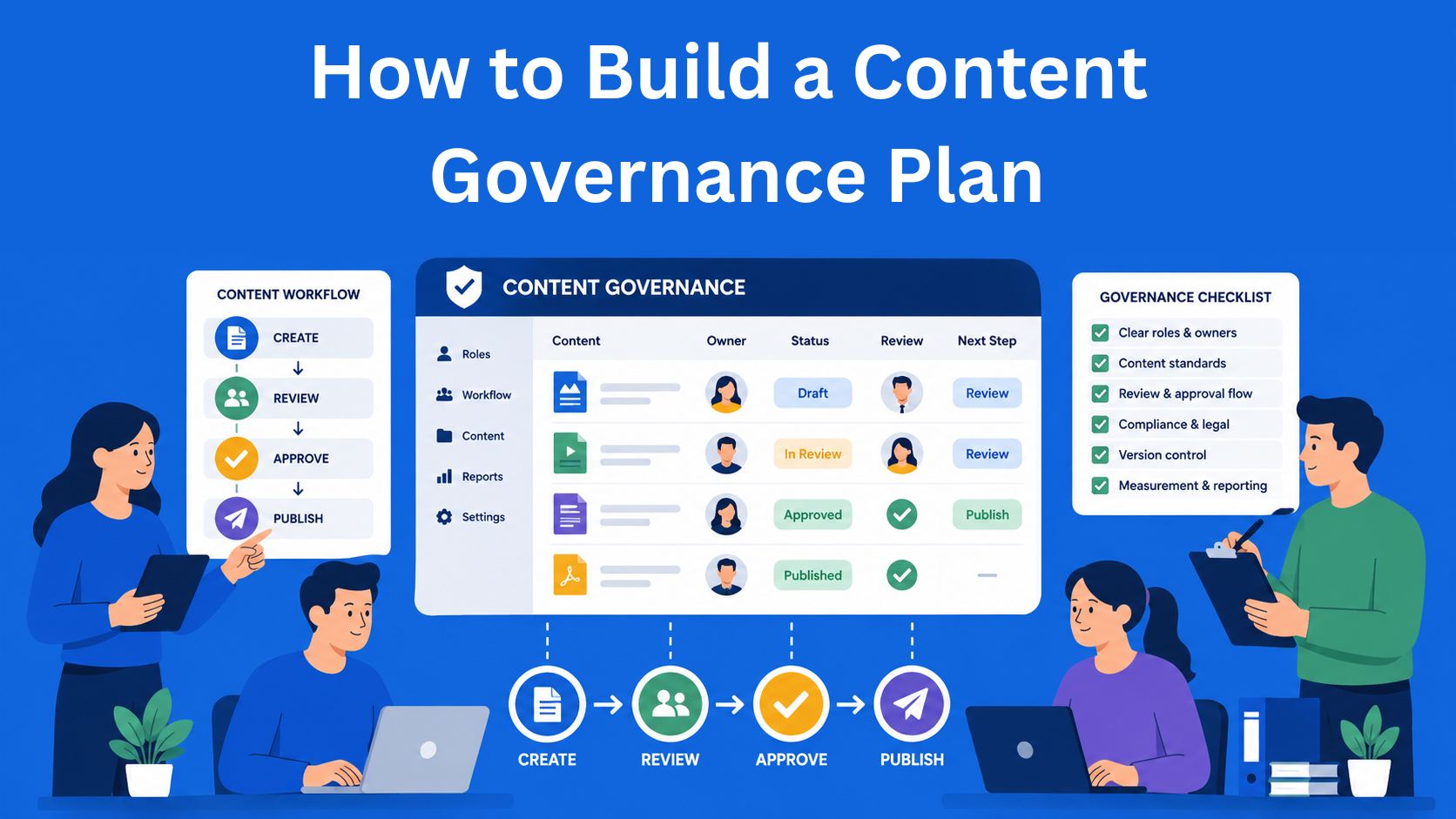
In practice, it is useful to define four roles:
- Content owner - makes sure the content is accurate and up to date; this does not always have to be the person who writes it
- Creator - writes, records, or designs the content
- Reviewer - checks quality, tone, and alignment with the brand
- Approver - gives final approval before publication (this can be a manager, the legal team, or someone else depending on the topic)
If you work in a team of five or fifteen people, you do not have to assign every role to a different person. Sometimes one person has two or three roles at the same time, the important thing is that everyone clearly knows who does what.
A practical tool that helps here is a RACI matrix, a table where, for each content type and each stage of the process, you can see who is:
- Responsible (does the work),
- Accountable (is responsible for the result),
- Consulted (needs to give input),
- Informed (needs to be kept updated).
You can find many free templates online. But at the beginning, you do not really need them. It is enough to create a simple table and clearly write who is responsible for what.
Step 3: Set Content Standards
Once you decide who does what, the next step is to define what the content should look like.
Content standards usually cover three areas:
Brand tone and voice. This is where you define how your brand should sound. Do you write in a formal or relaxed way? Are you direct, or do you like to give more explanation? This should be written clearly, because it helps every text your team creates sound similar and recognizable. It is not enough to simply say “write in a friendly way.” It is better to give specific examples of good and bad sentences.
Style guide. Which terms are used, and which ones should be avoided? How should the text be formatted? What are the guidelines for headings, lists, and visuals? Do you use a formal or informal tone when addressing the reader? These things may seem small on their own, but together they make the difference between content that looks professional and content that looks like it was written by ten different people.
SEO and metadata standards. If you want your content to be easier to find on Google, you need clear SEO rules. For example, how meta descriptions are written, how images are named, what URLs should look like, and where internal links should be added. Keywords should be researched in advance, and the team should agree on how they will be used, so that every writer does not do it in their own way.
Step 4: Map the Workflow, From Idea to Publication
When you know who does what and what rules need to be followed, the next step is to create a clear process. This means that every piece of content should have its own path, from the idea, through review, to publication.
A typical content workflow could look like this:
Planning → Creation → Review → Approval → Publication → Maintenance → Retirement
Each of these stages should have:
- a clearly responsible person
- a defined deadline
- a criterion for moving to the next stage
Many teams forget the last two steps, maintenance and content retirement. This means the work is not finished when the content is published. For example, a blog post that was accurate in 2022 may no longer be accurate today. If nobody regularly checks older content, those pages stay on the website and can confuse users or reduce their trust.
It is a good idea to define how often each type of content should be reviewed. Some texts may not need to be changed often, but guides, pricing pages, and team pages should be reviewed and updated regularly.
Step 5: Document the Plan and Make Sure Everyone Uses It
This is where many teams make a mistake. They write a good document, save it in some folder, but then nobody uses it. In the end, the team continues working the old way.
A good content governance document does not have to be long. In fact, the shorter and clearer it is, the more likely people are to actually use it. Cover the basics:
- Roles and responsibilities
- Content approval workflow
- Standards for tone, style, and SEO
- Where content is stored and how it is named
- How to report a problem or suggest a change
When it comes to where you keep all of this, it can be a tool like EasyContent. It is great for teams because you can define workflows, assign roles and responsibilities to team members, communicate in real time with team members inside the platform, access all content versions, track project statuses through a clear dashboard, and use many other helpful options.
Besides the tool, it is also important to introduce new team members to the plan. Every person who works on content should know the rules before they start writing, editing, or publishing. A short explanation at the beginning can prevent many mistakes and extra work later.
Step 6: Track What Works, What Does Not, and Adjust
A content governance plan is not something you write once and never look at again. The company changes, the team can grow, and the strategy can change. That is why the plan should be reviewed from time to time and adjusted to the new situation.
Review the plan at least once per quarter, and especially when something bigger happens, for example:
- You change the brand look or communication style
- The team grows significantly
- You launch a new product or service
- Rules or laws that affect your content change
Besides regular reviews, it is useful to track a few content governance metrics:
- The percentage of content that has a clear owner
- The average time from idea to publication
- The number of pages that do not have a responsible person or have outdated information
- How often mistakes pass review and get published
These numbers do not only show you how well your content is progressing, but also how well your system is working.
If someone does not follow the process, do not immediately criticize or punish them. It is better to explain how the process works and why it matters. Often the problem is not the person, but the fact that the plan is not clear enough or people cannot easily find it. You can fix that.
Conclusion
You do not have to build a perfect system from day one. Even a partial plan is better than no plan at all.
If you do not know where to start, first decide who is responsible for which content. Create a list of your most important texts, pages, or materials, and next to each one write the name of the person who should take care of it. That is already the first step toward good content management.
After that, add content rules, then a clear work process, and then write everything down in one document. You do not have to build the system all at once. Build it step by step. Over time, you will notice that the content is more consistent, approvals are faster, and there are fewer mistakes.
EasyContent is built for agencies managing many clients at once
- Every client's content, templates, and calendar stay isolated in their own project
- White labeling, on Business, keeps your own agency's brand in front of every client
- Client approvals happen through a shareable link, with no seat required
- You pay for a content workflow platform sized for what an agency actually needs