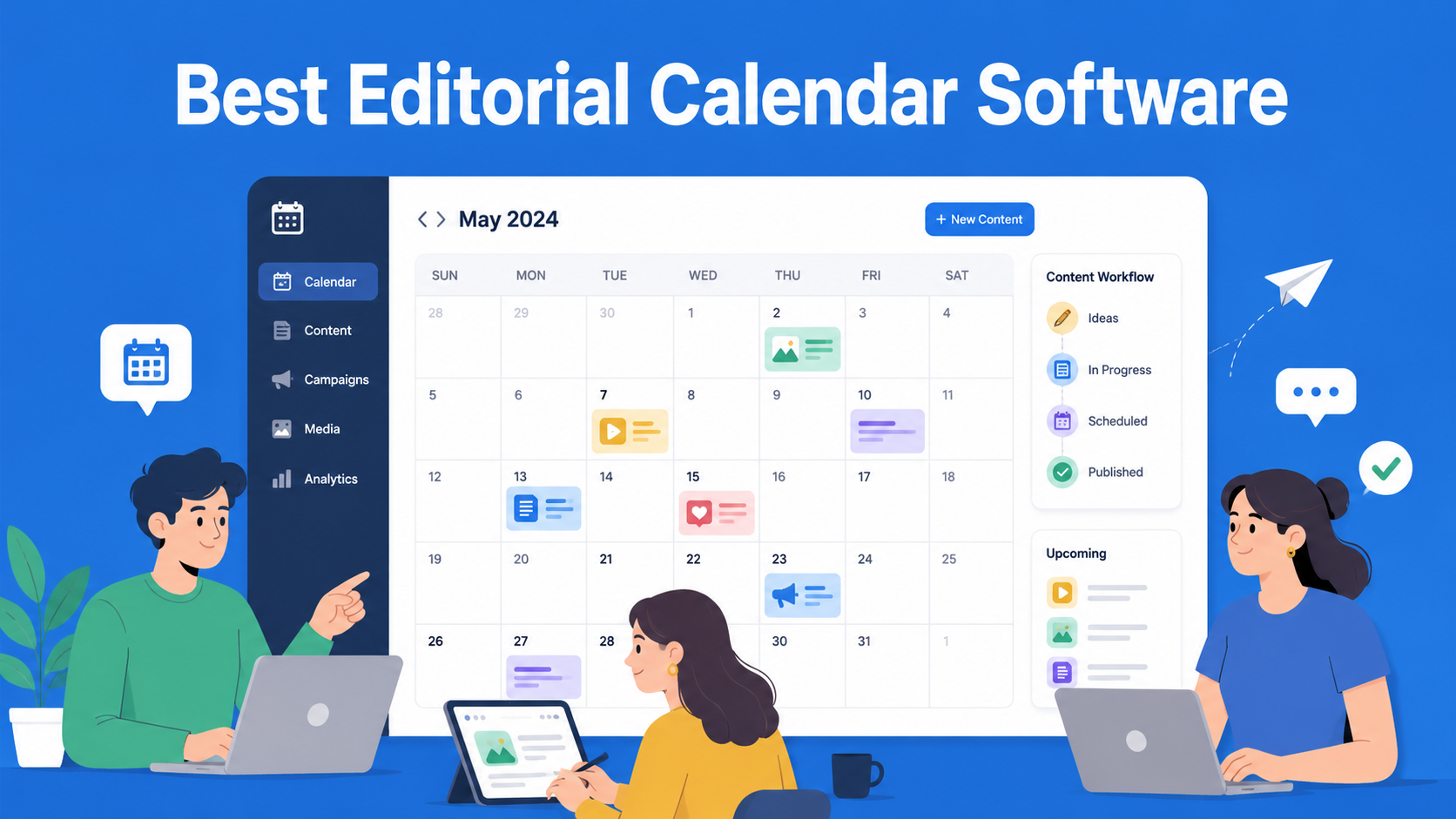
How to Build a Freelancer Content Workflow That Scales
Struggling to manage multiple clients as a freelancer? Learn how to build a simple, scalable content workflow that keeps your projects organized, saves time, and helps you grow without burnout.


Monday morning. You have three clients waiting for content, one is asking for an urgent edit, another is sending a new brief, and you don’t know where to start.
Most freelancers go through this phase. In the beginning, you work with one or two clients and everything works fine. But as soon as you start working with more clients, things quickly become problematic. That’s why a good freelancer content workflow isn’t something that’s “nice to have,” but something you need to work properly.
In this blog, I’ll show you how to set up a system that works for you, not the other way around, even when you have five clients at the same time.
Key Takeaways
- Freelancer workflows break without structure - managing multiple clients without a system leads to confusion, delays, and lost time.
- Standardized processes make work scalable - using the same briefing, production, and delivery steps for every client keeps everything organized.
- Clear rules for feedback save time - defined revision limits and deadlines prevent endless back-and-forth with clients.
- Centralized organization reduces chaos - keeping all content, briefs, and communication in one place makes managing multiple projects easier.
- Documented systems enable growth - clear workflows and SOPs allow freelancers to onboard help and scale without losing quality.
Why most freelancer systems break down
When you start as a freelancer, at first you don’t have a real system. You keep everything in your head and in your inbox. You track everything yourself, and you handle each client in your own way.
That works when you have one or two clients. But as soon as you add a third, things start falling apart.
Here’s where we usually run into problems in freelance content work:
Everything is in your head. You don’t have a written process or a clear way of working. If you forget something or lose track, everything stops.
Every client is handled differently. You send a brief by email to one, messages to another, Google Docs to a third. There’s no single system, just figuring things out as you go.
The process isn’t clear. When is a piece “done”? Who approves it? How many revisions do you do? If this isn’t clear, every project drags out and becomes complicated.
The four pillars of a good content workflow
When we say scalable content workflow, we mean a simple system you use all the time that works the same whether you have 2 or 10 clients. It’s not tied only to you, it can work without you too.
This system has four main parts.
Pillar 1 - Intake and briefing
Every project starts with a brief. A brief is a document where the client explains what they want, topic, tone, target audience, format, deadline.
The problem is that most freelancers wait for the client to explain everything. That’s a mistake. Instead, you should have a ready brief template that you send to every new client.
That template should include:
- What we’re writing about and for whom
- What tone and style the content should have
- The deadline and delivery format
- How many revisions are included
When you have this document, every new client goes through the same process. No improvising, no missing details.
Pillar 2 - Production pipeline
Content production is not just writing. It’s a process with clear steps:
- Research and planning
- Writing the first draft
- Review and revisions
- Finalizing and delivery
For each step, you need to know the deadline and who is responsible. When every piece goes through the same process, it’s much easier to organize your time and know how much work you can take on.
Pillar 3 - Feedback and revisions
This is where most time gets lost. A client sends comments by email at 11 PM, you reply the next day, they respond again two days later, and suddenly a week has passed and the content still isn’t finished.
The solution is an asynchronous review process. That means setting clear rules:
- Comments go directly into the document (Google Docs, Notion...)
- The client has a defined deadline for feedback (e.g., 48 hours)
- A maximum of two revision rounds is included
If you set these rules from the start, clients usually follow them. And you save hours every week.
Pillar 4 - Delivery and organization
How do you send finished content? Sometimes a link, sometimes a file in email, sometimes copy-paste? If every client gets it differently, things quickly get messy.
To avoid that, choose one method and stick to it. For example, each client has their own Google Drive folder. All content, briefs, and comments go there. No sending files all over the place.
It may seem like a small thing, but when you have multiple clients, it really helps to always know where everything is.
A useful addition is using the right tool. Tools like EasyContent are a strong choice here. They let you create your own workflow, build briefs with all key details, assign roles if you work in a team, create templates for any type of content, give feedback directly inside the platform, and much more.
When is it time to bring in help?
If you have a good system, at some point you’ll have more work than you can handle on your own. And you won’t want to turn clients away.
That’s when it’s time to bring in other people.
But before that, you need a clear and documented way of working. If nothing is written down, others won’t know how to work like you.
Create a simple SOP document (Standard Operating Procedure, a work guide). It doesn’t need to be complex. It just needs to cover:
- What the process looks like from brief to delivery
- What tone and style you use
- How revisions are handled and who approves them
- What tools are used and how
When you have this written down, you can onboard someone in a day, not a week. And you know the content will stay consistent even when you’re not writing every piece.
What a work week can look like when the system works
Monday: Review all active projects, confirm deadlines for the week, send briefs that are waiting.
Tuesday and Wednesday: Pure writing. No emails, no meetings, just production.
Thursday: Review and revisions - go through all client comments and finish the content.
Friday: Send finished content, get paid, and prepare the plan for next week.
This kind of schedule is the result of a clear freelancer content workflow that you can repeat every week.
Freelancers without a system spend up to 40% of their time on organization and communication instead of actual work. With a system, that percentage drops significantly.
Conclusion
Building a scalable content workflow doesn’t mean becoming a robot or overcomplicating something that used to be simple. It means setting a foundation that gives you freedom, to take on more clients, bring in help, or simply finish your work by Friday afternoon.
Start small. You don’t have to implement all four pillars at once. Start with a briefing template, it’s the smallest step with the biggest impact. Once that becomes a habit, add a pipeline, then feedback rules, then a delivery system.
In a month, you’ll have a system that works for you. And you’ll finally be able to grow, without burnout.
EasyContent structures content the way a large website is actually built
- A hierarchy view organizes pages the same way they'll sit on the live site
- Templates enforce the required fields each department already expects, with recommended limits shown as a guide
- Custom structures handle the one-off page a template was never built for
- Bulk creation gets a large page set started without building each one by hand