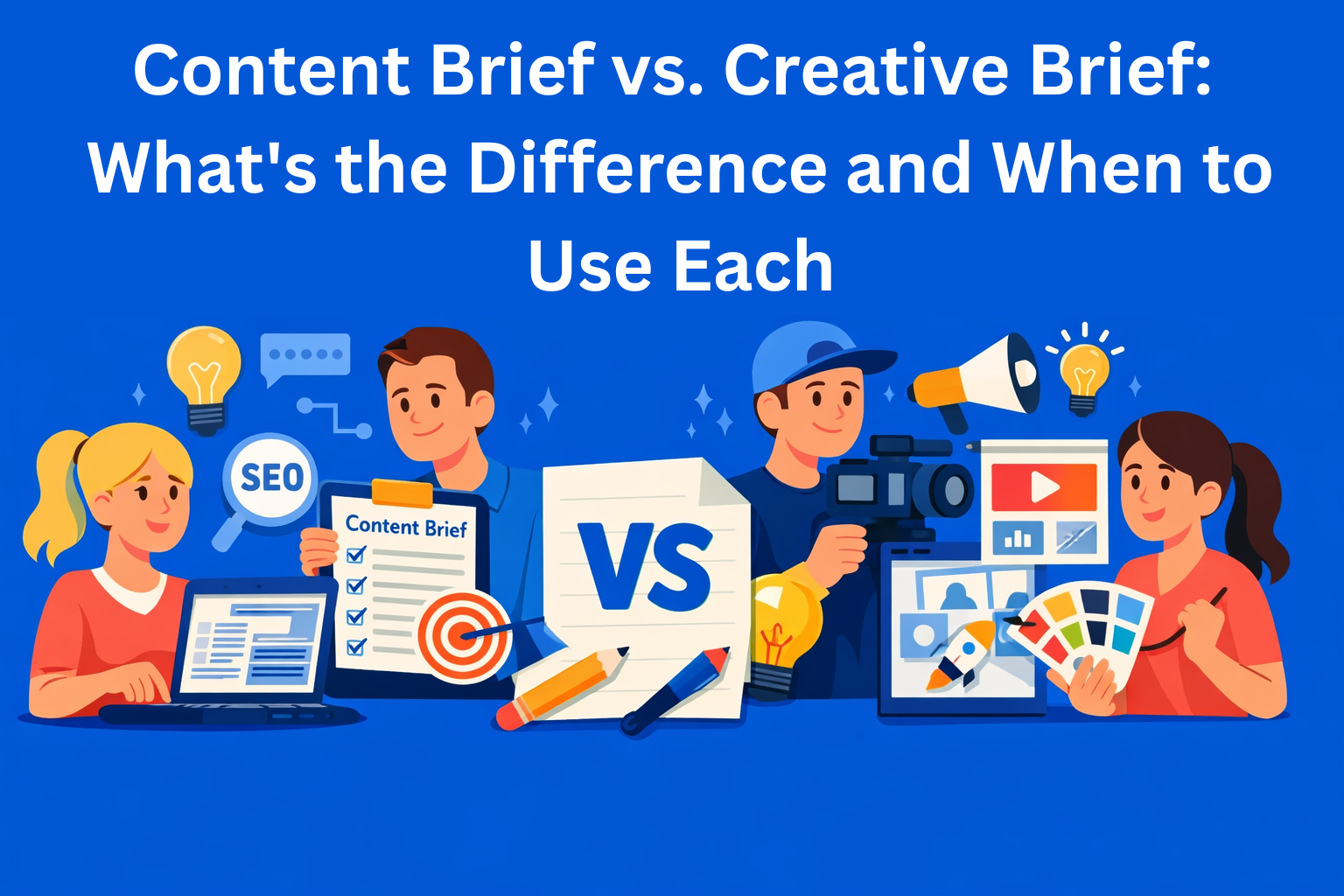
Content Brief vs. Creative Brief: What's the Difference and When to Use Each
Learn the difference between a content brief and a creative brief, when to use each, and how they impact SEO, campaigns, and team workflows. Avoid common mistakes and create clearer, more effective content and marketing projects.

Anyone who has worked in marketing or content writing has probably heard of a "brief." But many teams still use the wrong type of brief for the wrong job, and then wonder why the results aren’t what they expected.
The difference between a content brief and a creative brief is not complicated, but it is important. If you don’t understand it, you can easily waste time, money, and energy. In this blog, we’ll explain what each one is, what it’s used for, and when you should use which.
Key Takeaways
- Content briefs and creative briefs serve different purposes - one focuses on SEO-driven writing, the other on creative direction and campaigns.
- Content briefs guide structure and search performance - they define keywords, audience, format, and instructions for written content.
- Creative briefs shape ideas, visuals, and messaging - they align teams on goals, tone, and overall campaign direction.
- Using the wrong brief leads to confusion and poor results - mismatched expectations slow down teams and reduce content quality.
- Combining both briefs creates stronger outcomes - creative direction plus structured SEO execution leads to better-performing content.
What Is a Content Brief?
A content brief is a document that tells a writer or author exactly what to write and how to write it.
This type of brief is mostly used by SEO teams, content marketing teams, and editors who create written content for the web. Its main purpose is to make the text useful for the reader, but also to help Google recognize it and show it to as many people as possible.
What does a content brief include?
- Primary keyword the content is built around
- Target audience - who will read this content and what they want to learn
- Content structure - which headings and subheadings should be included
- Tone and writing style - whether the content should be formal, casual, or professional
- Word count and format (blog post, guide, list, etc.)
- Links - which sites or articles should be referenced
For example, if you work for a company that sells software and you need a text that appears on Google when someone searches "how to organize projects in a team," that’s exactly what a content brief is for. It gives the writer everything they need to write a piece that answers that question, and helps Google show it to the right people.
What Is a Creative Brief?
A creative brief is something different. It’s a document that describes what a campaign, ad, or creative project should achieve and how it should look and feel. It’s not focused on words and Google, but on the idea, emotion, and message.
This type of brief is used by advertising agencies, designers, video producers, and marketing teams when working on something visual or campaign-based. When a company decides to create a new ad, rebrand, or launch a new campaign on social media, that’s where a creative brief comes in.
What does a creative brief include?
- Project goal - what you want to achieve with the campaign
- Target audience - who these people are and what they care about
- Brand tone and voice - how the brand sounds and presents itself
- Deliverables - video, banner, poster, Instagram post, etc.
- Timeline and budget - deadlines and available resources
- Inspiration and references - examples that show the direction
Imagine a company wants to create a video campaign for a new product. The creative brief tells the team who the brand is, who they are speaking to, what feeling the video should convey, and what viewers should do after watching it. It acts as a compass for the entire creative team.
What Are the Key Differences?
Both documents have a similar goal, to help the team do a great job. But they approach that goal in completely different ways.
In short: a content brief tells you what to write, while a creative brief tells you what to create and how it should look and feel.
When Should You Use Each?
Use a content brief when:
You are writing content for a website or blog that needs to appear on Google. You are working with external writers or freelancers who need clear instructions. You have a topic and you know what the reader is searching for, you just need to explain it clearly and in a structured way to someone.
For example: a company wants to publish 20 blog posts per month. Each writer gets a content brief, and all texts follow the same style, structure, and goal. Without it, everyone writes in their own way and the result is chaos.
Use a creative brief when:
You are launching a campaign, doing a rebrand, or creating something where visuals and emotion play a big role. You are collaborating with designers, video teams, or agencies. There is no single correct answer, creativity is expected and needed.
For example: a brand wants to launch a Black Friday campaign. The creative team needs to understand the tone, visual identity, message, and target audience, all of that comes from the creative brief. Without it, the designer creates one thing, the copywriter writes another, and the campaign feels disconnected.
Can They Be Used Together?
Absolutely. In fact, in some projects, it’s recommended.
For example, if a company is creating branded content, texts that reflect the brand voice and have a creative angle, but also need to rank on Google, both briefs play a role.
- First, create a creative brief - define the goal, tone, message, and target audience
- Then, create a content brief - based on that direction, add SEO elements, structure, and clear instructions for the writer
This way, both documents work together, each doing its job, and in the end you get content that both sounds good and appears on Google.
Common Mistakes Teams Make
Mistake 1: Using a content brief for creative projects (and vice versa)
If you give a designer a content brief full of keywords and SEO instructions, they will be confused. If you give a writer a creative brief with references and inspiration but no clear instructions, the text will lack structure. Each tool has its purpose.
Mistake 2: Skipping the brief entirely
"We already know what needs to be done", this sentence often leads to bad projects. A brief is not just a formality, it helps everyone stay on the same page. It saves time and prevents misunderstandings. Even a short and clear brief is better than not having one at all.
Mistake 3: Writing a vague brief that doesn’t help anyone
A brief that says "write a text about marketing, keep the tone friendly, the audience is entrepreneurs", that’s not a brief, that’s just an idea for a brief. A good brief is specific. Who exactly is the reader? What do they already know? What do they want to learn? What is the target keyword? The more precise the brief is, the easier the work becomes for everyone.
Conclusion
Content briefs and creative briefs are not the same thing, and they should not be used interchangeably without thinking.
A content brief is for written content that needs to rank, inform, and attract readers through search.
A creative brief is for campaigns, visuals, and projects where brand, idea, and emotion play a key role.
If you are part of a team that creates content, take a minute and think: which type of brief are you using right now? Does it match the work you are doing? If you are not sure, this is a good moment to fix that.
EasyContent turns client feedback into a trackable approval trail
- Clients comment and approve directly on the page through a shareable link
- Tracked changes carry the author's name and a timestamp, visible on hover
- Weighing in as a guest only needs a free guest account, never a paid seat
- Approval status resets automatically when a page moves to its next stage