Content Governance for Nonprofit Organizations: Policies, Roles, and Processes
Learn why content governance matters for nonprofit organizations and how clear policies, roles, and simple approval processes can help your team protect trust, stay organized, and publish content with more confidence.

Today, almost every nonprofit organization has a website, Instagram, Facebook, LinkedIn, or sends emails. Content has become one of the most important ways to talk about your mission, attract donors, and help the people you serve. But without clear rules, that content can easily turn into chaos - the wrong message, an image that does not fit, or something that can damage the organization’s reputation. That is why content governance is important for nonprofit organizations.
Content governance means that an organization has clear rules for the content it creates and publishes. It helps make sure that every text, image, video, or post is aligned with the organization’s mission and does not create problems for the team, users, or donors.
In this blog, we will explain what it is, why you need it, and how to introduce it even if you are a small organization with a small team.
Key Takeaways
- Content governance ensures consistency and trust - clear rules help nonprofit organizations protect their reputation and align all content with their mission.
- Simple policies are enough to start - tone of voice, privacy, and content approval guidelines create a strong foundation for safe publishing.
- Defined roles prevent confusion and mistakes - knowing who creates, reviews, and approves content ensures accountability.
- A clear process keeps content organized - structured steps from idea to publishing make collaboration easier, even in small teams.
- Start small and improve over time - introducing basic rules and refining them gradually leads to a sustainable governance system.
Why do nonprofit organizations especially need content governance?
Nonprofit organizations work with limited money and limited people. Often, one person manages projects, writes posts, answers emails, and takes photos at events. In that kind of situation, it is easy for someone to publish something that has not been checked, that does not represent the organization in the right way, or that can create a legal problem.
Donors, users, and partners want to know that they can trust you. One bad post or one bad email can damage the impression you have been building for a long time. That is why content governance helps you protect the organization’s reputation, work faster and more easily, and leave a better impression on the people you are communicating with.
Basic policies you need
You do not have to write hundreds of pages of rules. Start with a few clear documents that everyone can understand.
First, a content creation policy. This explains what tone you use (warm, professional, simple), which words are allowed and which are not, and how photos and videos should be used. It is important that everything is inclusive and respects diversity.
Second, alignment with your mission and brand. Every text, image, or video should support what the organization stands for. If you work with children, you will not use dark jokes. If you help vulnerable groups, the photos must be respectful and dignified.
Third, a privacy and data protection policy. Who is allowed to photograph users? How do you get permission? How do you store their data? This is especially important because of personal data protection laws.
You should also add a social media policy (who responds to comments, how to act in a crisis) and a policy for old content (what gets archived and what gets deleted).
These rules do not have to be perfect right away. For the beginning, write short versions of 2-3 pages, and then update them later when you see what else is needed.
Who is responsible for what?
Clear roles are the most important part of content governance. Here is what that can look like in practice:
- The content coordinator manages the whole process and checks whether the rules are being followed. This can be one person or someone who has this as only one part of their job.
- The content creator creates the content. They write texts, take photos, record videos, or prepare posts.
- The approver checks the content before publishing and says whether it can be published or whether something needs to be changed.
- The director or legal person checks whether the content can create any legal problem, especially when personal data, photos, or sensitive information are used.
- Volunteers and external collaborators should receive clear instructions and send their work for review before anything is published.
It is best to create a simple table (RACI) that shows who is responsible, who approves, who needs to be consulted, and who needs to be informed. This prevents situations where everyone thinks someone else has done the job.
What does the process from idea to publishing look like?
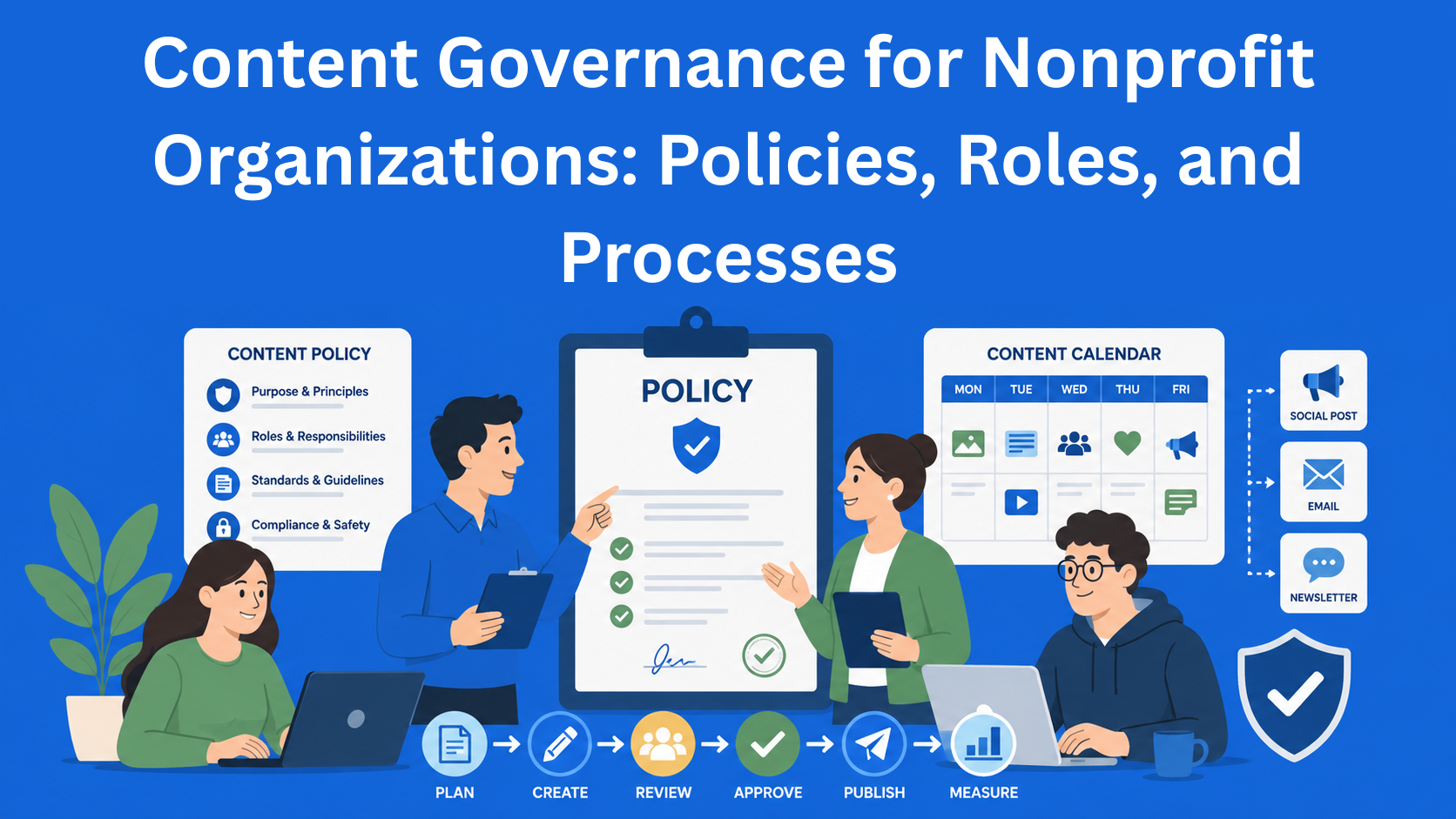
A good process does not have to be complicated. Here is a basic flow that also works for small organizations:
- Someone suggests an idea for a post, email, or report.
- The creator makes the content according to the agreed rules.
- They send it for review (usually two steps - content review and final review).
- The approver says yes or asks for changes.
- When everything is OK, the content is published.
- After publishing, you track how people react and measure success.
To track the work, you can use free tools such as Trello, Asana, Google Sheets, or even a simple folder in Google Drive. What matters is that everyone knows where to look and what they need to do.
Once or twice a year, do a content review - look at what you have published, what is still useful, and what needs to be deleted or updated.
How to start if you have a small team and a small budget?
You do not have to do everything at once. Start like this:
- First, write a short document with the basic rules (tone of voice, approval, privacy).
- Agree with the team on who is responsible for what.
- Create a simple approval form (it can also be in Google Forms).
- Test the process on the next 5-10 posts and see what needs to be changed.
After a few months, you will see that there are fewer mistakes, that the work moves faster, and that everyone has more confidence in what is being published.
Common mistakes to avoid
Many organizations make mistakes in the beginning:
- Too many rules at once - the team gets overwhelmed and stops following anything.
- No one is clearly responsible - everyone thinks someone else has checked it.
- Volunteers publish without the organization knowing - this can quickly create a problem.
- The focus is only on new posts, while old content stays outdated and can cause damage.
The solution is simple: start small, but be consistent. It is better to have five clear rules that everyone follows than fifty rules that no one reads.
Conclusion
Content governance is not something only large corporations do. It is a practical tool that helps nonprofit organizations stay professional, safe, and efficient with limited resources. Once you set basic rules, roles, and a process, you will see that you worry less every time something needs to be published.
Start with small steps. Write the first document this week. Talk to your team. Over time, the system will become a natural part of your work and help your mission reach more people in the right way.
If you want, you can download simple policy templates and checklists adapted for nonprofit organizations and get started right away.
EasyContent lets agencies bring on freelance writers without exposing the account
- Roles and permissions control exactly what a contributor can see and do
- A writer's access is limited to the projects they're invited to
- Comments and mentions keep feedback attached to the right piece of content
- One click deactivates a contributor when their work is done