Content Review Process Best Practices: The Checklist Every Editor Needs
Content review doesn’t fail because people are lazy, it fails because there’s no system. Use this simple checklist to catch mistakes early, improve content quality, and make your review process faster and more consistent.

You publish a piece. It seemed completely fine. A few people looked at it. And then someone tells you the headline is wrong, a link doesn’t work, or part of the text can be misunderstood.
This happens often. The problem is there’s no clear system.
When there’s no clear process, everyone works the way they think is right. Someone checks grammar, someone just looks at whether the text sounds good, and someone scans the headings and stops there. And then mistakes happen, quality drops, and the team spends time fixing things that could have been caught right away.
In this blog, we’ll go through a content review checklist you can start using immediately, whether you work alone or in a team.
Key Takeaways
- Content review is a multi-step process, not a single task - separating structure, editing, fact-checking, and approval prevents mistakes.
- A clear checklist ensures consistent quality - accuracy, clarity, structure, SEO, and CTA should be reviewed every time.
- Good review starts before the editor - writers should check basics and follow a brief to avoid unnecessary back-and-forth.
- Clear roles and ownership improve efficiency - one final decision-maker and defined responsibilities keep the process fast and focused.
- A repeatable system turns review into a habit - documented workflows, feedback templates, and regular updates make quality scalable.
5 stages every piece of content should go through
Before we move to the checklist, it’s important to understand one thing: review is not a single task. It’s a process with multiple steps, and each step has its role.
Stage 1 - Structure: Does the text make sense from start to finish?
Stage 2 - Draft review: Does the text make sense as you read it? Is there a part where the reader might get confused or lost?
Stage 3 - Copy editing: Grammar, spelling, style. Does the text sound like the brand?
Stage 4 - Fact-checking: Are the data points correct? Do the links work? Are quotes properly attributed?
Stage 5 - Final approval: SEO, CTA, images, formatting. Everything that prepares the text for publishing.
Each stage has its own job. If you try to do everything at once, something will slip. The process works properly only when the steps are clearly separated.
Before the editor even opens the document
Many teams make the mistake of starting the review when the editor opens the document. But good content review starts earlier, on the writer’s side.
Before handing over the text, the writer should check:
- Is there a brief attached (topic, audience, goal of the text)?
- Do all links work?
- Are images added and do they have alt text?
- Has the writer read the text once more?
- Are unclear parts marked with comments?
It may seem minor, but without a brief the editor has to guess the goal of the text. That wastes time and can easily shift the focus in the wrong direction. It’s much easier when both the writer and the editor know in advance what needs to be achieved.
Checklist every editor should have
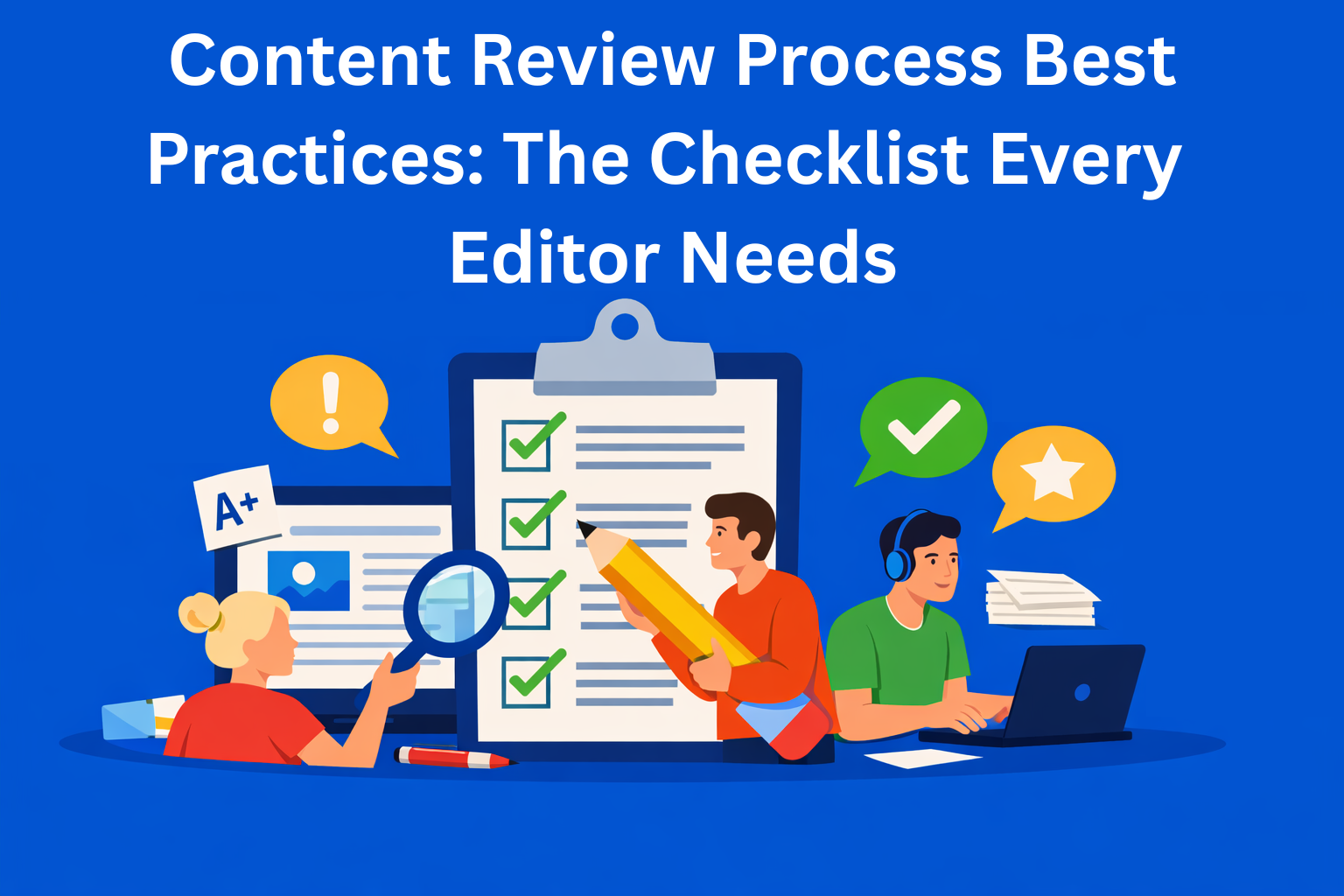
This is the core of the whole process. Seven things to check in every piece of content, in order.
1. Accuracy
Every claim in the text should be checked. If the text says “70% of companies use X,” where does that number come from? Is the link active? Is the research up to date?
This is not just about trust. Wrong data can cause serious problems. If you don’t check facts, it’s not a real review, you just skimmed the text.
2. Clarity
Read each sentence and see if it’s clear right away. If you have to read it twice to understand it, simplify it.
Watch out for jargon. What is clear to you may not be clear to the reader. Always write so the reader can easily understand.
3. Consistency
Are you using the same terms throughout the text? Does the tone stay consistent? Are headings formatted the same way?
Small inconsistencies might not stand out immediately, but they leave a bad impression. This is especially important when multiple people write for the same brand.
4. Structure
Do the headings follow a logical order? Does each paragraph have one main idea? Do the introduction and conclusion align?
If the structure is poor, people drop off halfway. A good editor doesn’t just look at words, but how they are organized.
5. Audience fit
Do you know who the text is for? Does it actually speak to that person?
If you’re writing for beginners, don’t assume prior knowledge. If you’re writing for experienced readers, don’t slow them down with basics. The key is that the text fits the person reading it.
6. SEO basics
This doesn’t have to be complicated. Check:
- Does the main keyword appear naturally in the text, title, and first paragraph?
- Is there a meta description and does it make sense?
- Is there at least one internal link to another article on the site?
- Do images have alt text?
SEO isn’t complicated, it’s just a list of things to check. If you skip it, you’re missing the chance for more people to see your content.
7. CTA and next step
What should the reader do after reading? If that’s not clear, something is missing.
A CTA doesn’t have to be aggressive. It can be a link to another article, an invitation to leave a comment, or a newsletter signup. The key is that it exists and makes sense in context.
Common mistakes editors make
Even experienced editors fall into the same traps. Here are the most common ones.
Focusing on grammar instead of the point. A text can be grammatically correct and still make no sense. First check what the text is saying, then the commas.
Reviewing without a brief. If the editor doesn’t know the goal, it’s hard to judge whether the text is good.
No clear final decision-maker. When “everyone reviews,” no one is responsible. It’s better to have one person who says: this is ready.
Everything feels equally urgent. When an editor marks many things without priorities, the writer doesn’t know what to fix first. It’s better to clearly say what matters most.
Skipping fact-checking when time is tight. When deadlines hit, this is the first thing to go. But it’s the most important, one unchecked mistake can slip through and cause problems.
How to build a repeatable process
A checklist is a good start. But for content review to really work in a team, it has to become routine, not an exception.
A few things that help:
Document the process. Notion, Google Docs, internal wiki, it doesn’t matter where, as long as there’s one place where everyone can see how review works. If it lives only in someone’s head, it disappears when that person leaves.
Clearly define roles. Who writes? Who does the first review? Who checks facts? Who gives final approval? Without clear roles, everyone assumes someone else will catch things.
Create a feedback template. Instead of random comments, use a simple format: what needs fixing, why, and how urgent it is. Writers will appreciate the clarity, and reviews will be faster.
Set realistic time for each round. If the editor has 48 hours, that should be known upfront. Without a clear deadline, review drags on. The workflow works when everyone knows what’s expected and when.
Do mini-retrospectives. Once a month, check what slipped through. Do the same mistakes repeat? If yes, add them to the checklist. A checklist isn’t something you create once, it should evolve as the team grows.
PS. The thing that brings all of this together is EasyContent, a platform where, in addition to all the things mentioned above, you can communicate with your team in real time, track changes directly in the editor, see all your projects in one dashboard, get automatic notifications when it’s your turn to work or when someone tags you in a comment, and much more.
Conclusion
Poor review happens when there’s no clear system, so everything depends on feeling and luck. A good process is written down, clear to everyone, and used every time.
You can take this checklist and start using it right away. Adapt it to your team, remove what you don’t need, and add what’s missing. The important thing is that it exists and that everyone uses it.
Because one mistake that slips through will always cost more than the minute it takes to catch it on time.
EasyContent keeps client sign-off out of your inbox
- A shareable link replaces the back-and-forth of email approval
- Clients approve or comment through a free guest account, never a paid seat
- Track changes shows exactly which words a reviewer changed, with their name and a timestamp attached
- Every approval round is saved and can be restored later