Multi-Jurisdiction Content Compliance: Managing Financial Content Across States
Learn how multi-jurisdiction content compliance helps financial companies manage content across different states, reduce legal risk, and publish marketing materials with more confidence.

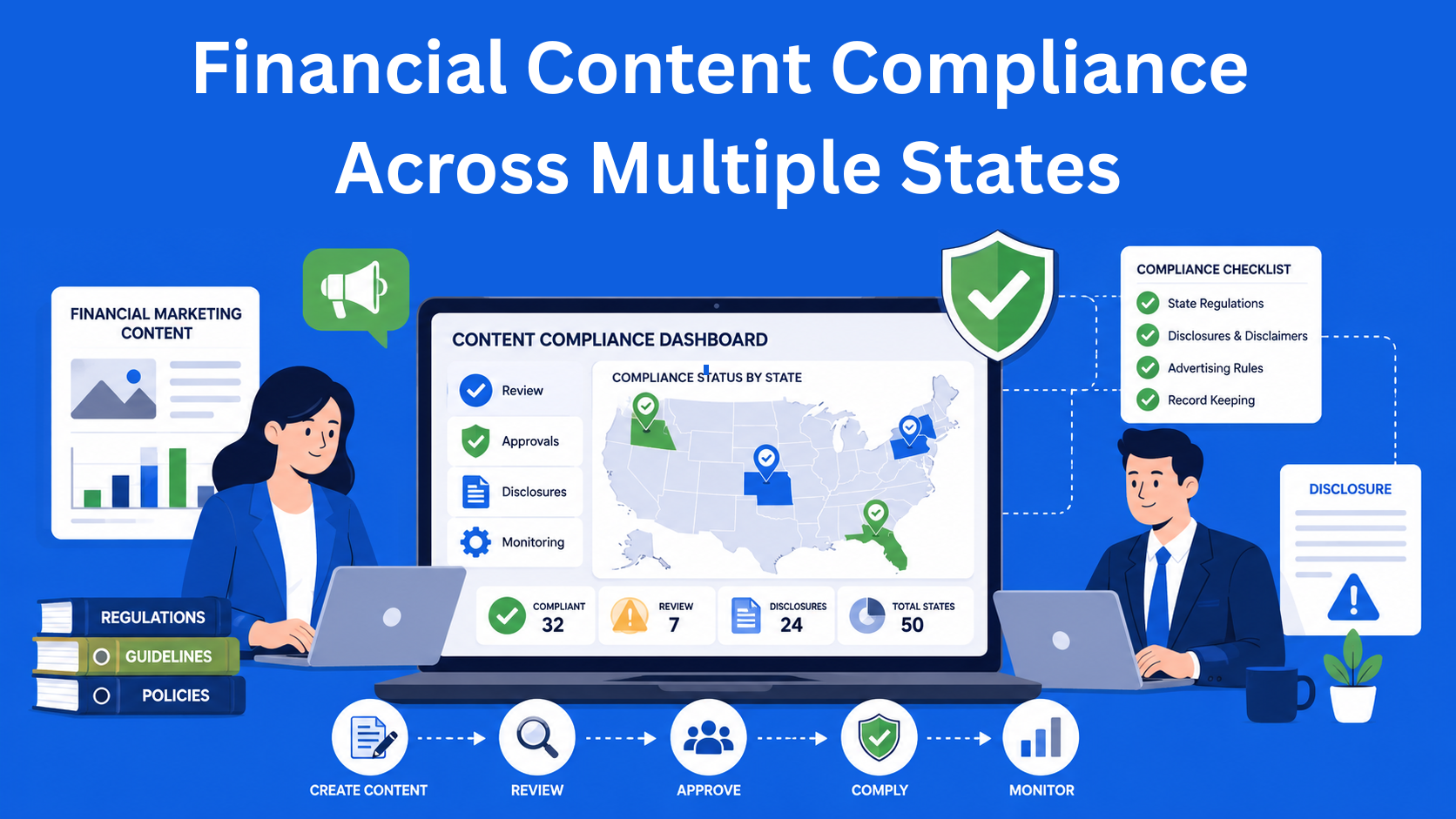
Financial companies are promoting their services online more and more. The same text, video, or ad can be seen by someone in California, New York, Texas, or Florida. And that can be a problem, because every state can have its own rules. That is why multi-jurisdiction content compliance is important for everyone who creates and publishes financial content.
Financial content compliance means that all your marketing, texts, images, videos, and ads, must follow the law in every state where people can see it. If you do not do this properly, you can face large fines, lose your license to operate, or lose your clients’ trust.
In this blog, we will explain in the simplest way what this actually means and how you can handle it.
Key Takeaways
- Multi-jurisdiction compliance requires adapting content to different regulations - what is allowed in one state may not be allowed in another.
- A one-size-fits-all approach creates legal and reputational risk - using the same content everywhere can lead to violations and fines.
- Collaboration between marketing and compliance is essential - both teams must work together from the beginning to avoid costly mistakes.
- Systems like compliance matrices and approval workflows reduce risk - structured processes make it easier to manage complex requirements.
- Technology and continuous updates are key to staying compliant - tools, training, and regular reviews help teams keep up with changing regulations.
Why is this so complicated?
Let’s say you are creating an ad for an investment fund. At the federal level, across the whole United States, there are already rules that come from the SEC and FINRA. But the situation does not end there. Every state can also have its own additional rules.
For example, one state may require clearer risk warnings. Another state may have special rules for crypto content. A third state may strictly control what you are allowed to say about past results and earnings.
That is why managing financial content across states is not something you can solve with one piece of content for everyone. What is perfectly fine in one state can cause a problem in another. If a company operates across the United States, it has to pay attention to several different rules at the same time.
The most common challenges in practice
The first big problem is that most companies want to use the same content everywhere. It is cheaper and easier. But this “one-size-fits-all” approach often leads to mistakes. For example, a claim about earnings that is OK in Texas may be prohibited in New York.
The second challenge is how quickly the rules change. Rules are changing, especially around cryptocurrencies, artificial intelligence, and ESG investments, which are investments that take the environment and society into account. Something that was fine last year may become a problem this year.
The third problem is collaboration between teams. The marketing team wants the content to be interesting, creative, and attractive to clients. On the other hand, the compliance and legal teams want everything to be safe and in line with the rules. If they do not work together from the beginning, something can easily be missed and turn into a problem.
There are also technical challenges, how do you know which state someone is viewing your content from, and how do you automatically show different messages?
Key areas you need to watch closely
There are several things that most often create problems in financial content compliance:
- Ads and promotional content, you must not promise guaranteed earnings or hide risks.
- Warnings and disclaimers, sentences like “Past performance does not guarantee future results” must be visible and placed in the right spot.
- Client stories and testimonials, if someone says, “I earned 300%,” that has to be true and you must have proof. Many states have strict rules for these kinds of statements.
- State-specific rules, California often requires stronger consumer protection, New York is known for being strict, and some other states have lighter rules.
Crypto companies have additional headaches because the rules for digital assets differ a lot from state to state.
How can you handle multi-jurisdiction content compliance properly?
The best way is to create a system. Many companies use what is called a compliance matrix, a simple table that shows what is allowed and what is not allowed in each important state.
Here are a few practical tips:
- Create a central library of approved content. Once something is approved by the compliance team, everyone else can use it.
- Use geotargeting, show different versions of a page or ad depending on where the user is located.
- Create clear approval procedures, every important piece of content should go through marketing, legal, and compliance.
- Regularly train the people who write content so they understand the basic rules.
- Use ready-made “safe” phrases that have already been reviewed and that reduce risk.
This way, managing financial content across states becomes much easier and less stressful.
Technology that can help you
Today, there are tools that make this job much easier. There are platforms that automatically scan text and tell you where there may be risk. Some use artificial intelligence to detect problematic words or claims.
Large companies use systems like Smarsh or similar compliance platforms that store all messages and content for years, because regulators often ask for old ads.
Smaller companies can start with simpler solutions, Google Tag Manager for showing different content based on location, or simple tables and checklists.
What can we expect in the future?
Multi-jurisdiction content compliance will become even more important in the future. AI will create more and more texts, ads, and other materials, so regulators will probably pay more attention to what companies publish. Some states may tighten their rules, while others may take a more relaxed approach.
Companies that introduce good processes now will have a big advantage in the next few years.
Conclusion
If you are serious about financial marketing, financial content compliance across multiple states is not something you can skip. It is not just about following the law. The point is also to protect your business, avoid expensive mistakes, and show clients that they can trust you.
You do not have to solve everything at once. Create a table with the basic rules for the most important states, introduce a clear approval process, and look at which tools can make your work easier. It does not have to be perfect right away, but it is important to have order and to know who checks what.
When you have a good system for multi-jurisdiction content compliance, you can create and publish content with much more peace of mind. You know what you are allowed to say, what you need to check, and where there may be risk. That way, you can grow more easily, work faster, and reduce the chance of expensive mistakes.
EasyContent stays in the background so your agency stays in front
- White labeling swaps in your logo and colors across the platform
- Notification emails go out under your own company name
- Clients experience your brand end to end, from brief to publish
- Available on the Business plan alongside SSO