How to Measure Content Operations Performance: KPIs That Actually Matter
Learn how to measure Content Operations performance with simple KPIs that show what works, what wastes time, and how your content can bring better results, more leads, and real business growth.

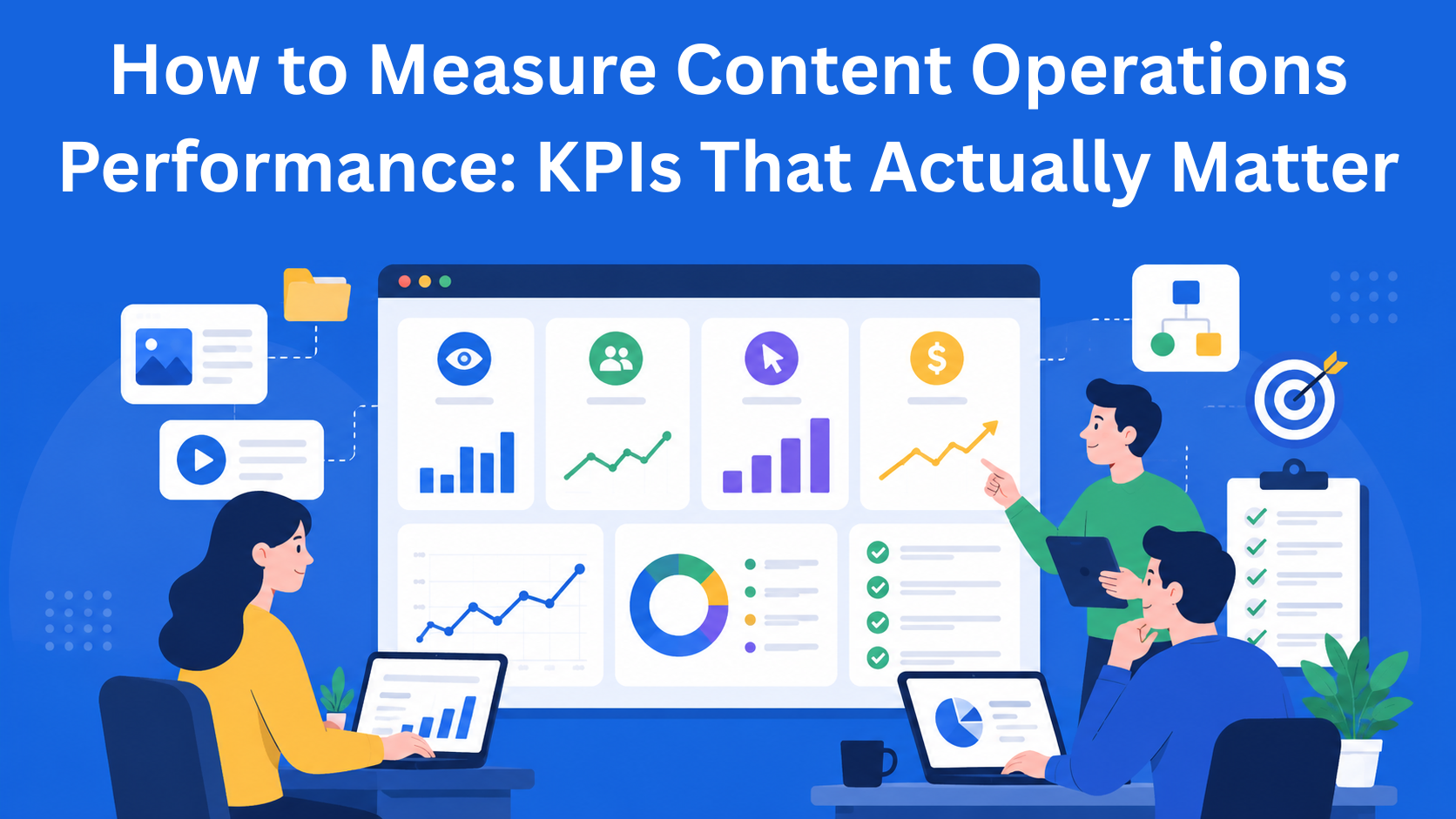
Most marketing teams spend hours and hours creating content, but in the end, they do not know whether that content is bringing real results. That is why it is important to learn how to measure Content Operations performance in the right way.
Content Operations is the way you organize the entire process of creating, publishing, and tracking content. When you do it well, you see clear results. When you do it poorly, you only waste time and money.
In this blog, we will show you simple and useful KPIs that truly show whether your content operations are working the way they should.
Key Takeaways
- Measuring the right KPIs is essential for content success - focusing on meaningful metrics helps teams understand what truly drives results.
- Vanity metrics do not reflect real performance - likes, views, and output volume do not show whether content brings value or business results.
- A balanced framework includes efficiency, quality, impact, and business value - tracking all four areas gives a complete view of content operations.
- Impact and business metrics matter the most - leads, conversions, and revenue show whether content is actually working.
- Simple tracking and regular reviews drive improvement - focusing on a few key metrics and reviewing them monthly helps teams optimize performance over time.
Why Most People Measure the Wrong Things
Many teams only look at numbers that look good but do not mean much. These are called “vanity metrics”, empty metrics. For example, the number of Facebook likes or the total number of published articles.
These numbers can make you feel good at first, but they do not show whether your content brings new clients, sales, or audience trust.
If you only measure how much content you publish, you can easily fall into the trap of creating many articles without getting real results from them. The team may be working regularly and publishing often, but still not know whether that content helps the audience, attracts the right people, or brings new clients. That is why it is not only important how much content you create, but also whether that content actually has an effect.
The Right Framework for Measuring Content Ops
The best way to measure Content Ops is through four main groups: efficiency, quality, impact, and business value.
- Efficiency shows how quickly and smartly you create content.
- Quality shows whether that content is good enough to represent your brand.
- Impact shows whether the content does what it was created to do, for example, bring traffic, engagement, or leads.
- Business value shows the most important thing: whether the content brings money, clients, or some other concrete benefit to the company.
This order helps you see the full picture, not just one part of it. Even if you are a beginner in content operations, this framework is easy to follow because it makes you look at both the process and the results.
Efficiency KPIs - How Fast and Smartly You Work
First, look at how much time you need to create one article, video, or any other piece of content. If one blog post has to go through many steps, long waiting periods, and many corrections, that usually means the process is not well organized.
Here you can track a few simple KPIs:
- Time from idea to publication - how many days pass from the first idea to the moment the content is published
- Cost per piece of content - how much one blog, video, or LinkedIn post costs you
- How many pieces of content the team creates each month
- Percentage of content that has to be corrected several times
If one article takes 15 days from idea to publication, that is a sign that something is slowing down the process. Maybe the writing instructions are not clear. Maybe the team waits too long for comments. Maybe too many people have to approve the article. When the process is well organized, the team knows who does what and when each person needs to finish their part, so the article can be completed much faster.
KPIs for Content Quality
Speed is important, but it is not enough. There is not much value in publishing an article quickly if it is full of mistakes, does not follow the brand tone, or does not match what the audience is actually looking for.
When it comes to quality, you can look at how many articles pass without major corrections. You can also track how many mistakes there are in the text, for example spelling mistakes, incorrect information, or parts that do not sound good. It is also important that the content sounds like your brand, not like a generic text that anyone could have written.
SEO score is another useful indicator. This means that the text should have a good title, clear subheadings, keywords that people actually search for, and a topic that clearly answers what the reader wants to know.
You can create a simple table with scores from 1 to 10, where someone from the team or an AI tool rates each article. For example, you can have a score for clarity, accuracy, SEO, brand tone, and usefulness for the reader. This quickly shows you whether quality is going up or down.
The Most Important KPIs - Impact and Business Results
This is where we come to what bosses and business owners care about the most. It is not enough for content to be well written and published on time. It needs to have a purpose.
One of the strongest content operations KPIs is content contribution to revenue, which means how much money came thanks to content. This is not always easy to measure perfectly, but you can track how many leads, inquiries, demo requests, or purchases come through content.
In addition to that, it is important to look at the number of qualified visits from organic traffic. It is not the same when 10,000 people come to your website but will never buy anything, and when 500 people come who truly have a problem that your product or service solves.
You can also track how many people who read the content later become leads or customers. For video content, it is useful to look at how many people watch it until the end. For blog posts, you can look at average time on page, scroll depth, and clicks on important links.
If you create content operations just so you can “be present,” these numbers will probably be weak. When you work smartly, you will see that certain types of content, such as guides, comparisons, case study articles, or problem-solution articles, often bring much more than generic articles.
How to Track All This in Practice
You do not need to buy expensive tools right away to get started. At the beginning, it is enough to use Google Analytics 4, Google Sheets or Airtable, and the tools you already have in your team, such as Canva, EasyContent, Trello, SEMrush, or something similar.
The most important thing is not to track too many things at once. Create one simple table or overview where you will write down the most important numbers. It is enough to track 8-10 things that truly matter to you. If you track too much data, it will be harder to understand what you need to fix.
Every month, sit down with your team and go through three questions:
- What worked well?
- What did not work well?
- What will we change next month?
These three questions are simple, but very useful. They push you not to look at metrics only as numbers in a table, but as a signal of what you should continue doing, what you should fix, and what you should stop doing.
Common Mistakes You Should Avoid
One of the most common mistakes is tracking too many metrics at once. When you have 30 different numbers in front of you, it is hard to know which one truly matters. It is better to track a smaller number of KPIs, but to really understand them and use them for making decisions.
Another mistake is believing that every piece of content has to bring sales immediately. Some articles are there to attract new people. Some are there to build trust. Some help people make a decision later. That is why the point is not to judge every article in the same way, but to know what role it has in the whole process.
Another big mistake is ignoring the quality of the audience. It is better to have 100 right people reading your content than 10,000 people who only visit and never come back. Content operations performance becomes great only when you connect speed, quality, and real business results.
Conclusion
Do not measure everything right away. Choose a few of the most important things you want to track. These can be the time needed to create content, the quality of articles, the number of visits, the number of leads, or sales that come through content.
Then create a table and enter the data for the previous month. Look at what works well, what does not bring results, and where the team loses the most time. After that, agree on what you will improve next month.
Measuring content operations performance does not have to be complicated. When you track the right things, it is easier to see which content brings results and which content only wastes time.
Then content is no longer just a cost. It becomes an investment that can bring new clients, better teamwork, and business growth.
EasyContent lets agencies bring on freelance writers without exposing the account
- Roles and permissions control exactly what a contributor can see and do
- A writer's access is limited to the projects they're invited to
- Comments and mentions keep feedback attached to the right piece of content
- One click deactivates a contributor when their work is done